• Home
  • Mission of This Site
  • Contact

Impeachable Offenses?

~ The Use & Abuse of Impeachment in the 21st Century

Impeachable Offenses?

Author Archives: impeachableoffenses

Trump, Antitrust and Impeachment

05 Tuesday Mar 2019

Posted by impeachableoffenses in Uncategorized

≈ 1 Comment

By Frank Bowman

Jane Mayer recently reported in the New Yorker that in 2017 President Trump ordered Gary Cohn, former director of the National Economic Counsel, to pressure the Antitrust Division of the Department of Justice to block the pending merger of AT&T and Time/Warner. Trump’s opposition has been widely ascribed to the fact that the AT&T deal would insure the continuing competitiveness of the Time/Warner family of companies, including CNN, which Trump famously reviles. It is speculated that Trump hoped blocking the merger would damage CNN and its parent financially, or even force CNN’s sale, perhaps to a more Trump-friendly owner.

George Conway, indefatigable Trump critic and half of the oddest marriage in contemporary American politics, tweeted that, “If proven, such an attempt to use presidential authority to seek retribution for the exercise of First Amendment rights would unquestionably be grounds for impeachment.”

While I don’t disagree with the constitutional sentiment, obtaining the necessary proof seems to me unlikely.

Let’s start with the constitution. The American founders inherited impeachment from their British parliamentary forbears. In England and America, its most important function has been to protect the constitutional order against executive abuses of power. The phrase “high crimes and misdemeanors” includes serious indictable crimes, but also non-criminal abuses of authority that undercut bedrock principles such as neutral enforcement of national law.

For example, the second article of impeachment approved by the House Judiciary Committee against Richard Nixon encompassed all the many ways he sought to misuse federal agencies to protect his friends and harm his political enemies. It charged that Nixon’s partiality violated his oath to defend the constitution and breached his constitutional duty to take care that the laws be faithfully executed.

A presidential attempt to use the antitrust laws to punish a media company for its unfavorable coverage would violate two constitutional imperatives — the general obligation of impartial enforcement of law and the First Amendment’s particular command that the freedom of the press not be impaired by government action.

The problem would be proving that Trump actually influenced DOJ decisionmaking, or even came seriously close to doing so, for constitutionally impermissible reasons.

On the suspicious side of the ledger is the fact that Trump loudly opposed the merger during the presidential campaign, and that shortly after Trump’s alleged directive to Cohn, the Antitrust Division filed suit to stop the merger. In itself, this need not have been objectionable. Antitrust enforcement is what the Antitrust Division is for. And there is nothing wrong with presidents having strong opinions about antitrust and seeking to implement them. Much of Teddy Roosevelt’s presidential reputation was based on his crusade as a “trust buster.”

What makes Trump’s position, and that of his Justice Department, peculiar is that Trump has no record of prior interest in antitrust policy and that the AT&T – Time/Warner merger was of a type that both modern antitrust law and conservative antitrust scholars have generally found unobjectionable.

To vastly oversimplify, the type of merger antitrust law finds most objectionable is a so-called “horizontal merger,” that is, a merger between companies that compete directly with other by selling the same type of good or service. Horizontal mergers are suspect because they are apt to reduce competition and harm consumers by reducing choice and increasing prices.

By contrast, a “vertical merger” joins companies that do not compete directly with one another, but operate at different points along the same supply chain. For example, an auto manufacturer might acquire a steel mill or an auto parts maker. Some observers believe that such mergers can be undesirable by concentrating too much economic power in a single entity, thus creating barriers to entry and other undesirable effects. Nonetheless, current orthodox antitrust law has generally looked benevolently on such mergers. More to the present point, tolerance of massive, vertically integrated corporate conglomerates is congenial to the generally corporatist position of the Republican Party.

The AT&T – Time/Warner deal is, at least predominantly, a vertical merger. Time/Warner provides media content. AT&T owns content delivery services like cable networks and DirectTV. The last time DOJ sued to stop a vertical merger was over forty years ago. Moreover, the head of the Antitrust Division at the time suit was filed, Makan Delrahim, was on record before Trump’s election as viewing the merger as unobjectionable. His views seemingly changed only after a stint as Deputy White House Counsel and his subsequent appointment to head Trump’s Antitrust Division.

All of this is certainly suspicious, particularly given Trump’s rabid hostility to CNN. But opposition to the AT&T – Time/Warner merger was not self-evidently wrong. Indeed, many voices on the left, including Bernie Sanders, Al Franken, and Elizabeth Warren urged DOJ to stop it. From the point of view of many Democrats, therefore, if Trump tried to get DOJ to block the merger, it would have been a case of doing the right thing for the wrong reasons.  Moreover, the nub of the Mayer story about Trump’s order to Gary Cohn was that Cohn walked into the hallway with White House Chief of Staff John Kelly and said, “Don’t you f–ing dare call the Justice Department. We are not going to do business that way.”

It’s possible, of course, that someone made the call anyway, or that Makan Delrahim didn’t need a call to know what the president wanted and why.  And that, knowing the president’s wishes, he pursued the case for political reasons and against his better legal judgment. But at this point, that’s all speculation.  In any event, DOJ lost in both the trial and appellate court and the merger will now almost certainly proceed.

When a president tries to commit a constitutional wrong, the fact that he is thwarted doesn’t necessarily exonerate him from blame or even impeachment. The House Judiciary Committee pointedly observed that successful resistance by federal officials and agencies to Nixon’s improper commands was not a defense. Nonetheless, if all we have is a president raging around the White House demanding that DOJ do something, but no proof that those demands were ever conveyed to DOJ, still less that they formed a part of the motivation for the Antitrust Division’s actions, what we have is further confirmation of Trump’s authoritarian impulses, but not much in the way of solid evidence for an impeachment case.

There are a host of potentially impeachable behaviors those opposed to Mr. Trump should be pursuing. Absent stunning new revelations, this merger should probably sit low on the list.
Share this:

  • Share on X (Opens in new window) X
  • Share on Facebook (Opens in new window) Facebook
Like Loading...

Reflections on Michael Cohen’s testimony

03 Sunday Mar 2019

Posted by impeachableoffenses in Uncategorized

≈ Leave a comment

Tags

bank fraud, cohen, Deutsche Bank, House Oversight Committee, Justin Amash, Michael Cohen, Michael Cohen testimony

By Frank Bowman

I tuned in and out of Michael Cohen’s testimony before the House Oversight Committee on Wednesday. By the end, my reactions were pretty much in tune with what has become the general consensus.

Cohen told us very little we didn’t already know. Mostly he confirmed from an insider’s perspective that Trump is the man he appears to be. A liar. A bigot. An adulterer. A cheat. A narcissist to the marrow who, unlike the mythical Greek who gave obsessive self-regard its name, will not pine quietly away staring at his own reflection in a sylvan pool, but has found in the modern media an endless river of print and digital pools in which he daily and desperately schemes to be reflected.

In his portrait of Trump, Cohen was entirely believable. Not because he is himself notably honest. Nor because his claimed epiphany about Trump’s flaws and his own foolishness in following such a man is particularly credible. To the contrary, what makes Cohen on Trump so obviously true is that he is just the kind of guy attracted to the Trumps of the world. A second-rater, endowed with only modest talents and unburdened by any noticeable moral code. But hungry for money and respect and happy to abase himself before a seeming bigshot and do his twisted bidding to swim in the bigshot’s wake.

Just as guys like Cohen are drawn to Trump, so too does Trump instinctively surround himself with Cohens. He needs servility and moral bankruptcy and avarice in his servants. And he recognizes and draws those with these traits into his orbit. In this respect, Trump is like the mob bosses he obviously admires and seeks to emulate. There are no honest men or women in his circle, at least none who stay for long. Most either come to him bent or become so by association. Those who retain their ethical grounding either leave when resurgent self-respect compels them or are cast out when Trump realizes that they resist corruption.

Cohen’s testimony rings true in its essence to me in part because I’ve prosecuted and sometimes flipped (and occasionally defended) enough guys just like him. Most members of criminal enterprises are not comic book villains. They are customarily just greedy and weak and amoral. When caught, they often have precisely Michael Cohen’s sort of self-pitying charm. But their flawed humanity makes them no less blameworthy. Still less does it excuse the actions of the bigshots who use them.

All that said, Cohen’s testimony really doesn’t advance the ball very much for those who hunger for Trump’s political demise. The essential problem, often remarked upon, is that Trump’s base in the right-wing media echo chamber, in red state America, and, sadly, in the congressional Republican Party knows who he is and just doesn’t care.

The performance by Republican congressmen in the Cohen hearing cemented this point. With perhaps one exception, the Republican members of the Oversight Committee asked no questions about any of Cohen’s general or specific allegations. They were ostentatiously uninterested in discovering whatever the facts may be on any point. Indeed, they did not even attempt to challenge Cohen on the particulars of his testimony. Their entire effort was repeated variations of the playground taunt “Liar, liar, pants on fire” — which incredibly they put on a poster in the hearing room. The most astute thing Cohen said the whole day was that the Republicans on the committee had transformed themselves into publicly elected versions of himself.

This leads to two reflections:

First, if any doubt lingered, there will be no repetition of the Watergate experience in which, although there was partisan wrangling aplenty, members of Congress of both parties worked together most of the time to discover the facts about President Nixon’s behavior. At a bare minimum, in public hearings members of Nixon’s party (and their staff) felt it necessary to seem interested in the truth and thus asked questions aimed at acquiring information. For example, it was minority counsel for the Senate Watergate Committee who discovered and then publicly exposed the existence of Nixon’s White House taping system. In the Cohen hearing, with the possible exception of Cong. Justin Amash (R-MI), not a single Republican congressman asked a question aimed at discovering facts.

Second, if Democrats in Congress hope to get to whatever the truth may be about Trump’s various possible misbehaviors, they are going to have shoulder the responsibility themselves. And they are going to have to do a better job than they did on Wednesday. If Cohen’s testimony confirmed the existing sad portrait of Trump’s general character and modus operandi, it added little by way of detail or corroborating evidence.

On Russia, as Republicans gleefully noted, Cohen had little or nothing to add. Indeed, he denied the claim in the Steele dossier that he’d been to Prague doing something nefarious.

The check from Trump to Cohen reimbursing him for paying off the mistresses for their silence was a nice touch, but no one seriously doubts that Trump arranged those payoffs. And it’s pretty plain that Trump is not going to be indicted on that ground during his presidency or impeached for it either.

The Trump financial statements produced in tandem with Cohen’s allegation that Trump made false statements to Deutsche Bank in connection with an effort to obtain a loan to buy the Buffalo Bills are certainly suggestive. It may well prove that Trump committed bank fraud in various transactions predating his presidency, but Cohen’s testimony does nothing more than suggest avenues of further investigation.

If Republican members merely demonstrated their blind fealty to Trump, Democrats demonstrated their lack of preparedness to serve as serious investigators. There was precious little indication of a coordinated Democratic strategy for interrogating Cohen or of individual Member preparation to explore the evidentiary clues Cohen provided. It was political theatre and little more.

In my next post, I will consider whether the House Democrats’ allocation of investigative authority for matters Trumpian suggests a serious effort to build a case for impeachment, or a disposition to create a continuing series of spectacles like the Cohen hearing.

Share this:

  • Share on X (Opens in new window) X
  • Share on Facebook (Opens in new window) Facebook
Like Loading...

Prof. Bowman on SLATE on Jeff Bezos’ allegation that AMI tried to blackmail him

08 Friday Feb 2019

Posted by impeachableoffenses in Uncategorized

≈ Leave a comment

Tags

AMI, catch and kill, David Pecker, extortion, Jeff Bezos, Karen McDougal, Lauren Sanchez, Michael Sanchez, National Enquirer, non-prosecution agreement, saudi arabia, Stormy Daniels

See this link to Professor Bowman’s discussion in Slate magazine of the Jeff Bezos extortion allegations, their effect on the non-prosecution agreement between the National Enquirer’s parent company, AMI, and the U.S. Attorney’s Office for the Southern District of New York, and how all this fits into the widening gyre around the White House.

Share this:

  • Share on X (Opens in new window) X
  • Share on Facebook (Opens in new window) Facebook
Like Loading...

The Case for Impeachment of Donald Trump, Part 4 (Subversion of the justice system)

28 Monday Jan 2019

Posted by impeachableoffenses in Uncategorized

≈ 1 Comment

Tags

Abraham Lincoln, Andrew Jackson, Brian Morris, bruce ohr, case for impeachment, Chief Justice John Roberts, Franklin D. Roosevelt, George Mason, Gonzalo Curiel, hillary clinton, James Robart, Jay Bybee, John Marshall, Obstruction of Justice, Richard Nixon, Roy Cohn, subversion of constitution, subversion of justice system, Thomas Jefferson, William Orrick

By Frank Bowman

Much of the public conversation about possible impeachable conduct by Mr. Trump has centered on obstruction of justice in the narrow sense of a violation of criminal statutes defining obstruction. I have discussed the legal issues surrounding the application of those statutes to Mr. Trump at length on this blog (see this link for a list of those posts). I will do so again once the Mueller investigation is complete. Until then, I am reluctant to offer a definitive view on whether Mr. Trump’s conduct constitutes obstruction in the legal sense or on whether such legal violations are of the type that constituted so large a part of the impeachment case against Richard Nixon.

Nonetheless, if the case for technical obstruction of justice remains uncertain, the conclusion that Mr. Trump has systematically sought to corrupt and subvert the justice system as a whole is ironclad.  Inasmuch as the health of the justice system is essential to the health of constitutional order, a presidential effort to undermine it deserves consideration as impeachable conduct.

Throughout his pre-presidential career in business, Mr. Trump viewed the law from two perspectives.  As the operator of multiple businesses some aspects of which, at best, skirted the edges of legality, Mr. Trump viewed the government’s civil and criminal enforcement agencies as opponents to be thwarted or circumvented.  Conversely, he learned early to use his money to employ private civil litigation as a weapon against personal and business adversaries.  As of 2016, he and his businesses had been involved in more 3,500 lawsuits.

Mr. Trump has carried his prior attitude toward the law into the White House.  Early in his presidency, exasperated by the pertinacious refusal of James Comey to back off the Russia investigation and by Attorney General Sessions’ decision to recuse himself from that investigation, Trump famously asked, “Where is my Roy Cohn?”  The reference being to the notoriously hard-nosed and questionably ethical lawyer who acted as Trump’s legal fixer and attack dog early in his career.  More disturbing than the desire for a personal legal heavy is the fact that Mr. Trump plainly imagines the role of the Department of Justice and the rest of the federal law enforcement establishment as defending him against legal inquiries and standing ready to use the law to discredit or even imprison his critics and opponents. 

The essence of Mr. Trump’s defensive approach has been to appoint justice officials chosen for personal loyalty (e.g., Jeff Sessions and Matthew Whitaker) and simultaneously to attack any official, whether political appointee or career civil servant, who pursues matters that might implicate Trump, his family, or his supporters.  When Sessions disappointed Trump’s expectations of servility by recusing himself from the Russia investigation, Trump turned on him, calling him “weak,” “disgraceful,” and an “idiot” before finally firing him.  He has characterized the FBI as “in tatters” and the Justice Department itself as “an embarrassment to our country.”  His personal assaults have even reached down into the middle levels of the Justice Department bureaucracy, as exemplified by his baseless demonization of career DOJ official Bruce Ohr. The unifying theme of Trump’s assaults on all the men and women doing their duty by investigating matters that might implicate or inconvenience him is that they are corrupt members of the “Criminal Deep State.”

Trump’s denigration of the integrity of anyone who stands in his way is not restricted to officials and employees of the executive branch he heads, but notoriously extends to the federal judiciary.  Trump routinely attacks any judge or judicial panel that rules against him or any administration initiative.  The examples are too numerous to mention them all, but include:

During his 2016 candidacy, Trump said of U.S. District Judge Gonzalo Curiel, then presiding over suits against Trump University, that he should be disqualified because, as a person of Mexican heritage, he would necessarily be biased against Trump.  When U.S. District James Robart enjoined Trump’s travel ban on persons from certain Muslim countries, Trump tweeted, “The opinion of this so-called judge, which essentially takes away law enforcement away from our country, is ridiculous and will be overturned.”  When U.S. District Judge William H. Orrick enjoined Trump’s executive order attempting to punish so-called “sanctuary cities,” Trump called the order “ridiculous,” and the White House put out a statement declaring, “The San Francisco judge’s erroneous ruling is a gift to the criminal gang and cartel element in our country, empowering the worst kind of human trafficking and sex trafficking, and putting thousands of innocent lives at risk. This case is yet one more example of egregious overreach by a single, unelected district judge.”  When U.S. District Judge Brian Morris of Montana enjoined implementation of President Trump’s order to proceed on the Keystone XL oil pipeline, Trump said, “It was a political decision made by a judge.  I think it’s a disgrace.” In response to a pointed rebuke of this kind of rhetoric from Chief Justice Roberts, Trump attacked the Ninth Circuit, asserted that “Obama judges” differ from persons “charged with the safety of our country,” and claimed that judicial restrictions on law enforcement will lead to “bedlam, chaos, injury, and death.”

Of course, throughout American history presidents have disagreed with particular decisions of federal courts and sometimes said so. Both Thomas Jefferson and Andrew Jackson disagreed heartily with important opinions of Chief Justice John Marshall, with Jefferson swallowing them graciously except in private correspondence and Jackson being more outspoken. At the outset of the Civil War, Abraham Lincoln simply ignored an opinion by Chief Justice Taney purporting to void Lincoln’s suspension of habeas corpus near vital rail lines Maryland. When the Supreme Court persistently voided New Deal legislation, Franklin D. Roosevelt fumed and mooted the possibility of inflating the number of justices — his famous “Court Packing Plan” — but never acted on the idea.

Trump’s defenders have attempted to analogize his routine denigration of the judicial branch to prior expressions of presidential unhappiness with legal outcomes. But the effort is strained and unconvincing. No president before Trump has ever made a staple of his ordinary public statements attacks on the integrity of individual judges or the legitimacy of the judiciary as a whole as arbiter of the meaning of the law.

This persistent pattern of questioning the integrity and legitimacy of the courts is not merely distasteful, or, as Trump’s defenders are apt to say, simply a matter of his personal “style.” It is instead overtly dangerous.  Court of Appeals judge Jay Bybee (a Republican appointee of impeccable conservative credentials) wrote in his dissent from the Ninth Circuit’s order upholding the injunction against Trump’s so-called “Muslim ban”:

Even as I dissent from our decision not to vacate the panel’s flawed opinion, I have the greatest respect for my colleagues. The personal attacks on the distinguished district judge and our colleagues were out of all bounds of civic and persuasive discourse—particularly when they came from the parties. It does no credit to the arguments of the parties to impugn the motives or the competence of the members of this court; ad hominem attacks are not a substitute for effective advocacy. Such personal attacks treat the court as though it were merely a political forum in which bargaining, compromise, and even intimidation are acceptable principles. The courts of law must be more than that, or we are not governed by law at all.
— Washington v. Trump, 858 F.3d 1168, 1185 (9th Cir. 2017) (en banc) (Bybee, J., dissenting).

Moreover, Mr. Trump’s abandonment of critical norms of presidential behavior in relation to the law have not been limited to questionable appointments decisions or ceaseless rhetorical denigration of legal officers, but has extended to placing pressure on the Justice Department and law enforcement agencies to open criminal investigations into his critics and opponents.  He has apparently been dissuaded from issuing direct orders for such investigations, but has made repeated calls for them in public declarations, most recently in response to the Roger Stone indictment.

Perhaps the most disturbing of Mr. Trump’s demands has been the endless harping that Hillary Clinton, his defeated 2016 rival, should be both investigated and jailed. The famous staple of his political rallies before and after the election — “Lock her up!” — can mean nothing else.

Even Republican stalwarts like former Attorney General Michael Mukasey have said that launching criminal investigations of defeated political candidates is un-American and akin to the practices of “banana republics.” He is right. The hallmark of successful democracies is the peaceful transfer of power from one elected administration to its popularly chosen successor. Such transfers reliably occur only if the electoral losers know that the sole consequence of the loss is return to private life. If a possible consequence of of losing is criminal prosecution by the winner, then losing becomes unthinkable and the contestants will be tempted to ever-more-extreme measures to prevent it. This is the all-too-common precursor to the death of democracy in the developing world. But regression is perfectly possible among mature democracies like our own.

In short, systematic public assault on the executive and judicial branch employees of the justice system is bad enough because it risks creeping corrosion of the public trust essential to the rule of law.  Far more troubling is employing, or even threatening to employ, the vast powers of the federal criminal apparatus against opponents because it places this or any country on a straight road to autocratic rule. 

The facts that the Justice Department has, so far, ignored Trump’s efforts at jawboning and forged ahead with investigation of the president and his associates; that judges have, so far, continued to rule against the administration when moved to do so by their reading of the law; and that the federal law enforcement apparatus has, so far, largely resisted Trump’s calls for retaliatory investigations of his critics does not materially diminish the seriousness of Mr. Trump’s deviation from American constitutional norms. Nor does it materially alter the impeachment calculus.  Federal agencies for the most part resisted Richard Nixon’s efforts to enlist them in efforts to obstruct justice or punish his enemies, but the House Judiciary Committee included Nixon’s unsuccessful efforts along with his more successful ones as grounds for his impeachment.

The Framers inserted the impeachment remedy into the Constitution precisely in order to deal with an executive whose conduct, in George Mason’s words, “subvert[ed] the constitution.” By “constitution,” Mason and his colleagues meant not merely the document they were drafting. They understood that their brief composition could only be the skeleton to which later generations would add the flesh and sinew of statutes, judicial decisions, customs, and behavioral norms that make up the true constitution of any mature state. A president who would subvert that constitution may be impeached.

Trump’s persistent shamelessness has dulled all our senses to the point that he has normalized behavior that would only two years ago have seemed unthinkable. Unthinkable because it strikes so deeply at the unwritten norms — here the impartial, apolitical, administration of the law — that sustain American constitutionalism. It behooves us to shake ourselves free of his narcotic influence to at least consider whether he presents a danger great enough to merit his removal.

Share this:

  • Share on X (Opens in new window) X
  • Share on Facebook (Opens in new window) Facebook
Like Loading...

Prof. Bowman’s CTV interview on Stone indictment

26 Saturday Jan 2019

Posted by impeachableoffenses in Uncategorized

≈ Leave a comment

Tags

CTV, Frank Bowman, Mueller investigation, roger stone, Stone indictment

Shortly after Roger Stone’s arrest on a seven-count indictment charging lying and obstruction, Prof. Bowman appeared on the Canadian news network, CTV, to comment on the case. His interview appears here.

Share this:

  • Share on X (Opens in new window) X
  • Share on Facebook (Opens in new window) Facebook
Like Loading...

Giuliani backtracks … too late

21 Monday Jan 2019

Posted by impeachableoffenses in Uncategorized

≈ Leave a comment

Tags

Giuliani, rudolph giuliani, Trump Tower Moscow

By Frank Bowman

Yesterday I discussed Rudolph Giuliani’s remarkable, and remarkably damaging, admissions to the New York Times that his client, Donald Trump, told him that the project to build a Trump Tower Moscow was a live possibility up through the November 16, 2016 election. Giuliani quoted Trump as saying of the Moscow project, “It was all going from the day I announced to the day I won.” As I noted, a lawyer’s public statements about what his client said are admissible against the client because the lawyer is, in that setting, the clients’s speaking agent. Federal Rule of Evidence 801(d)(2)(C).

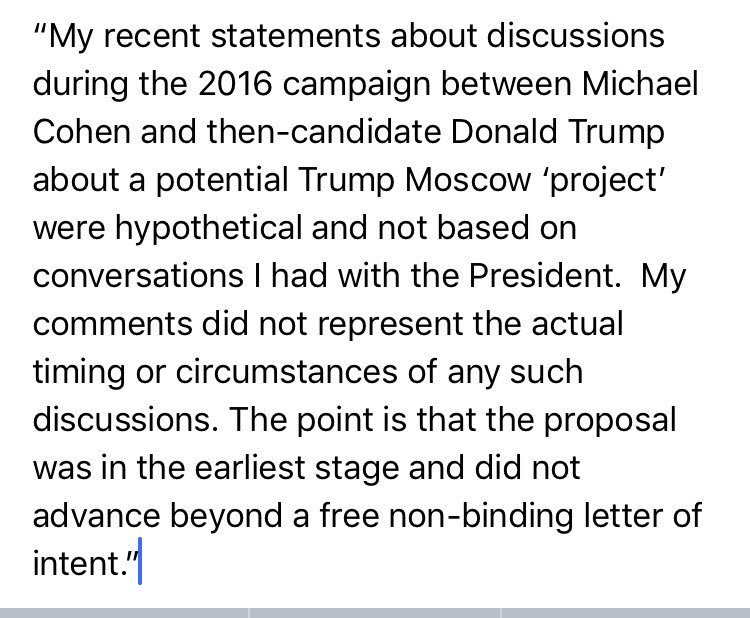
It would appear that someone reminded Giuliani of this basic fact of evidence law, or perhaps just explained how damaging his new timeline is to Mr. Trump. Because today Giuliani effectively said, “Never mind.” He put out a statement saying:

Hypothetical, my foot. When a lawyer quotes his client speaking in the first person, that’s not hypothetical. It’s a quote, pure and simple. Of course, the lawyer can claim, as Giuliani basically does here, that he made up the quote without consulting his client. But neither the opposing party, nor the courts, nor Congress is obliged to accept that claim. They are instead entitled to take the lawyer’s original words at their face value and subpoena him to explore under oath what he represented as the client’s statement and circumstances of its making.

Of course, neither Mr. Mueller nor Congress may think Mr. Giuliani’s testimony worth the caterwauling brawl that a subpoena to him would produce. But at a minimum, this is yet another example of Giuliani’s extraordinary unfitness as an attorney.

There are really only three possibilities here:

(1) Giuliani talked to Trump in advance of the Times interview and Trump made the statement attributed to him, but did not give Giuliani permission to disclose a client confidence. In that case, Giuliani’s disclosure is a flagrant violation of professional ethics, specifically ABA Model Rule of Professional Conduct 1.6.

(2) Giuliani didn’t talk to Trump in advance of the Times interview or did, but Trump did not make the statement attributed to him. In that case Giuliani not only betrayed his client’s interests, but, by lying to the press, violated ABA Model Rules of Professional Conduct 4.1 and 8.4(c) prohibiting making false statements to third persons in connection with representation of a client and conduct involving dishonesty generally.

(3) Giuliani talked to Trump in advance of the Times interview, Trump made the statement attributed to him, and the two of them decided that revealing that statement would help get out ahead of facts that would come out later anyway. Afterwards, when the statement was reported as a potentially incriminating gaffe, Trump ordered Giuliani to cover by issuing a false denial to the press. That false denial would be a violation of ABA Model Rules of Professional Conduct 4.1 and 8.4(c).

When I was a young lawyer in the Department of Justice back in the early 1980s, Rudi Giuliani, then up in the S.D.N.Y., was known as a really sharp prosecutor — sharp-elbowed, to be sure, and transparently ambitious — but sharp. This creature fawning on Trump and spinning feeble falsehoods in his service is a pathetic remnant of that younger self. As a lawyer, I wouldn’t wish him on any client other than the one he’s now got.

Share this:

  • Share on X (Opens in new window) X
  • Share on Facebook (Opens in new window) Facebook
Like Loading...

Giuliani helps build the case that his client may be a Russian asset (and maybe helps restore Buzzfeed’s credibility)

21 Monday Jan 2019

Posted by impeachableoffenses in Uncategorized

≈ 1 Comment

Tags

attorney-client privilege, buzzfeed, Giuliani, Michael Cohen, Robert Mueller, rudolph giuliani, Trump Tower Moscow, waiver of attorney-client privilege

By Frank Bowman

Somewhat lost in the coverage of Mr. Trump’s apparently unsuccessful effort to end the government shutdown standoff comes the quite remarkable story of Rudy Giuliani’s interview with the New York Times in which Giuliani:

  • admitted that conversations about building a Trump Tower in Moscow continued throughout the 2016 campaign up until the November election;
  • quoted Mr. Trump as saying of the Moscow project, “It was all going from the day I announced to the day I won”;
  • claimed that the whole project was run by Cohen with little input by Trump, quoting Trump as saying, “We talked about it, I knew [Cohen] was running with it, I honestly didn’t pay much attention to it”;
  • “acknowledged that Mr. Trump might have talked to Mr. Cohen before his congressional testimony [in which Cohen falsely claimed that the Trump Tower Moscow negotiations ended in January 2016], but … said his client had never instructed Mr. Cohen to lie.”

From a lawyer’s perspective, perhaps the most amazing part of this interview is the fact that Giuliani just created evidence against his own client, admissible in any court and certainly in the more procedurally relaxed setting of a congressional investigative hearing or an impeachment proceeding.

Non-lawyers probably think that whatever Giuliani says to the press presents no risk to Trump because of the attorney-client privilege. But that’s quite wrong. Attorney-client privilege covers only statements made by the client to the lawyer in confidence for the purpose of obtaining legal advice. What a client said to his lawyer is privileged as long as both lawyer and client keep it secret. Once either of them discloses a client statement, it is no longer privileged. Indeed, even unauthorized or inadvertent lawyer disclosures of client statements sometimes waive the privilege.

Certainly once the lawyer assumes the role of public spokesman for the client and makes public assertions of fact in that role, the lawyer becomes a “speaking agent” of the client and the lawyer’s statements are admissible against the client. Federal Rules of Evidence 801(d)(2)C). This basic rule doesn’t change where the fact publicly asserted by the lawyer is the content of what his client said in an otherwise-private conversation.

Hence, Giuliani just became a witness to the duration of the Trump Tower Moscow project and to Trump’s knowledge of that duration. He may also have become a witness to what Trump told him about any conversation with Michael Cohen before Cohen’s congressional testimony.

Why it could matter

It has been reported that, right up to election night, Trump did not expect (or maybe even want) to win the election. He admits that he was keeping his options open. As he put it, “There was a good chance that I wouldn’t have won [the election], in which case I would have gone back into the business. And why should I lose lots of opportunities?” But both during and after the campaign he repeatedly insisted that he had no deals in Russia. In January 2017, after his election, he explicitly stated that, “I have no dealings with Russia, I have no deals in Russia, I have no deals that could happen in Russia because we stayed away.”

Of course, as we now know, he and the Trump Organization had not “stayed away” from Russia. Far from it. Nonetheless, once the existence of Moscow tower negotiations became public, Trump minimized his interest and the duration of negotiations. As recently as two months ago, in a statement on the South Lawn of the White House, he claimed that they did not continue past “the early part of ’16.” Placing that end date on the project allowed him to dismiss any connection between his financial self-interest in 2016 and his otherwise odd chummy attitude to Putin and promotion of pro-Russian policy throughout the election season. 

Michael Cohen tried to back Trump’s story by telling Congress that the Trump Tower Moscow project ended in January 2016. Cohen has admitted this was a lie and that the project was pursued  actively through at least June 2016. But Giuliani has now established that the project continued still longer. More importantly, he has provided independent proof that Trump knew about its duration and repeatedly lied about it. Proof of Trump’s knowledge no longer depends on Michael Cohen’s unsupported assertions or even on inferences from whatever Trump Organization documents Mueller may have. Instead, it can be established by Giuliani’s testimony about what Trump himself admitted.

Proof of the duration of the Moscow project and Trump’s knowledge of it matters because it solidifies at least one incentive for Trump’s peculiar affinity for Russia during the campaign. More importantly, it proves beyond any shadow of a doubt that, after the election, the Kremlin had leverage on Trump.

Once Trump won, the Kremlin knew that Trump had been actively trying to do a deal in Moscow, while simultaneously and repeatedly publicly denying it. That gave Putin leverage. He could expose the new president as a liar who had been trying to curry financial favor with a traditional enemy state. There are multiple other Russian pressure points that remain unproven – mostly the possibility of ongoing financial relations with Putin-backed Russian oligarchs – but here we have a concrete indisputable fact, corroborated by both Trump’s former and current attorney.

And this concrete indisputable fact lends credence to the still-astonishing possibility that the President of the United States is compromised by a hostile foreign power.

Giuliani’s Times interview does one other thing — it may help rehabilitate, at least somewhat, the BuzzFeed report that Trump told Cohen to lie before Congress. Giuliani denies that Trump told Cohen to lie, but concedes that Trump “might have” talked to Cohen before Cohen’s congressional testimony. That statement has two effects.

From a common sense perspective, Giuliani’s “might have” is as good as an admission that such a conversation occurred. Admission of its occurrence would help Cohen’s credibility immensely if he were to claim that Trump made damaging statements. After all, the mere occurrence of such a conversation — the President having a private talk with a potential witness against him –would be breathtakingly inappropriate. One obvious purpose of such a conversation would be to influence the upcoming testimony. Although speculation is dangerous, Giuliani’s de facto admission suggests that Robert Mueller’s repudiation of BuzzFeed‘s reporting may stem from the wording of the Buzzfeed story, rather than its essence. For example, Cohen may be prepared to say, not that Trump unequivocally told him to lie, but that Trump hinted at how he would prefer the testimony to run. Likewise, Mueller may have objected to the language of the BuzzFeed story insofar as it over-promised, suggesting that the special prosecutor had documentary corroboration of an express presidential direction to commit perjury.

From a legal point of view, Giuliani’s choice to discuss with the press what his client said about the occurrence of a Trump-Cohen conversation and its contents may constitute a waiver of attorney-client privilege on that topic. It certainly provides a legitimate basis upon which a grand jury or a congressional committee could subpoena Mr. Giuliani and seek to compel his testimony about what the President told him about any pre-testimony talk with Cohen.

Things grow curiouser and curiouser.

Share this:

  • Share on X (Opens in new window) X
  • Share on Facebook (Opens in new window) Facebook
Like Loading...

The Case for Impeachment of Donald Trump, Part 3 (Foreign Policy)

15 Tuesday Jan 2019

Posted by impeachableoffenses in Uncategorized

≈ 1 Comment

Tags

Bolingbroke, Duke of Buckingham, Earl of Danby, Erdogan, George Mason, impeachment for foreign policy, James Madison, mattis, Mohammed bin Salman, NATO, Orban, Oxford, Paris Climate Accords, Putin, Strafford, TPP, Warren Hastings, William Blount, William de la Pole, WTO

By Frank Bowman

Among the most persistent misconceptions about impeachment under the United States constitution is that indictable criminal conduct is a prerequisite for impeachment. The prevalence of this error is easy to understand inasmuch as the textual standard for impeachable conduct is “Treason, Bribery, or other other high Crimes and Misdemeanors” — a phrase that sounds like it refers to crime of the customary sort. However, as has been repeatedly discussed on this blog and as virtually all serious students of impeachment recognize, the phrase “high Crimes and Misdemeanors” was adopted by the Framers from British and early American impeachment practice and extended to a wide variety of non-criminal official ineptitude or misbehavior. There is powerful evidence that the Framers included conduct severely damaging to U.S. foreign policy interests in the category of impeachable behavior.

During the Constitutional Convention of 1787, the delegates decided that presidents and other federal officers could be impeached, but they wrestled over what conduct should be impeachable. Various formulations were advanced.  As the convention rounded into the home stretch, the phrase that had taken hold was “treason or bribery.”

George Mason objected because he thought “treason and bribery” far too narrow.  Mason was a student of British impeachment and had authored the post-revolutionary impeachment provisions of the Virginia state constitution.  He wanted a federal impeachment remedy analogous to British practice at least in the conduct it covered, even if not in the sorts of brutal personal punishments Parliament could impose.

“Treason,” Mason said, “will not reach many great and dangerous offences. Hastings is not guilty of treason.” He was referring to the impeachment trial of Warren Hastings, Governor General India, just about to start in England. Mason wanted American impeachments to reach beyond the two indictable crimes of treason and bribery to important breaches of public trust in both the domestic and foreign sphere, the kinds of offenses charged against Hastings.

Mason’s solution was to add the word “maladministration” after bribery. But James Madison rose to object, saying, “So vague a term will be equivalent to a tenure during pleasure of the Senate.”

Mason thought the matter over and came back with a compromise. Omit “maladministration” but add to treason and bribery “other high crimes and misdemeanors.”  The new language passed 8 states to 3.

Mason’s choice of “high crimes and misdemeanors” was not whimsical.  Rather, he lifted it from British practice where, beginning in the 1600s, Parliament increasingly (though not invariably) used this phrase to describe conduct it charged as impeachable.  My study of British and American impeachments convinces me that “high crimes and misdemeanors” does not limit Congressional impeachment power to the necessarily idiosyncratic and antique list of misdeeds Parliament had addressed by 1787.  Both Parliament and the Framers were acutely conscious that the sorts of dangerous public misconduct for which impeachment is a necessary remedy could not easily be described in advance. However, the Framers’ choice of “high crimes and misdemeanors” does set the baseline minimum for the scope of American impeachments. In other words, American officials are properly impeachable for at least the range of conduct covered by British practice.

A persistent theme in British impeachments was the charge that the impeached minister had pursued a policy at odds with the nation’s basic foreign policy interests.  Impeachments on this ground were a constant beginning with the charges against William de la Pole in 1450 for his role in arranging the marriage of Henry VI to Margaret of Anjou.  The Duke of Buckingham was impeached in 1626 in part for loaning English ships to the French to employ against the Protestant Huguenots at Rochelle.  In 1678, the Earl of Danby was impeached for assisting King Charles in negotiations with France for British neutrality in the Franco-Dutch War.  Lords Oxford, Bolingbroke, and Strafford were impeached in 1715 for their advocacy of the Treaty of Utrecht, which was widely despised as selling out Britain’s Dutch allies in favor of making accommodations with Britain’s traditional enemy France. And Warren Hastings’ 1787 impeachment, so central to George Mason’s thinking, centered on fundamental disagreements about the proper relationship of Great Britain to its Indian possessions and the states that abutted them.  

Over and over again, Parliament employed impeachment to assert an authority independent of the royal executive to define the nation’s true foreign policy interests. That Congress has believed itself to have similar authority is demonstrated by the first impeachment in American history, that of Senator William Blount, charged in 1797 with conspiring to assist the British in acquiring Spanish territory in Florida.  Blount was acquitted, but only because there were doubts that senators are “civil officers” subject to impeachment and because he had already resigned.

During the 1788 ratification debates on the federal constitution, James Madison insisted that a president who made a treaty that “violated the interest of the nation” and convinced the Senate to ratify it could be impeached. 3 Jonathan Elliot, The Debates in Several State Conventions of the Adoption of the Federal Constitution 500 (1827).  If, in the considered opinion of the architect of the American constitution, a president can be impeached for inveigling the Senate into one bad treaty, we surely can impeach a president for heedlessly shattering a basket of good treaties and the entire intricate web of foreign relationships they support without so much as a by-your-leave.

Consider Mr. Trump’s rolling destruction of American foreign policy.  (And assume that his actions flow merely from caprice or bad judgment, and are not, bizarre though it seems to say such a thing, the result of his having been compromised by Russia.)

To summarize, in the seventy-odd years since the Second World War, generations of American presidents, legislators, soldiers, and diplomats have labored to create a world order of multilateral institutions and agreements with the United States at its center.  That order has averted nuclear annihilation, prevented conventional war between the major powers, secured a stable, democratic Europe and an increasingly prosperous and stable East Asia, managed the fall of Soviet communism, and overseen a fairly universal rise in human material welfare, all while maintaining the United States as the single indispensable world power.  All has not been wine and roses for everybody, of course.  Humanity is on the verge of destroying the world’s ecosystem through climate change, pollution, and habitat destruction.  And global overpopulation and income inequality pose continuing threats to individual well-being and regional peace.  However, the looming existential crises of the age can only be addressed (if they can be at all) through increased collaboration and cooperation across borders. Most importantly for present purposes, whatever else one may think about the post-World War II world order, it has been hugely advantageous for the United States, placing this country at the center of all important decisions about international trade, finance, technology, and security.

Since his election, Mr. Trump has moved steadily in the direction of unilaterally dismantling the United States’ foreign policy, trade, and security architecture by formally abandoning or denigrating every form of multilateral engagement from the Paris Climate Accords, to the Trans-Pacific Partnership, to the Iran Nuclear Accord,to the World Trade Organization,[ to a nuclear weapons treaty with Russia, to the United Nations, not to speak of our most fundamental military alliance, NATO.[ He has consistently quarreled with our oldest democratic allies, while cozying up to autocracies across the globe: Duterte’s Philippines, Crown Prince Mohammed bin Salman’s Saudi Arabia, Viktor Orban’s Hungary, Recep Erdogan’s Turkey, and, of course, Vladimir Putin’s Russia.  The result is that, if allowed to continue, Trump will, singlehandedly, transform America’s position among the nations, from being the leader (however imperfect) of the free world and indispensable fulcrum in every realm of hard and soft power to a diminished, cranky, ungenerous, avowedly self-absorbed friend of tyrants and oligarchs. 

It is of particular moment that Trump is taking the country down this path singlehandedly.  The policies he is pursuing are not the policies of the party under whose banner he ran.  They are not the policies recommended to him by the vast bulk of civilian and military leaders and experts in his administration.  Indeed, as recently demonstrated by the resignation of Secretary of Defense Mattis following Trump’s sudden decision to withdraw entirely from Syria and partially from Afghanistan, they are often undertaken against the explicit opposition of those persons.  They do not emerge from any process of study or consultation. They proceed from his personal whims (or, though I shudder to to contemplate it, perhaps from directions or suggestions provided by Vladimir Putin), abetted by a very small coterie of courtiers. In the case of the Syrian withdrawal, the decision apparently occurred literally in the middle of a phone conversation between Trump and Turkish President Erdogan.  Trump’s position on foreign policy is “l’état c’est moi.” That is not the design of the United States Constitution.

President Trump can do these things in part because Congress has, quite unwisely, acquiesced in the doubtful doctrine that, while two-thirds of the Senate must vote to ratify a treaty, a president may withdraw from it without consent of Congress or anyone else. As pernicious as this legislative timidity has been in principle, one could excuse it on the ground that Congress has assumed with some justice that presidents would be cautious, judicious, and consultative before taking so drastic a step.  While that confidence has not always been justified, it generally has. 

However, in Mr. Trump, the country has for the first time a president who combines a near-complete lack of understanding of history, finance, trade, military affairs, or diplomacy with supreme confidence that he, and no one else, knows exactly how to arrange matters in all these arenas.  In short, the electoral system has placed in the White House the ignorant demagogue that the Framers feared at a time when the system of institutional checks they installed to deal with such an eventuality has atrophied so far as to be nearly useless.  Catastrophe looms unless Congress recognizes the danger and reasserts the powers the Constitution gave it. 

Some of the foreign policy damage Trump is doing could be prevented or at least ameliorated if Congress woke up and employed the tools short of impeachment at its disposal.  That said, there is little question that the constitutional impeachment power includes a situation in which a president is inflicting irreparable harm on the nation’s position in the world and will not be dissuaded. 

Share this:

  • Share on X (Opens in new window) X
  • Share on Facebook (Opens in new window) Facebook
Like Loading...

Prof. Bowman debates Hans von Spakovsky on the Mueller investigation and impeachment

11 Friday Jan 2019

Posted by impeachableoffenses in Uncategorized

≈ Leave a comment

Tags

Hans van Spakovsky, indictment of president, Lawyer2Lawyer, Mueller investigation, Mueller report, Robert Mueller

Professor Bowman appeared today on the podcast “Lawyer2Lawyer” hosted by J. Craig Williams to discuss the Mueller investigation and its relation to the impeachment process. His fellow guest was Hans von Spakovsky of the Heritage Foundation, a former member of the Federal Election Commission and, as the Washington Post put it, “a polarizing figure in voting rights circles.”

Modest fireworks ensued. You can listen here.

Predictions on the Mueller Report

Share this:

  • Share on X (Opens in new window) X
  • Share on Facebook (Opens in new window) Facebook
Like Loading...

National Emergencies and Impeachment

11 Friday Jan 2019

Posted by impeachableoffenses in Uncategorized

≈ 4 Comments

Tags

emergency, George Mason, impeachment for declaring emergency, impeachment for violating separation of powers, National Emergencies Act, presidential declaration of emergency, separation of powers, wall

By Frank Bowman

The looming question in the ongoing government shutdown is whether Mr. Trump will, as he repeatedly threatens, declare a “national emergency” to get funding for his border wall if Congress will not pass budgetary authorization for the edifice. Multiple excellent analyses of a president’s legal authority to declare such emergencies have appeared. The upshot of all of them is that the administration could make superficially plausible arguments for such authority, but that all such arguments would trigger compelling legal challenges. Moreover, a use of “emergency” powers to circumvent congressional unwillingness to fund a long-wished-for presidential pet project would be both unprecedented and a serious challenge to constitutional separation of powers norms.

What has not been fully addressed is the claim, floated by several commentators, that declaration of a national emergency under these circumstances would constitute an impeachable offense. As a constitutional matter, I believe such a declaration could constitute part of a larger pattern of impeachable conduct. However, three factors would make the political path to impeachment on that ground very tricky. The first is the promiscuity with which Congress has ceded emergency authority to the president. The second is the Supreme Court’s overzealous limitations on the so-called “congressional veto” — a mechanism for constraining presidential misuse of Congress’s grants of discretion. The third is the distressing likelihood that Republican legislators, blinded by tribalism and cowed by Trump’s enduring popularity with the Republican base, would not defend their own constitutional authority.

Let’s walk through the problem.

First, as all but a few outliers concede, impeachable offenses need not be crimes. As George Mason, who introduced the phrase “high Crimes and Misdemeanors” into the constitutional text, observed, the primary objective of the impeachment mechanism is to forestall “[a]ttempts to subvert the Constitution.” Multiple British parliaments, from whose precedents Mason drew the phrase “high Crimes and Misdemeanors,” employed impeachment, not for punishment of statutory crime, but to remove executive officials who “subvert[ed] the ancient and well-established form of government” of Great Britain.

One of the most fundamental precepts of American constitutional government is that Congress makes the laws and, in particular, maintains the power of the purse. Article I, Section 9 of the Constitution is unequivocal: “No Money shall be drawn from the Treasury, but in Consequence of Appropriations made by Law.” The wall dispute is nothing more than an appropriations fight. The president wants Congress to appropriate money for a special purpose — building a border wall — and Congress declines to do so. A president who claims the power to spend $5.7 billion dollars on a project Congress has expressly refused to authorize is therefore in undoubted violation of the most basic separation of powers principle … unless he can claim that Congress has somehow already authorized him to act.

That’s where the threatened declaration of national emergency comes in. One potentially salutary effect of Trump’s threat is that it has awakened the public to the striking variety of laws permitting a president to claim emergency powers. On the one hand, the existence of such laws is unsurprising. In the modern interconnected world, real threats to the public welfare — war, terrorism, disease, or natural disaster — can arise quickly. Sometimes the federal government is the only entity with the resources for adequate response and sometimes action will be required before congress can authorize it. On the other hand, Congress’s choice to delegate emergency power rests on the assumption, the norm if you will, that presidents will not misuse that power to circumvent ordinary constitutional arrangements. Mr. Trump is casting a bright and disconcerting light on that happy assumption.

Sources of emergency authority

The most likely legal sources of emergency authority for wall-building lie in statutes relating to military matters such as 10 U.S.C. 2808(a). That act provides that, upon presidential declaration of “a national emergency … that requires use of the armed forces,” the government may “undertake military construction projects … that are necessary to support such use of the armed forces.”

Of course, whatever one’s view of the current situation at at the border, there is no serious case that it “requires the use of the armed forces.” Regulating commerce, immigration, and crime at the border are all traditional civilian functions and there has been no recent change, no “crisis,” remotely justifying military intervention. Moreover, even if one believed that the Army had a useful role to play in border security, it cannot be plausibly argued that building several hundred miles of wall would be “necessary to support” military operations. Indeed, Trump’s approach to the issue would turn the statute on its head. He has not claimed that there are required military operations for which a wall would be necessary support. Rather, he claims that the wall is necessary and thus, in the absence of congressional authorization to build it, military funds should be diverted for its construction.

Counteracting an emergency declaration

But assume that whether under Section 2808(a) or some other statute Trump claims emergency power to build his wall. Opponents would have two possible avenues of response.

First, subject to rules about standing, a variety of folks might sue (Congress itself, individual congressmen, border landowners, conservation groups, etc.). Three lines of argument seem likely: (a) there is no “emergency” justifying a presidential declaration in the first place; (b) emergency or not, building a border wall doesn’t fit within the parameters of whatever emergency statute Trump chose to rely on (e.g., building a wall is not necessary to support military operations); or (c) the broader contention that this particular declaration of emergency powers is a transparent nullification of the constitution’s allocation of powers among the branches of the federal government.

Traditionally, courts try very hard to avoid second-guessing presidential decisions in areas where either the constitution or statutes grant him wide discretionary authority. That said, using emergency powers to authorize a long-debated civilian construction project in the face of congressional refusal to appropriate seems such a flagrant abuse that I suspect the courts would ultimately rule against Trump. Nonetheless, he would have a fig leaf of legal justification and resolving the matter would take months or years.

Alternatively, Trump’s congressional opponents could invoke the provisions of the National Emergencies Act. That law, passed in 1976, created a mechanism for congressional termination of presidentially-declared emergencies. As originally written, such emergencies ended once the president said so or congress passed a “concurrent resolution” (a resolution by both the House and Senate). In its original form, the law did not involve the president in the congressional termination process; once the concurrent resolution passed both houses, the emergency was over, regardless of what the president had to say about it.

However, in a 1983 case called INS v. Chadha, the U.S. Supreme Court seemingly voided all so-called legislative vetoes. Chadha involved a statute that allowed a vote by one house of congress to reverse certain executive branch decisions about immigration cases. The Court decided that this procedure violated the constitutional requirement that lawmaking be bicameral, i.e., involve votes by both the House and Senate, and the so-called presentment clauses that require presidential signature before a bill can become law. The primary focus of Chadha was the unicameral nature of the immigration procedure at issue, but Chadha at the least casts grave doubt on the validity of even bicameral congressional veto procedures.

Therefore, in 1985, Congress amended the National Emergencies Act to specify that presidential emergencies terminate when “there is enacted into law a joint resolution terminating the emergency.” This language implies that, to become “law,” the joint resolution would have to be presented to the president for signature. Thus, the president could veto the resolution, leaving the emergency in place unless Congress could summon 2/3 majorities in both houses for an override.

In any previous era of American history, securing a majority or a even super-majority of both House and Senate to void a president’s blatant nullification of the constitutional appropriations authority of Congress would, I think, have been a cinch. Any rational legislator, even one of the same party as the president, would recognize that acquiescence would badly dilute his or her own institutional power. Not to speak of creating a precedent that would be employed by succeeding presidents of the opposite party.

However, the standards and institutional self-respect of this Congress (particularly, if I may say, its Republican members) are so degraded that it seems entirely possible that all but a handful of Republicans would vote to uphold the emergency declaration — the Constitution and separation of powers be damned.

Impeachment

Which brings us to impeachment. I have no doubt that the Founders would have considered presidential abuse of emergency powers to nullify congressional appropriations authority to be impeachable conduct. Invocation of emergency authority in the wall dispute would be unprecedented. It would amount to presidential rule by decree and subversion of a bedrock of American constitutional design.

That said, I suspect even the most doctrinaire constitutionalists might hesitate to impeach a president for a single instance of such abuse. One can fairly argue that Harry Truman’s effort to seize the steel industry for national security reasons in the face of a nationwide strike was a more egregious overstep, and the remedy there was not impeachment, but a judicial smackdown by the Supreme Court in the Steel Seizure Case. However, an unwarranted emergency declaration by Trump would not be an isolated misstep, but merely a single item in the bill of particulars supporting impeachment for a pattern of conduct destructive of the constitutional order.

The likelihood of a Trump wall emergency becoming part of articles of impeachment would be enhanced if one or both of two things occurred:

First, before Congress could seriously contemplate impeaching Trump for abusing his emergency powers, it would have to have exerted its own authority by voting to terminate Trump’s emergency declaration under the National Emergencies Act. If Congress made no effort to use this tool or failed to secure majority votes in both houses, it would be poorly placed to argue that Trump had committed a major constitutional sin against congressional prerogatives. Congressional termination of the emergency by majority votes including significant numbers of Republicans in both houses would be an especially persuasive indicator that this was a constitutional, and not a partisan, disagreement. Still better (though implausible) would be termination votes by veto-proof 2/3 majorities. Sadly, the events of the past two years give one little confidence that many Republican legislators retain sufficient awareness of constitutional principles or indeed sufficient institutional self-respect to resist their raging leader.

Second, if the Supreme Court definitively rejected Trump’s move as an unconstitutional breach of the separation of powers, the case for impeachment would be significantly strengthened. A ruling against Trump on the ground that he violated the terms of a particular emergency powers statute would also be helpful, though not as compelling. Mere misapplication of statutory language — even if the misapplication is willful and flagrant — has less resonance as a ground for removal than a constitutional infraction. In either case, Trump would surely bluster and denigrate the judges, but a well-reasoned judicial repudiation of Trump’s overreach could stiffen the spines and harden the resolves of Republican legislators now too timorous to do what most know is right.

Share this:

  • Share on X (Opens in new window) X
  • Share on Facebook (Opens in new window) Facebook
Like Loading...
← Older posts
Newer posts →

Blog Owner

Frank O. Bowman, III


Curators' Distinguished Professor Emeritus
Floyd R. Gibson Missouri Endowed Prof of Law Emeritus
Univ of Missouri School of Law

Web Profile

Enter your email address to follow this blog and receive notifications of new posts by email.

Professor Bowman on Impeachment »

Bibliographies

Explore bibliographies categorized by author and subject, and find other resources.

Posts by Topic

  • The Case for Impeachment
  • Defining Impeachable Conduct
  • Impeachment on Foreign Policy Grounds
  • Impeachment for Unfitness
  • Obstruction of Justice
  • Abuse of Criminal Investigative Authority
  • Election Law Violations
  • Foreign Emoluments
  • Conspiracy to Defraud the   United States
  • Politics of Impeachment
  • Lying as an Impeachable Offense
  • Abuse of Pardon Power
  • Electoral College
  • House Impeachment Resolutions
  • The Logan Act
  • The Mueller Investigation
  • Impeachment of Missouri Governor Greitens
  • Historical Precedent for Impeachment
  • Messages from Professor Bowman

Student Contributors »

Enter your email address to follow this blog and receive notifications of new posts by email.

Blog at WordPress.com.

  • Subscribe Subscribed
    • Impeachable Offenses?
    • Join 199 other subscribers
    • Already have a WordPress.com account? Log in now.
    • Impeachable Offenses?
    • Subscribe Subscribed
    • Sign up
    • Log in
    • Report this content
    • View site in Reader
    • Manage subscriptions
    • Collapse this bar
%d