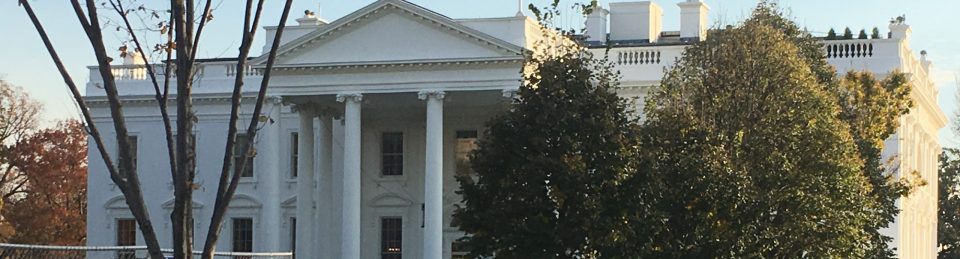
Busy day as House managers named & transmission of articles approved

Lots of talking for Professor Bowman today. The day began with an hour on CSPAN talking about impeachment and the upcoming Senate trial. For those interested, you can watch at this link. https://www.c-span.org/video/?468101-5/washington-journal-frank-bowman-previews-senate-impeachment-trial

The role of the Chief Justice in an impeachment trial

Tags

, , , , , ,

by Frank Bowman

Several days ago, I composed for SCOTUSblog an analysis of the likely role of Chief Justice Roberts in the upcoming impeachment trial. You can read that piece at this link.

Mr. Whit McKinley, a learned attorney from Jackson, MS, read my piece and sent me a thought-provoking response by e-mail. With his permission, I reproduce it below:

Professor Bowman 

Your article on SCOTUSblog is a good piece on the constitutional text and likely role of the Chief Justice in President Trump’s impeachment trial.  I enjoyed it greatly. 

On balance, I agree that Chief Justice Roberts is unlikely to be, or would wish to be, the captain of the ship in the impeachment trial (to mix a metaphor).  However, I do believe that you overstate your case that merely “having a judge preside implies that the process will be akin to a conventional judicial trial.”  In two of the cases that you cite, the Samuel Chase and Samuel Johnson impeachments, the presiding officials (VP Burr and CJ Salmon Chase respectively) put significant pressure on the Senate to make the process more judicial than mere politics would require.  In both of those cases, the Senate membership was composed of more than 2/3rds of the opposing political party to the impeached officer.  And in both cases, rather than a brief trial and easy conviction (that the supermajority of Senate members anticipated), the presiding officers wielded significant power in their roles that, in fact (as opposed to implication), created a proceeding that was more judicial than merely political.  

In the Chase trial, Burr (likely because he was not a friend of Jefferson) stated that he would hold any Senator being absent (or eating or talking) during the questioning in contempt.  He stated further that he was well-aware that the Senators could overrule him, but that he looked forward to reading the names of every individual Senator who felt they need not pay attention to the proceedings published in the paper the next morning.  Ultimately, the Senate settled down and Chase presented a full defense.  The trial lasted 30 days and Chase was not removed from office.  Likewise, in the Johnson impeachment, Chief Justice Salmon Chase used a wide variety of procedural presiding powers in deciding to take up which motions first, what constituted a proper motion, etc.  In the end, the trial was the longest on record and President Johnson was not removed from office.  As you note in your article, the Senate could have overruled  any of Salmon Chase’s rulings (and did some of them), but in both trials the presiding officers rulings were made in such a way that doing so was not worth the cost to the members of the Senate. 

All of this is not to say that the Chase and Johnson trials are similar to the current situation, the issue in the current impeachment is quite different.  There is no risk of a runaway Senate convicting Trump on a partisan basis alone.  In this circumstance there is a concern of the inverse, that in a rush to acquit (the acquittal being a nigh-certainty) that there will not be a trial but a purely partisan proceeding.  I would posit that the Chief Justice has no concern about the outcome of the trial (factually or constitutionally), but he does have great concern for the legitimacy of both the Constitution and the law, which in this circumstance includes the concern that he as presiding officer is trapped in a proceeding that is devoid of a judicial meaning.  I believe that he will not likely have to work very hard to see that those minimal standards for a judicial proceeding are well-met (trappings to the skeptical mind).  Nevertheless, he can insist on them.  I submit that you leave out the one power the Chief Justice retains that makes his role indispensable, and creates not a mere implication, but the requirement of a judicial trial.  

A Chief Justice must attend the Senate trial to have a valid impeachment.  The requirement of him presiding, as an element of a constitutional acquittal or conviction, provides ample authority to the Chief Justice to require the Senate to meet the judicial process requirements on which he may insist.  If not, the Chief Justice may simply retire to his usual chambers across the street, at which time the trial cannot proceed.  This power is one that has been discussed in a number of Johnson impeachment articles.  Again, I highly doubt such would occur, but it is a sword of Damocles of which the Senate (and Chief Justice Roberts) is doubtless aware.  I believe it would be relatively simple to work out a compromise to meet the presiding officer’s needs.  I agree with you that those needs very likely will be met, but the Chief Justice may require that they be.  Assuming they are, a Rehnquist-like role is one that I, like you, would expect.

Thank you again for your good article.  I spend an inordinate amount of time reading and pondering on these issues, which will never arise in my daily practice.  I am grateful to have the opportunity to write you as to my thoughts so rarely expressed for want of a forum. 

Sincerely,

Whit

William W. McKinley, Jr., Esq.

         Currie Johnson & Myers

         P.O. Box 750,  Jackson, MS 39205

The senatorial oath requirement in impeachment trials

Tags

, ,

By Frank Bowman

Over the past few weeks, the requirement of Article I, Section 3, of the Constitution that senators, when sitting in trials of impeachment, “shall be on oath or affirmation,” has provoked some heated discussion. The Constitution does not prescribe a particular form of words, but, by tradition, senators now declare that, “I, [name], solemnly swear, (or affirm, as the case may be,) that in all things appertaining to the trial of the impeachment now pending, I will do impartial justice, according to the Constitution and laws: So help me God.”

Democrats have decried Senate Majority Leader Mitch McConnell’s statement that he is not impartial and will coordinate trial strategy with the White House as a preemptive violation of this oath. Others have suggested that the oath implies an obligation by all senators to pursue relevant evidence by adopting rules that authorize Senate subpoenas to recalcitrant administration witnesses.

These may be effective rhetorical ploys, but as a constitutional matter, the oath requirement probably doesn’t compel any particular action.

In truth, we don’t really know what the Framers had in mind with the senatorial oath requirement. Some commentators have suggested that it was meant to emphasize that the Senate proceeding, in which the Senate has “the sole power to try all Impeachments,” is to be a trial-like process with trial-like rules. But that’s pure speculation, and it doesn’t really help very much even if true. To say that an impeachment trial should have some attributes of trials in other settings just doesn’t get us very far.  The Supreme Court, in its only case on the minimum requirements for a Senate impeachment trial, U.S. v. Walter Nixon, said that the word “trial” doesn’t imply any particular procedural rules.  In essence, it found that the Senate can adopt pretty much any rules it likes short of deciding cases by coin flip.

Moreover, trying to analogize Senate trials to, for example, ordinary jury trials and senators to jurors (or even judges) just doesn’t work. The distinctive function of criminal and civil trial juries is that the judge tells them the law — i.e., what facts the plaintiff or prosecution must prove — and then the jury is to perform the very narrow task of deciding if the facts have been proven to the requisite degree of certainty (beyond a reasonable doubt in criminal cases, or to a preponderance of the evidence in civil trials).  Juries are never asked if the facts they have found should matter. 

For example, if the CEO of a corporation is tried for fraud, the jury is asked to decide whether Elements A, B, C, and D of the crime the law calls “fraud” have been proven, but they are not asked if fraud should be a crime in the first place.  Nor are they asked to consider whether this particular fraud by this defendant under these circumstances ought to be excused because it’s just not serious enough. Nor are they allowed to decide to wave away the whole affair because, on balance, the defendant has been a good CEO and removing him would be bad for the corporation.

Yet this is exactly what the senators are charged with doing in an impeachment case.  They find facts, yes, but they are also the judges of the law, by which I mean the questions of whether the proven facts amount to an impeachable “high crime or misdemeanor” and whether the president’s conduct ought to result in removal from office.

What’s more, unlike jurors in a court case, or even judges in such cases, senators as a body are not bound by any preexisting rules of procedure or evidence.  They are entitled to make such rules as seem appropriate to them at the outset, and to change them by majority vote in the middle of the trial if they like. 

In the end, I think the oath requirement has, and perhaps was intended to have, three related functions. First, it emphasizes the solemnity of the occasion.  Second, it admonishes senators to be honest in their judgments of the facts and, so far as possible, not swayed by partisan allegiances or personal political considerations.  Third, it reemphasizes the oath senators take upon assuming office to support and defend the constitution insofar as the impeachment trial oath charges senators with making judgments consistent with maintenance of constitutional order and promotion of the national interest. 

Therefore, one can fairly argue that the oath requirement calls senators to examine their motives and their consciences both when framing the original trial rules and in subsequent votes on process and substance.  Such an examination should tilt in favor of insistence on full production of evidence by the administration.  It should also, at least in my view, dispose senators to uphold the law, long-accepted norms of presidential behavior, and the institutional prerogatives of their own chamber even at some political risk.

Sadly, however, other than as a basis for an appeal to conscience, and when that fails, as a rhetorical club with which to thrash Republican senators, I don’t think the oath requirement has much practical value.

The “withhold the articles” strategy makes no sense

Tags

, , ,

By Frank Bowman

In The Atlantic this morning, I argue that the strategy being bruited about in the House of withholding the articles of impeachment to induce rule changes in the Senate trial is both futile and counterproductive. A link to the article follows:

https://www.theatlantic.com/ideas/archive/2019/12/house-dems-cannot-force-senate-fair-trial/603928/

In impeaching Donald Trump, we speak to a watching world.

Tags

,

By Frank Bowman

Today, I joined with my friend Alan Baron and a group of other distinguished commentators on Politico to consider the likely verdict of history on the impeachment of Donald Trump. The entire series of commentaries can be found at this link. My original submission to Politico was (entirely sensibly) edited for length. I reproduce the original slightly longer version here:

Donald Trump has been impeached by the House of Representatives.  Sometime next month, the Senate will acquit him.  All will proceed as long predicted by the cynics, or, if you prefer, the realists.  Inevitably, some of those realists will adopt a tone of world-weary wisdom and deride the impeachment effort as pointless at best, and as a political blunder at worst.

The realists will be wrong.

I say this regardless of the fact that impeachment will not immediately remove Donald Trump from office, and regardless of the suggestion (implausible though it seems to me) that impeachment may somehow aid him in his reelection. Whatever the short-term consequences, this impeachment is the right thing to do.

It is right because the truth matters. The United States is an inheritor of the Enlightenment conviction that the world is comprehensible, reality is discoverable, and social arrangements should be built on clear-eyed assessments of fact. American democracy depends on a special elaboration of the Enlightenment ideal which insists that truth is not the private property of priesthoods or aristocracies, but is the public province of every citizen, the necessary predicate to informed communal choice.

Our president is a liar. He sits at the center of a web of falsehood, constantly spinning grotesque new entanglements, constantly abetted by his hired sycophants and, more consequentially, by a dark element of the media which finds in Trump the perfect champion of its own impulse to transform the press from arbiter of truth to purveyor of profitable propaganda. Trump’s dishonesty is so integral to his personality and to all his works that to support him requires that one become a liar oneself, or at least to become willfully indifferent to mendacity.

The House impeachment process was essential to the cause of recovering truth as a public value. Without it, Trump’s misconduct in relation to Ukraine would have remained a mere scandalous rumor, blithely denied by Trump and generally ignored by the public. More fundamentally, the hearings in the House Intelligence Committee recaptured, for a blessed moment at least, the world we are in danger of losing, a world in which it is natural for honest public servants to serve their country impartially and speak the truth when they witness a betrayal of its values. This impeachment calls us to renew our mutual obligation of public candor.

This impeachment is necessary because right and wrong matters. It is wrong for an American president to use the vast power given him as a public trust for his private selfish ends.  It is trebly wrong for a president to engage in a contemptible extortion of a vulnerable people struggling to resist foreign aggression, a people aspiring to join the community of free democracies we, until recently, had the honor to lead.  The offense is rendered blacker still when the result is to abet the totalitarian aspirations of Vladimir Putin and to damage our own security and that of democratic Europe.

Until the ascendance of Trump, no serious person of either party would have defended any particle of what Trump did in Ukraine.  It was simply, and unequivocally, wrong. And considered in the round, it is the quintessence of the “violation of … public trust” for which the founders designed the impeachment remedy.

This impeachment is inescapable because the constitution must be defended. The framers wrote into the constitution a president of limited powers, not a king.  Trump’s plain ambition, plainly announced, is for personal rule, unfettered by law, rule, regulation, judge, or Congress itself. In this, he is being actively encouraged by populist ideologues, white nationalists, unitary executive zealots, and media screamers, while being passively enabled by party functionaries and Republican legislators who know better, but are cowed by the legions easily whipped to fury by his Twitter bile.

The constitution gave Congress many tools with which to assert control over a misguided or demagogic president, but this Congress, or more particularly the Republicans in this Congress, refuse to wield them.  In such a case, the only tool remaining to the one party not under his sway is impeachment. If, in the end, Republicans refuse to either to restrain Trump or to oust him, Democrats at least have the consolation that they sounded the alarm and gave their colleagues the chance to rise to the occasion.

Finally, the value of any public act cannot necessarily be measured in its immediate success of failure. By voting to impeach Donald Trump, Democrats express their faith in, to adapt a phrase from Charles DeGaulle, a certain idea of America. An America that is commonly truthful, unusually generous, customarily trustworthy, instinctively democratic, committed to human freedoms and individual rights, self-protective without being selfish, always imperfect but perennially challenging itself to do better. An America that, to borrow a favorite image from a man Republicans used to revere, at least aspired to be the world’s shining city on a hill.

Loyalty to that certain idea of America matters, as did DeGaulle’s lifelong allegiance to “une certaine idée de la France.”  DeGaulle was a difficult, stubborn, arrogant, sometimes impossible man.  But he proclaimed his “certain idea of France” through the darkest time in French history, when the country was occupied by Nazis and its politics dominated by enthusiastic collaborators and cynical defeatists. DeGaulle’s certain idea was in some respects a delusion – a vision of French political and cultural superiority and national glory that had never truly existed in the past and could certainly never be wholly realized in the modern world – but it spoke to Frenchmen’s vision of their best selves.  It sustained them, rallied them, and then inspired them to restoration of a France that could again take pride in itself.

We are assuredly not yet in so dire a strait as Vichy France in 1942. But we are under threat from some of the same resilient external forces, as well as dark internal impulses never entirely vanquished in any culture. It is not hyperbole to suggest that our Republic is in peril. In impeaching Donald Trump for his betrayal of American values, we reassert to each other our commitment to a resurgent democracy.  And we speak not just to each other but to a watching world. We demonstrate that, although for the moment America is in the grip of madness, there remains a sturdy contingent of Americans willing to fight for the hopeful America upon which so many of the world’s highest aspirations depend.

First Thoughts on the Articles of Impeachment

Tags

, , , ,

By Frank Bowman

I read the newly announced articles of impeachment against President Donald Trump from two perspectives – as a student of impeachment and as an old prosecutor.  Several things stand out immediately.

First, the choice to frame these articles as abuse of power and obstruction of Congress’s impeachment investigation is sound. Abuse of power has been one of the impeachable “high Crimes and Misdemeanors” of Anglo-American constitutional practice since the 1300s, and it has recent powerful precedent in the case of Richard Nixon. Obstruction of an impeachment investigation was not only the basis of one of the articles voted out of the Judiciary Committee against Nixon, but such behavior may strike even more deeply at the heart of constitutional order than other presidential abuses. If, as is now the case under the Justice Department’s self-imposed rule, sitting presidents may not be indicted, the only check on egregious presidential misconduct is impeachment. And when, as is now the case under the Barr Justice Department, prosecutors decline either to investigate presidential misconduct or to assist in the enforcement of congressional subpoenas, a president who misbehaves and then brazenly stonewalls congressional inquiries becomes an elected king unless Congress can impeach him for his defiance of their authority.

Second, I am very pleased that the Judiciary Committee avoided the temptation to call Trump’s behavior in relation to Ukraine “bribery.”  For a period, the term was in vogue among House members, the thought being that it is a freestanding textual basis for impeachment – “treason, bribery, or other high crimes and misdemeanors – and that it would be easier to explain to the average person.  But the most obvious lesson of the testimony of the four law professors at last week’s Judiciary Committee hearing was that the definition of bribery for purposes of impeachment is uncertain, and an article on that ground would open an array of technical questions that merely confuse the issue.

Third, I understand the decision not to base any individual article expressly on Trump’s dalliance with Russian election interference in 2016 or the second volume of the Mueller Report relating to obstruction of the investigation into Russian meddling.  Although the substance of Mueller’s evidentiary presentation was very strong – the report contains overwhelming evidence of presidential obstruction – the report failed as a persuasive document and Mueller failed as a persuasive witness before the Judiciary Committee. For at least half the public, it’s old news and not sufficient for impeachment. 

Moreover, one of the few points on which Judiciary Committee Republicans were correct on Monday was that Democrats are constrained by the calendar.  Given that the Senate is deeply unlikely to convict Mr. Trump regardless of the charges brought against him, the task of the House must be to make the best case they can without dragging the trial into the late spring and summer when the country’s attention should properly be on the election.  Reviving aspects of the Mueller Report as the centerpiece of a separate article of impeachment would take time – more witnesses, more constitutional explanations – time the Democrats realistically don’t have.

Fourth, considering these articles as if they were charging documents in a criminal case, the Democrats have elected for “notice pleading,” a short, simple description of the charge and underlying conduct.  The Nixon articles, by contrast, were what a white collar prosecutor would call a “speaking indictment.”  That is, they laid out a story of misconduct replete with many details and many particular bad acts.  That was appropriate in Nixon because he was impeached, not for one bad incident, but for a long-running pattern and practice of misbehavior and cover-up. The narrow scope of the case against Trump favors the simpler form.

Finally, both articles nonetheless include language framing Trump’s Ukraine misconduct as part of two larger patterns – “previous invitations of foreign interference in United States elections” and “previous efforts to undermine United States government investigations into foreign interference in United States elections.”  These phrases permit House Managers presenting the case in the Senate to bring aspects of the Mueller investigation and related matters into the conversation.  On the optimistic assumption that at least some Republican (and wavering Democratic) senators remain persuadable, placing Ukraine in the larger frame of Trump’s persistent malfeasance advances the objective of demonstrating that the Ukraine extortion was not an one-time anomaly, but an exemplar of a pattern of conduct sufficiently serious to merit conviction and removal.

A wonderful guide to impeachment from the BBC

Tags

, , , , , ,

Readers may enjoy a BBC podcast program that just came out earlier this week on the history of impeachment from ancient times to the modern day. https://www.bbc.co.uk/programmes/m000bm83

It’s truly marvelous.  The very best thing of its kind I’ve heard.  A combination of live voices, recorded material from the past, actors recreations, and a terrific narrative line.  It’s good enough that I would recommend it to anyone, regardless of their existing degree of knowledge about impeachment who wants a thorough and immensely engaging hour-long primer on the subject.  I may, of course, be biased because I have the honor of joining former Representatives Elizabeth Holtzman and William Cohen, John Dean, author Brenda Wineapple, former Clinton staffer Sidney Blumenthal, and former Sen Chuck Hagel as the live voices on the program.  But I don’t think that unfairly skews my appraisal of its merits.

If you’re interested in impeachment and have about 50 minutes to listen, you really should.

1941 – A Parable

Tags

, ,

By Frank Bowman

Return with me now to April 1941. Germany has overrun France and all of western Europe. The British saved their army the previous year with a fighting withdrawal from Dunkirk. But their cities are being blasted from the air by the German Blitz and their ocean supply lines are being strangled by German U-boats. The freedom of the last island bastion against Hitler’s tyranny hangs by a thread.

In March, the U.S. Congress had passed the Lend-Lease Act, permitting America to lend or lease (rather than sell) military supplies to any country deemed “vital to the defense of the United States.”  Britain is cash-strapped and desperate for the gusher of food, arms, and equipment America’s farms and factories could provide under the terms of the new bill.

But somehow the aid is mysteriously held up. Prime Minister Churchill calls President Roosevelt on the newfangled transatlantic telephone.

CHURCHILL: Mr. President. A great pleasure to speak with you. This island is in grave danger of being starved out of the war against the Nazi menace. We need supplies to carry on the fight. It had been my hope that the generosity expressed in the magnificent Lend-Lease Act would by now be filling the holds of convoys of merchantmen steaming across the Atlantic. I am told, however, that there have been unaccountable delays.

ROOSEVELT:  You’re right. We’re generous. I’m generous. The most generous. Do a lot for you, I guess you call it England. Or Britain. Or whatever. More than anybody. A lot more than those Frenchies.

CHURCHILL: Our gallant French allies suffered greatly and …

ROOSEVELT: Gallant! Ha!  Buncha frog-eating losers. But we’ve been very, very good to you Brits. I wouldn’t say it’s reciprocal necessarily because things are happening that are not good.

CHURCHILL: Mr. President, I’m sure any issues that impede our two great democracies standing shoulder-to-shoulder against Hitler’s barbarism can be resolved with frank discussions between our military and diplomatic experts.

ROOSEVELT: Don’t know what you got against Hitler. He says nice things about me. Regardless, General Marshall and all my generals, and Cordell Hull and all his Deep State crowd at the State Department say I should let you have the aid. But I’d like you to do me a favor, though.

CHURCHILL: Anything to advance the common cause of the free peoples of the world.

ROOSEVELT: You remember that Wilkie guy I beat in 1940. Greatest victory in history. Biggest crowds. Everybody says so. Well, anyway, Wilkie’s married, but I hear he’s got action on the side. Van Doren’s her name. I hear she wrote letters to some dame in London, spilling it all. If I had those letters, that’d fix his wagon for 1944.

CHURCHILL:  Mr. President, I’m not sure…

ROOSEVELT: Oh, and one other thing, Doug MacArthur.  He’s out in the Philippines now. May need him as a general if the Japs get frisky. But he’s got White House fever. Some people say his wife had shady dealings with bankers in your Singapore colony before the war.

CHURCHILL: We looked into that. There was nothing to the rumors.

ROOSEVELT: Just announce you’re reopening an investigation. That’ll do fine.  Until then, good luck with those U-boats.

***

This fictional dialogue reads like farce because we cannot imagine Franklin Delano Roosevelt extorting personal political favors as the price of keeping Britain free and an ally against spreading dictatorship. Indeed, it is impossible to envision any of the historical moments that defined America and tested its presidents and insert into the frame a personality as ignorant, as rude, as shallow, as self-interested, and as unprincipled as Donald Trump.  But the analogy between my farce and Trump’s real-world extortion of a Ukraine besieged by expansionist Russia is far too close for comfort.

Precisely because it is impossible to imagine an American president from our rightly storied past acting like Donald Trump does every day of our frighteningly diminished present, his enablers and acolytes are forced to pretend that events which undeniably happened never happened at all. 

Or worse, as the evidence becomes so overwhelming that even some Republicans grudgingly admit the facts of Trump’s conduct, some defend him with an unpardonable libel on every one of his predecessors – that it is normal, or at least unexceptional, that an American president should leverage the massive power of the United States to against an imperiled democracy for personal gain.

Donald Trump will pass. That’s certain.  What is achingly uncertain is whether he –and those who cling to him – will warp our conception of ourselves so far that we can never recover the essential decency that is the core of the American identity and the true source of our power among the nations.

[Historical footnotes: Wendell Wilkie reportedly did have an extramarital affair with a Ms. Van Doren. The reference to “shady dealings” by Gen. McArthur’s wife is my invention; so far as I know, Mrs. McArthur never had any connections in Singapore and was rigorously correct in her private life.]

Prof. Bowman on “Richard French Live” — WRNN-TV

Tags

,

Some readers may enjoy this segment of “Richard French Live” — a program of WRNN-TV from the New York metro area. Prof. Bowman appears and discusses both the history of impeachment and the current status of the Trump impeachment investigation.

A comparative look at American & Brazilian impeachment practice

Tags

, , , ,

What follows is another in a series of contributions from the terrific students in my Georgetown Law Center seminar on “Impeachment Power and the American Constitutional Balance.” __ F. Bowman

By Hugh Rosenberg

Donald Trump has been embroiled in scandal after scandal. Many of them could have justified his removal from office. Yet, he remains president. Only now, in the wake of the disturbing Ukraine call, is there real movement towards impeachment. Despite this momentum, it remains improbable that Trump will be removed. A number of factors support this prognosis: the high bar to conviction set by the requirement of a 2/3 majority in the senate, the vague standard of impeachable conduct that the Constitution provides, and features of American politics and society extrinsic to the Constitution.

To better understand how impeachments can be brought to completion, it will prove beneficial to survey the impeachment processes of different countries around the world, Brazil’s specifically, in comparison to that of the United States. Brazil stands above the rest as the undisputed champion of impeachment. Since 1990, it is by far the most prominent country – no disrespect to Ecuador, Paraguay, and Peru intended – to have removed two Presidents through the impeachment process. Technically Brazilian President Fernando Collor de Mello resigned before proceedings were completed, but his trial continued and he was found guilty by the Senate.[1] The United States on the other hand, has never convicted a President in a Senate impeachment trial in its 230-plus year history, although the specter of the process and nearly-guaranteed outcome prompted Nixon’s resignation.

Without looking at the respective Constitutions, one might assume that the reason for this disparity is that the procedure for impeachment in Brazil is much less rigorous than that of the United States. In fact, the opposite is true. Removal of a President from office in the United States requires a simple majority in the House of Representatives to impeach and a super majority in the Senate to convict. According to the Brazilian Constitution, a super majority is required in the lower house (the Chamber of Deputies) to impeach, as well as in the upper house (the Senate) to convict.[2] At least facially, it poses a more difficult  challenge to convict a President in an impeachment trial in Brazil than in the United States. So, the fact that conviction of a U.S. President requires a super majority of the Senate does not stand alone as an insurmountable bar to removal.

One explanation for this apparent incongruity is the fractured multi-party system in Brazil as opposed to the extremely polarized binary that exists in America. Representatives from eighteen different parties took part in the 2016 Senate vote to convict Dilma Rousseff.[3] Brazilian Presidents, unlike American ones, are easily left on an island amid the sea of political parties: “… the President can rarely count on a single-party support base large enough to weather impeachment crises.”[4] What’s more, and likely even more damning for a President under siege, is that even if her particular party outsizes the others, she can’t necessarily count on them. “The Brazilian party system is also characterized by a lack of cohesion within parties… The lack of disciplinary measures available to party leaders in most parties makes it less costly for individual legislators to defy party leadership.”[5]

Perhaps impeachment is so difficult to accomplish in America because no one understands what makes for impeachable conduct. Article II, Section 4 of the U.S. Constitution provides that “The President … shall be removed from Office on Impeachment for, and Conviction of, Treason, Bribery, or other high Crimes and Misdemeanors.” The meanings of treason and bribery are easy enough to tease out. Indeed, treason is defined explicitly in the Constitution. It is the meaning of that third element – “high Crimes and Misdemeanors” – that has proven to be frustratingly evasive.

It may be that the Framers of the U.S. Constitution intended the phrase to be somewhat amorphous – amenable to different interpretations in correspondence with different circumstances and contexts. One scholar argues this point convincingly – “The written constitution granted successive generations of legislators the power to identify for themselves the essential characteristics of the American constitutional system and to defend that system by removing its chief executive officer if he or she, by any individual act, pattern of behavior, or culpable inattention, places it at risk.”[6] While the Framers almost certainly had such intentions, it is likely that they failed to foresee the extent to which Congress, and the Senate in particular, would become so hyper-partisan. The flexibility that they intended the phrase to have, with the aim of making it easier to apply, now seems to hinder its application. The current composition of the Senate, split nearly down the middle, with members of both factions entrenched along party lines, makes it difficult for 67 of the 100 Senators to agree on “the essential characteristics of the American constitutional system.”

Impeachable conduct as defined by the Brazilian constitution is simultaneously much broader and more specific than its American counterpart. Section III, Article 85 provides:

Acts of the President that are attempts against the Federal Constitution are impeachable offenses, especially those against the: I. existence of the Union; II. free exercise of the powers of the Legislature, Judiciary, Public Ministry and constitutional powers of the Federation; III. exercise of political, individual and social rights; IV. internal security of the Country; V. probity in administration; VI. the budget law; VII. compliance with the laws and court decisions.[7]

Interestingly, it makes attempts against the Constitution impeachable. Such wording stands in stark contrast to the language in the Constitutions of other countries, such as the Philippines (“…culpable violations of the Constitutions…”[8]), Lithuania (“… grossly violated the Constitution…”[9]), South Africa (“… a serious violation of the Constitution…”[10]), and Romania (“…serious offenses which violate provisions of the Constitution…[11]) While there may be little practical difference between attempts against the Constitution, actual violations, gross violations, and even “high Crimes and Misdemeanors” – the verbiage used in the Brazilian Constitution expresses the desire of its drafters to hold their leaders accountable. The degree of culpability to which a Brazilian President’s bad behavior must rise is, according to the diction used in the different provisions, less than in many nations.

Similarly, though it is difficult to conceptualize what an attempt against the “existence of the Union” or “probity in administration” might look like in concrete terms, the sheer numerosity of named categories makes it easier for those seeking impeachment to associate objectionable conduct with an item on the list. The array of differentiated buckets of impeachable acts, paired with the shallow depth of culpability, leaves a Brazilian President with few outs should he or she become attached to a scandal.  The impeachment of Rousseff illustrates this.

Dilma Rousseff, whose removal was predicated on violations of items V and VI of Article 85 of the Brazilian Constitution, as well of a Fiscal Responsibility Law, was, by most accounts, not as corrupt as many in the government, including those who voted to impeach her.[12] However, Rousseff was not entirely innocent either – “there is broad agreement that Ms. Rousseff’s administration employed budgetary tricks to conceal a looming deficit and enhance her prospects during a bitterly fought re-election campaign in 2014.”[13] Her conduct, though hardly heinous, could be fairly construed as an “attempt against the budget law.” While her ouster may have been unfair, especially relative to the corruption of her adversaries, it was not a coup. As one Brazilian law professor put it, “[Rousseff’s crimes] are not penal crimes, so you cannot be put in prison because of them, but you can lose your mandate.”[14] A prominent historian noted that Rousseff’s impeachment was entirely consistent with the country’s Constitution in that it followed the law and was subject to judicial oversight.[15]

            The context surrounding the drafting of the 1988 Constitution supports the inference that its impeachment provision was designed to be executed despite a low level of culpability on the part of the President. The new Constitution arose at a time when Brazil had just emerged from more than two decades of military rule.[16] The two previous Constitutions served to perpetuate the regime above all else. They “heavily centralized power in the Executive and badly distorted separation of powers. Each transferred large amounts of power to the federal government from the states and local governments, and from the legislature and judiciary to the executive. None provided any serious protection for individual rights.”[17] In response to this dark period of Brazilian history, and to lay the foundation for a brighter future, the new Constitution looked much different. “The 1988 Constitution was designed to weaken the executive and to strengthen the legislature and judiciary. Indeed, initial drafts adopted a parliamentary rather than a presidential system of government. The present Constitution makes the President accountable to Congress…”[18] Removal is one such check on executive domination and can be accomplished through two avenues – in the manner described above – and through a criminal prosecution initiated by the lower house and tried by the Supreme Court.[19] The Brazilian Constitution also has in place measures, unincluded in the American Constitution, that prevent final fits of misbehavior when a President realizes that he or she is on the way out. “[A]n indicted President is suspended from office as soon as the Supreme Court receives the criminal accusation, while an impeached President is suspended from office as soon as proceedings are instituted in the Senate.”[20]

            So, structural differences account for some of the greater success of Brazilian impeachment than American, but certainly don’t tell the whole story. Mass protest in Brazil seems to play a critical, clinching role in sealing a President’s fate once the political tide has started to turn against him or her. Following a major 1992 corruption scandal involving Brazilian President Collor, 100,000 young people, faces painted with the colors of the Brazilian flag, took to the streets demanding his removal.[21] Again in 2016, subsequent to corruption allegations against Dilma Roussef, as many 3 million protesters marched across the country, once more clad in yellow-and-green, literally making their voices heard with chants of “Dilma Out!”[22] The rampant corruption that persists in Brazil today, the dismal state of the economy, and a history of violence and oppression vivid in living memory have fostered a dynamic where the average citizen is more than willing to loudly voice his or her discontent in demand of change.

These conditions are obviously much less prevalent in the United States, and thus, despite the brazen corruption emanating from the current White House, Americans aren’t quite sure how to react. Indeed, a sizeable portion of the population persists in fully supporting the actions of the President and his administration. Yet the tradition of protest isn’t entirely foreign to America, having come alive at important moments in the country’s history – from the Vietnam War, to the Civil Rights Movement, all the way back to the Boston Tea Party – and has precipitated change. The kind of sustained, truly popular outcry seen in Brazil’s recent history, and in America’s more distant past, might be what is needed to finally get an impeachment all the way over the hump in America.


[1] Kada, Naoko ‘Impeachment as a Punishment for Corruption?’. Checking Executive Power, edited by Jody C. Baumgartner and Naoko Kada. Praeger, 2003, pp. 122-123.

[2] Articles 52 & 53 of Brazil’s Constitution. 

[3] “Dois Senadores Do PR Votaram Contra Impeachment.” CORREIO DO LAGO, 12 May 2016, https://web.archive.org/web/20160623190625/http://www.correiodolago.com.br/noticia/dois-senadores-do-pr-votaram-contra-impeachment/34033/.

[4] Kada, supra, at 116.

[5] Id.

[6] Bowman, Frank O. High Crimes and Misdemeanors: A History of Impeachment for the Age of Trump. Cambridge University Press, 2019, p. 111.

[7] Article 85 of Brazil’s Constitution.

[8] Article XI, Section 2 of the Philippines’ Constitution.

[9] Article 74 of Lithuania’s Constitution.

[10] Provision 89 of South Africa’s Constitution.

[11] Article 95 of Romania’s Constitution.

[12] The Editorial Board. “Making Brazil’s Political Crisis Worse.” The New York Times, The New York Times, 13 May 2016, https://www.nytimes.com/2016/05/13/opinion/making-brazils-political-crisis-worse.html.

[13] Jacobs, Andrew. “Brazil Impeachment Debate Hinges on a Thorny Legal Question.” The New York Times, The New York Times, 20 Apr. 2016, https://www.nytimes.com/2016/04/20/world/americas/dilma-rousseff-impeachment-brazil.html?module=inline.

[14] Id.

[15] Id.

[16] Rosenn, Keith S. “Separation of Powers in Brazil.” Separation of Powers in the Americas … and Beyond Symposium Issue, Duquesne Law Review, Fall 2009.

[17] Id.

[18] Id.

[19] Id.

[20] Id.

[21] Rezende, Tatiana. “UNE 70 Years: “Fora Collor: The Cry of Face-Painted Youth.” EstudanteNet – Portal Oficial UNE e UBES, https:web.archive.org/web/20070903131454/http://www.une.org.br/home3/movimento_estudantil_20007/m_9920.html.

[22] Flynn, Daniel. “Record Brazil Protests Put Rousseff’s Future in Doubt.” Reuters, Thomson Reuters, 14 Mar. 2016, https://www.reuters.com/article/us-brazil-rousseff-protests/record-brazil-protests-put-rousseffs-future-in-doubt-idUSKCN0WF0IX.