The Western Alliance Totters: From Congress, Silence

Tags

, , ,

By Frank Bowman

I’ve been in Washington these past few days, burrowed in at the Library of Congress researching English impeachments for a chapter in my upcoming book on Impeachment in the Age of Trump (University of Cambridge Press 2019).  Sitting in the Main Reading Room of that astounding institution — both a breathtakingly beautiful building and perhaps the greatest repository of knowledge in human history — during the events of the past week or so has both inspired and deeply depressed me.

The United States is a great nation, not merely because of its great size and abundant resources, its fortunate geographic insulation in its formative years from the wars of Europe, or even its thriving economy and powerful military.  What has made America great — in a sense Donald Trump will never understand — has been the accretion over two-and-a-half centuries of many foresighted, large-minded decisions grounded in a belief in democratic government and human possibility. At any given moment in our history, we like every people will be found making mistakes, sometimes even violent and vicious ones, but the throughline has been reversion to a mean of remarkable wisdom and generosity.

The Library of Congress is but one among many monuments to our happy inheritance.  A place where, long before there was a thing called the internet, Congress decreed that virtually all the knowledge in the printed universe would be gathered under a single roof.  The impetus for this creation is, in the present moment, even more remarkable than its execution.  Congress created a library for itself because it recognized that making sound policy for a nation required knowledge, and it wanted all the available knowledge at its immediate call.  And then Congress decided something even more remarkable — that all the knowledge it was gathering for its own use should be freely available to the citizenry.  Because they deemed an informed and educated citizenry as essential to the operation of a democratic republic as an informed legislature.

These were quintessentially American choices.  I will not say that no other nation has ever made similar ones.  Certainly most of the democracies in what we, with increasing anachronism, have referred to as the West have, at least at some points in their histories, arrived at similar conclusions and created similar institutions. But in America, the dedication to political choice informed by knowledge, study, and reflection by both leaders and citizens has been central to our identity since our beginnings.

Sitting in the Library of Congress and drawing on its treasures inspires awe and gratitude for the good fortune of living in this marvelous country.

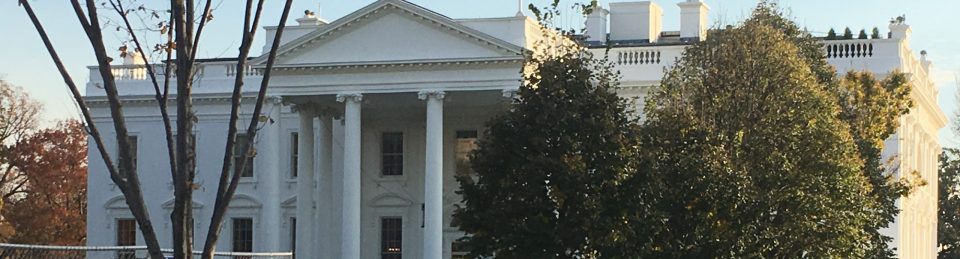
But, at the close of a day in the cocoon of our brilliant past, one emerges and looks across the street at the U.S. Capitol.  There it stands, its classical forms massive and inspiring, but a moment’s reflection on those who now inhabit the place can only plunge an American patriot into gloom.

It is literally inconceivable that today’s Congress would imagine or vote to maintain a Library of Congress if it did not already exist.  And every day, that once-august body betrays the ideals upon which the Library was founded and long maintained.  Both Houses are presently controlled by a party aggressively uninterested in knowledge, particularly knowledge that might threaten the short-term political interests of its members or the transitory prejudices of its “base.”  That same congressional party is now in thrall to an administration even more actively determined to suppress inconvenient knowledge.  More particularly, that party has apparently surrendered even its own capacity for independent thought to a president who is both utterly ignorant in virtually every sphere of science, technology, history, and economics, and proudly determined not to learn anything new, even when the safety and prosperity of the country depends on it.

Yesterday, Mr. Trump effectively spat on both the Western military alliance and the world economic architecture that have together maintained peace among the great powers and been the foundation of American economic prosperity since 1945. His boorish, petulant, bottomlessly ignorant performance was only the latest in a series of mindless assaults on global institutions created by generations of American statesmen, Republican and Democrat, wise enough to recognize that America thrives, not as a selfish bully, but as the keystone of an international structure of mutual benefit.

This is not a partisan judgment.  Before November 2016, while there would have been disagreements about details, no serious national political figure doubted that the NATO alliance, a strong and unified Europe, cordial trading relationships with our North American neighbors, and an existing world economic order markedly attuned to American needs were all fundamentally beneficial to the United States.  Indeed, these ideas and institutions were, if anything, more firmly embraced by Republicans than Democrats.

And yet, the response from the Congressional Republicans to Trump’s steady destruction of a world order from which this country benefits so profoundly has been … silence. There have been occasional mild bleatings of disapproval at one or another particularly obnoxious Trumpian utterance.  But the bleats have come almost exclusively from legislators who have decided not to run again, or in the case of John McCain, a man whose heroic struggle against death will, sadly but inevitably, preclude any future electoral contests.

Remember that the Founders imagined Congress as the dominant player in American government.  And remember that, even though since the early 20th Century Congress has steadily ceded much power to the presidency, Congress retains ample constitutional authority to thwart any chief executive if it chooses to use that authority.

But the Republican party which now commands Congress has instead meekly abandoned virtually everything it professed to believe about America’s relations with the world.  It would be one thing if this about-face were the result of a revolution in economic or political thought stemming from careful study of all the knowledge carefully stored in the great Library across the street from our congressmen’s offices.  Intellectual revolutions do happen.  And they are sometimes profoundly beneficial.

But we all know that nothing of that sort has occurred.  Instead, Republicans have simply bowed to the demonstrably irrational whims of their vapid puppet master.  Individually and collectively, they quake and cower, as the world America built crumbles.  Perhaps the most maddening feature of the Republicans’ moral collapse is that it does not even come in the service of a definable new world order.  Even the evils of the great 20th century dictatorships in Germany, the Soviet Union, and China were inflicted by servants of articulable, if twisted, ideologies.

There is no new ideology at work in Trumpism.  No plan. No thought. No rational end state.  Everything that now happens at the pinnacle of American government is simply that day’s whim of a bloated, narcissistic fool.

And congressional Republicans know this as well as you or I.  Yet they do nothing.

Lest it be thought that all blame devolves on the Republicans, congressional Democrats bear their share, however much diminished by their minority status.  While I recognize that Democrats cannot pass legislation on their own, as a group they seem to me remarkably quiet at a time when our circumstances call for unceasing, intelligent, forceful resistance to the daily outrages of the president and his minions.

History will not be kind either to the overt cowardice of congressional Republicans and the tactical meekness of congressional Democrats.  This feckless Congress is not the institution the Founders imagined, past generations celebrated, or the present generation desperately needs.
The G-7 plus 1?

Tags

, , , , , , , , , , , , , , , , , , ,

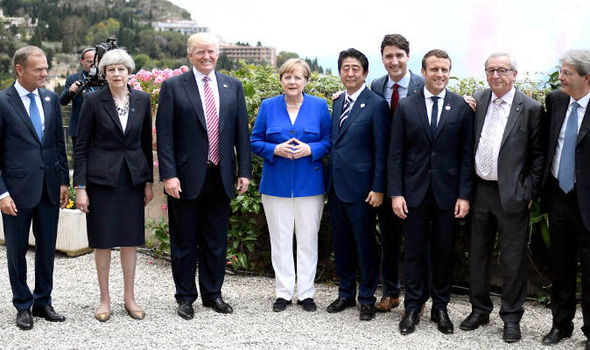
President Trump, at the annual summit meeting, suggested that Russia be readmitted into the G-7, the group of 7 nations (Canada, France, Germany, Italy, Japan, the United Kingdom, and the United States) which meet to discuss world-economic policy. Russia was ousted from the then G-8 in 2014 for seizing parts of the Ukraine. Trump defended his suggestion, stating as follows:

“You know, whether you like it or not — and it may not be politically correct — but we have a world to run. And in the G-7, which used to be the G-8, they threw Russia out. They should let Russia come back in. Because we should have Russia at the negotiating table.”

President Trump acted antagonistically at the summit meeting, rendering himself an outsider, and causing some to refer to it as “G-6 plus 1.”  For some this is a cause of concern: Trump treating allies as enemies and enemies as allies. And it could further bolster the theory that there was and is collusion going on between Russia and Trump; however, it is unclear that that rejoining the G-8 is actually on Putin’s agenda. In response to the news, the Kremlin spokesman, Dmitri S. Peskov, said that “we are putting emphasis on different formats,” insinuating that Russia is not particularly interested in rejoining the G-7. Russian officials made similar comments in 2014 when they were removed: Russian Foreign Minister Sergey Lavrov said that Russia was “not attached to this format and we don’t see a great misfortune if it will not gather.” So if Trump is acting on behalf of Russia, it is the result of some very coy maneuvering. Regardless of the reason for his stance, however, it betrays more of the same peculiar friendless we have seen since the beginning of Trump’s presidency. We will find out exactly what it means in due time.

g7-summit-trump-may-merkel-macron-809690.jpgexpress.co.uk

Celebrity pardons

Tags

, , ,

By Frank Bowman

Today brings news that, at the behest of that well-known legal eagle and social justice crusader, Kim Kardashian, Mr. Trump has issued a presidential commutation of the life sentence imposed on a woman convicted of drug trafficking. While the issuance of a presidential commutation to this particular prisoner seems unobjectionable on the merits — she’s 63 and has already done 20 years — the process that produced it is profoundly dispiriting.  At the very same time that Trump’s Attorney General, Jeff Sessions, is rolling back Obama-era DOJ policies designed to reduce lengthy drug sentences for non-violent, first-time offenders, Trump picks one prisoner out of thousands … apparently because he got a personal plea from a buxom female celebrity.

One is reluctant to attribute too much cunning to any of Trump’s in-the-moment decisions, but starting to issue pardons to some folks who actually merit them by conventional standards would be a prudent precaution.  I’ve argued on this blog that Trump’s emerging pattern of employing pardons almost solely for political allies or for the purpose of signalling a willingness to pardon his own associates now under scrutiny by federal law enforcement could, if continued, form a plausible constitutional basis for impeachment.  Diluting the core of self-interested pardons with a stream of apparently disinterested displays of mercy would make the impeachment case much harder.


The Letter from Trump’s Lawyers to Mueller Refutes Itself

Tags

, , , , , , , , ,

By Frank Bowman

The New York Times has published a lengthy letter dated January 29, 2018, from John Dowd, then head of Trump’s legal team, to Special Counsel Robert Mueller contending that Trump could successfully assert executive privilege and refuse to testify, even if subpoenaed.

The Dowd letter doesn’t quite say that Trump will invoke executive privilege.  It merely argues that he would have solid grounds for doing so and thus, by implication, warns the special counsel not to put the question to the test.  Remarkably, the letter is so poorly executed that it ends up demonstrating exactly why such a subpoena is enforceable under existing law.

Courts have recognized that presidents need a zone of confidentiality within which they can receive and discuss information and recommendations from their advisers.  To protect that zone, several privileges (often lumped together under the term “executive privilege”) have emerged.  One of these covers communications to the president  from his advisers and also communications among the advisers about matters on which they will advise the president.

Unlike many other privileges with which the public is familiar, such as the Fifth Amendment privilege against self-incrimination, the presidential communications privilege is not absolute.  If a criminal suspect claims his right against self-incrimination, he cannot be compelled to talk (at least without granting him immunity from prosecution), no matter how useful his testimony might be.  By contrast, even if a president can show that subpoenaed materials are covered by the presidential communications privilege, the court will order them produced anyway if the prosecution (or a civil litigant) can make a sufficient showing of relevance and need.

The Espy case, on which the Dowd letter places great reliance, sets out the standard for relevance and need:

[I]n order to overcome a claim of presidential privilege raised against a grand jury subpoena, it is necessary to specifically demonstrate why it is likely that evidence contained in presidential communications is important to the ongoing grand jury investigation and why this evidence is not available from another source.

The Dowd letter makes three interlocking claims: (a) implicitly that Trump’s own testimony is covered by the presidential communications privilege; (b) that Mr. Trump did not, indeed legally cannot, commit obstruction of justice and therefore the grand jury has no legitimate need for his testimony; and (c) that, even if there were a need, the White House has already provided so much information from sources other than the president’s own mouth that his testimony would be superfluous.

As to the scope of the privilege, it’s surely correct that, to the extent advice to the president is covered, the president’s memory of that advice and his mental processes in deciding how to respond to the advice should be covered, as well.  The catch, however, is that not all advice and not all presidential decisions fall within the privilege.  It exists in order to maintain the confidentiality necessary to sound exercise of the president’s legitimate powers.  However, if a president does illegitimate things, that is things he has no power to do or things that violate the criminal law, then the fact that he is the president does not immunize him or his advisers from disclosure of either the advice or his personal rationale for choosing to do wrong.  Richard Nixon was legally required comply with a subpoena seeking White House tapes that recorded him receiving advice and giving orders that amounted to criminal conduct during Watergate.

Dowd’s argument that there was no obstruction and therefore no need for a Trump interview has two threads.  The first, and the one that has drawn immediate outraged responses, is the by-now familiar claim by Trump’s acolytes that a president cannot commit obstruction of justice by firing or giving instructions to executive branch law enforcement officials.  The argument takes the noncontroversial truth that a president has wide Article II powers to hire and fire executive branch subordinates and considerable discretionary authority to supervise their work and distorts it into an absurd absolute.  This extreme application of the so-called unitary executive theory has been given thorough scholarly debunkings elsewhere.

But one scarcely needs to be a scholar to discern its absurdity.  If a president can never commit a crime by ordering his subordinates not to investigate or prosecute, regardless of how self-serving or corrupt the president’s motive, then a president can effectively exempt both himself and anyone he favors from the constraints of law.  Anglo-American jurisprudence abandoned that idea — what the English called the royal prerogative — four centuries ago during the reign of King Charles I.  The Framers did not revive this relic of absolutist monarchies in the U.S. constitution.

The second prong of Dowd’s obstruction argument is less shockingly authoritarian, but ultimately no less wrong.  Essentially, he goes through various incidents possibly indicative of obstruction — Trump’s alleged remark to James Comey about letting General Flynn go, the Comey firing, and others — and tries to show that no obstruction occurred and therefore there can be no need for Trump to testify about them.  The argument has two gaping holes.

The first was noted in the original Times report: incredibly, Dowd based his entire exposition on the wrong obstruction statute.

There are a number of federal obstruction of justice statutes.  The three most important are 18 U.S.C. Sections 1503, 1505, and 1512.  The Dowd letter says, “The only statute that could even theoretically be implicated on the alleged facts is 18 U.S.C. § 1505….”  This is not only wrong, but laughably wrong.  Sections 1503 and 1512 between them cover proceedings before judges, grand juries, Congress, and executive agencies, while 1505 is directed primarily at obstruction of proceedings before federal regulatory agencies.  No prosecutor faced with allegations of obstruction of a federal grand jury investigation would ever use section 1505.

Not only do sections 1503 and 1512 fit the facts of this case far better than 1505, but Section 1512 is phrased to eliminate the technical issues raised in the Dowd letter, such as whether there was a “pending proceeding” at the time of Trump’s allegedly obstructive behavior and, if so, whether he was aware of its pendency.  Section 1512(f) specifically provides that in 1512 prosecutions “an official proceeding need not be pending or about to be instituted at the time of the offense.” In short, under Section 1512(c), all the government must prove is that the defendant corruptly attempted to obstruct, influence, or impede some official proceeding (a term that includes grand jury investigations) that is either under way or that might reasonably be anticipated.

Dowd’s choice to claim 1505 as the only applicable obstruction statute is inexplicable. It can only have drawn incredulity mixed with contempt from Mueller’s team.  And it casts everything else in the Dowd letter into doubt.

The remainder of the letter fulfills this low promise.  The primary obstacle to proving that Mr. Trump violated 18 U.S.C. 1512 is not proving that he has acted in ways that tend to “obstruct, influence, or impede” investigation of his affairs.  He plainly has.  His Twitter feed is now devoted obsessively to that project. (Which may be why the Dowd letter relies so heavily on the specious claim that a president can never obstruct justice.)  The real legal challenge for a prosecutor is proving that the president acted “corruptly,” which is to say with an improper purpose.  In other words, the one issue on which Mueller is in the most need of evidence is Trump’s state of mind.

Yet most of the factual discussion in the Dowd letter amounts to arguments that Trump acted with proper, rather than corrupt motives.  Sometimes the letter argues that the evidence already in Mueller’s hands should be read as demonstrating that Trump’s motives were pure. And sometimes, particularly with respect to former FBI Director Comey’s allegations about Trump’s private statements to him, the letter just denies that any such statements were made.

But of course all this rigamarole really demonstrates is how crucial Trump’s testimony is to the obstruction inquiry.  Only two people know what Trump said to Comey.  Mueller has Comey’s evidence.  What’s missing is Trump’s.  Even if other evidence on the point is equivocal, one person knows for certain whether Trump’s motives in impeding the Russia investigation are legitimate or corrupt.  Trump himself.

In short, the Dowd letter actually achieves exactly the reverse of its stated purpose.  It shows precisely why Mueller needs Trump’s testimony and why no other kind of evidence is a reasonable substitute.  And it therefore makes the best possible case for enforcing a subpoena to the president.


The D’Souza pardon: Trump builds the case for his own impeachment

Tags

, , , , ,

By Frank Bowman

Mr. Trump just pardoned right-wing provocateur Dinesh D’Souza for federal campaign finance violations.  In isolation, this pardon is of little importance.  It is aggravating, of course, inasmuch as nothing about D’Souza’s case or personal history would seem to qualify him for such an extraordinary exercise of executive clemency.  To the contrary, he pled guilty to crimes he plainly committed, received a light sentence, and has been utterly unrepentant. Moreover, the pardon was issued completely outside of the normal painstaking review process which passes through the Justice Department’s Office of the Pardon Attorney.  It was just a Trumpian spasm.

A good many commentators have raged against the D’Souza pardon. Some contend that it is yet another indication of Trump’s contempt for the law. Others suggest that it may be a direct signal to Trump courtiers in the Special Counsel’s sights that they need not cooperate because pardons are freely available to friends of the man up top.  I agree with all these observations, but I take some solace in the realization that Mr. Trump’s gleeful deployment of a presidential power he imagines to be absolute is, in reality, adding to the case for his impeachment.

Mr. Trump is right that a president’s pardon power is nearly absolute.  Some academics have argued that a pardon can be reviewed and reversed by courts either on due process or separation of powers grounds.  Those arguments are almost certainly wrong. A president’s pardon of himself may be invalid as violating the fundamental common law principle that no man may be the judge of his own case, but even that is debatable.  However, to say that the pardon power is nearly absolute means only that a pardon, once issued, cannot be undone and the person pardoned cannot be unpardoned.  That does not mean that the pardoner — the president — is immune from consequences if he misuses his constitutional authority.

Indeed, it is absolutely clear that the Framers of the Constitution believed that a president could be impeached for misuse of the pardon power.

During the Virginia ratifying convention for the federal constitution, George Mason expressed concern about the breadth of the pardon clause and indeed about the very idea of giving pardon power to the president.  He said:

Now, I conceive that the President ought not to have the power of pardoning, because he may frequently pardon crimes which were advised by himself. It may happen, at some future day, that he will establish a monarchy, and destroy the republic. If he has the power of granting pardons before indictment, or conviction, may he not stop inquiry and prevent detection?

James Madison responded:

There is one security in this case [a misuse of the pardon power by the president] to which gentlemen may not have adverted: if the President be connected, in any suspicious manner, with any person, and there be grounds to believe he will shelter him, the House of Representatives can impeach him; they can remove him if found guilty….

In short, Madison said that the remedy for presidential misuse of the pardon power was impeachment.

George Nicholas, another delegate to the Virginia convention, made a similar observation, suggesting that the American constitution was superior to British arrangements because the president was subject to impeachment for preemptive pardons of political allies.

These founding era statements are most obviously applicable to any effort by Mr. Trump to pardon political or business associates or family members under investigation by the Justice Department.  Use of the pardon power either to shield Mr. Trump personally from liability or to shield him from the political repercussions of criminal prosecutions of his intimates or supporters is indisputably an impeachable offense.

But I would go further.  Alexander Hamilton suggested in The Federalist Papers, No. 74, that the presidential pardon power had a twofold purpose: to provide a means of tempering with executive clemency the sometimes harsh results of rigid application of the law and as a tool of statecraft.  Hamilton’s example of the second purpose was the use of a well-timed pardon to potential rebels or insurrectionaries to prevent open conflict.  Over the succeeding centuries, multiple presidents have employed pardons and amnesties for reasons of state, often after hostilities to reconcile a divided country or region.  Notable illustrations include George Washington’s pardons of participants in the Whiskey Rebellion, Madison’s amnesties to deserters in the War of 1812, Andrew Johnson’s pardons of Confederates after the Civil War, and the post-Vietnam War pardons of draft law offenders by Presidents Ford and Carter.

Neither the mercy nor statecraft rationale for pardons can be extended to the issuance of pardons for partisan political ends.  Of course, one must tread carefully here because one man’s exercise of mercy or statecraft is another man’s partisan political maneuver.  Thomas Jefferson pardoned violators of the Alien and Sedition Acts because he thought that the Act was probably unconstitutional and certainly contrary to American principles.  But Jefferson had opposed the Acts in the first place and the pardons pleased his political supporters.  Barack Obama pardoned or commuted the sentences of hundreds of drug law violators.  For many observers, this was a long-overdue and even insufficient reaction to over-criminalization of narcotics offenses.  For Obama’s harsher critics, it could be portrayed as a pander to his electoral coalition.

Likewise, there is plainly some constitutional room for pure whimsicality in presidential judgment about what offenses deserve executive clemency.

Nonetheless, there is no obvious precedent for what appears to be an emerging pattern with Trump — pardons issued almost exclusively (1) to Trump political allies or fellow travelers, (2) to friends or friends of friends, or (3) for the purpose of sending political messages.  D’Souza and former Arizona sheriff Joe Arpaio plainly fall in the ally and fellow traveler box. In the second category is the pardon of Scooter Libby whose case seems to have been brought to Trump’s attention by Victoria Toensing, who with her husband and law partner Joe diGenova, is an ardent public defender of Trump and was briefly set to represent him. In the third category is the pardon of Kristian Mark Saucier.  Saucier was a sailor convicted of the unauthorized retention of defense information and Trump explicitly compared his treatment to the supposed failure of the Justice Department to prosecute a top Clinton aide.  Some have intimated that the Libby pardon also falls in the signaling category inasmuch as Libby was convicted of the kinds of crimes, perjury and obstruction of justice, that figure so heavily in the ongoing Mueller investigation.

The common feature of all these pardons is that none was issued following the ordinary DOJ and White House review processes created to avoid the actuality or appearance of presidential arbitrariness or favoritism.  Likewise, none of them was accompanied by any principled explanation of why the defendant merited an exercise of clemency.

I have argued elsewhere that the Arpaio pardon is technically an impeachable offense (although I have never imagined that, standing alone, the Arpaio case would generate an article of impeachment). None of the other pardons discussed here, considered in isolation, reaches that level.  Nor do we yet have a sufficient number of cases to prove an incontestable pattern of misuse of the pardon power for partisan purposes.

That said, when I teach evidence to law students, I sometimes use the following analogy to illustrate how lawyers go about satisfying the burden of proof necessary to win a lawsuit: Imagine, I tell the students, that the amount of evidence necessary to meet the burden of proof is a brick wall, about so long, and so wide, and so high.  To be relevant — that is, helpful in the task of meeting the burden of proof — no single piece of evidence has to be the size of a complete wall.  Each piece of relevant evidence is just a brick in that wall.

As a careful student of the Constitution’s impeachment clauses, I believe that a pattern of using the pardon power for partisan ends is an impeachable offense.  Such a pattern is not yet established in Mr. Trump’s case.  But the D’Souza pardon is a solid brick in an emerging wall of proof.  If Mr. Trump persists on his current path of misusing the pardon authority for personal aggrandizement and political gain, the D’Souza affair could properly take its place among a bill of particulars in an entirely appropriate article of impeachment.

The Foreign Emoluments Clause: an Analysis and History

Tags

, , , , , , , , , ,

Erik M. Jensen, Coleman P. Burke Professor Emeritus of Law of Case Western Reserve University, wrote a journal article published in the Elon Law Review titled the Foreign Emoluments Clause. That article examines the definition of emoluments, the history of the emoluments clause, and debate as to whether the clause applies to Trump and his businesses.  He sums up the problem of the Trump Hotels as follows:

[S]uppose a foreign diplomat is paying the same rate as the guest in the next room, but he is occupying a room that would otherwise have been empty for the night.Or suppose the diplomat, in selecting sleeping quarters, chooses an otherwise unoccupied luxury suite over an otherwise unoccupied, but substantially less expensive, room. In those cases, whatever is paid for the room, or the extra that is paid for the luxury suite, is mostly gravy for the hotel’s owners. Why is that not a potential problem under the Foreign Emoluments Clause (at least if we assume that the presidency is an “office of profit or trust”)? By any standard, the arrangement is unseemly, and by its terms the clause has no de minimis exception.

180529204622-trump-rally-052918-exlarge-169.jpg

Limiting the Removal Power

Tags

, , , , , , , , , , ,

Qualified Tenure: Presidential Removal of the FBI Director is an article written by Leah A. Hamlin which was published in the Ohio Northern University Law Review. It addresses the question of whether the President’s power to remove an FBI director is limited by the 10-year term instituted by Congress, and whether it may, constitutionally, be further limited by Congress. Hamlin ultimately concludes:

that the ten-year term does not limit the president’s ability to remove the director at will, and that, given the importance of the FBI director to the effective functioning of a unitary executive, Congress may not limit the president’s removal power without infringing on the separation of powers limits laid out in case law.

This question is especially significant, of course, in light of the firing of James Comey which was met with such outrage, and which some believe could constitute obstruction of justice.  Though Hamlin concludes that Congress cannot not interfere with the President’s removal power, it is doubtful that her conclusion would extend so far as to suggest that Congress could not wield its impeachment power in wake of a removal which constitutes a high crime or misdemeanor.

gettyimages-694398560.jpgThe Washington Post/Getty Images

Congress grows a notochord

By Frank Bowman

It has now been announced that the White House briefings on the supposed FBI “spy” on the Trump campaign will include the so-called “Gang of Eight” group of leaders from both parties who are customarily read in on security matters.  This rapid change from the original plan to brief only Republican congressmen Devin Nunes and Trey Gowdy was undoubtedly a response to yesterday’s post on this blog. Lord, I love the power of the press!!

But seriously, folks, the change is a teeny, tiny positive development.  Even if the quick switch was made mostly to improve the awful optics of a Republicans-only meeting, it appears that congressional leadership did squawk a bit at the insult to their institutional prerogatives.  And that’s something, I guess…

P.S. A notochord is the evolutionary precursor to the spine.

The Destruction of Congress

Tags

, , , ,

By Frank Bowman

I have already remarked on the absurdity of Mr. Trump’s latest assault on the FBI and the Department of Justice — the claim that a “spy” was planted in the Trump campaign by nefarious anti-Trump deep state actors. The allegation is bad enough, but Trump’s demand that the Justice Department both investigate it and disclose confidential information about an ongoing investigation is worse.  That Mr. Trump would promote this pernicious nonsense is, sadly, unsurprising.  But dangerous though this behavior is, one might be able to console oneself with the thought that Trump is a uniquely twisted soul whom the country will have an opportunity to vote out of office no later than 2020.

The more troublesome aspect of this story has been the response of the Republicans in charge of Congress, particularly those in the House.  There is much to be said on this score, but today I’ll focus on just one point.

The White House has demanded that FBI Director Andrew Wray and a Justice Department representative produce material related to supposed FBI misconduct at a meeting to be attended by only two legislators — Republican Congressmen Devin Nunes and Trey Gowdy.  No senators were invited (although three Republican senators have requested to be included.)  And no Democrats from either house are to be allowed to be present or see the material.

In the era of Trump, we have so often had occasion to declare things “unprecedented” that the term is losing all effect.  But this is truly unprecedented.  Congress has investigated presidents and federal agencies many times.  Oversight is a key congressional function.  Some of those investigations have surely had partisan objectives.  But even when the majority party in one or both houses embarked on investigations it hoped would pay political dividends, congress acted as a body.  The majority party gets more members on the investigative committee and often more support staff.  But both parties participate in the investigation, have access to all the relevant materials, and have a full opportunity to debate the evidence, vote on any conclusions, and publicize disagreements with any final conclusions.

I am old enough to remember the spirited, but procedurally meticulous and scrupulously even-handed, debates in the Senate and House committees investigating Watergate.   The senators and representatives of that era demonstrated what it means for Congress to be a democratic, representative, deliberative body and their work stands in proud contrast to the tawdry behavior of the current Republican-dominated gaggle.

The spectacle we are witnessing here is the collapse of Congress as a co-equal branch of the American government.  It is not merely that a subset of Republican House members have eagerly signed on to protect Donald Trump by promoting conspiracy theories.  There will be unprincipled, intellectually dishonest, opportunists in any age and any party.  The horror is that the institutional leadership in both House and Senate has supinely acquiesced in this vicious foolishness.

I say foolishness because, even for the congressional Republican party, this is astoundingly shortsighted behavior.  Do Republicans imagine that they will retain their majority forever?  And do they imagine that Democrats, having been treated as, in effect, a party of traitors unworthy of viewing and deliberating on evidence of supposed law enforcement corruption, will not respond in kind when the wheel turns?  Forbearance by the Democrats would require more than human rectitude.

All of this is, or should be, achingly obvious to Republican congressional leadership.  But in neither house has the leadership done any leading whatsoever.  This should perhaps be no great surprise given that, in the Senate, majority leader McConnell has been an innovator in destroying the collaborative traditions of the Senate, and in the House, the Republican leadership since Dennis Hastert has effectively ruled out all cross-party legislative efforts.  But even these blinkered partisans should exhibit either some appreciation of the historical role a strong, deliberative congress plays in American government or at least some miniscule degree of foresight concerning the retribution their own party will inevitably suffer.

If and when the wheel does turn and Republican congressmen reap what their confederates have sown, I will not shed a tear for them.  They and their party will deserve every humiliation heaped upon them

But we should all weep for the lasting damage these thoughtless partisan Republicans are wreaking on Congress as an institution.  A congress in which distrust is so deep that legislators of one party are unwilling even to share information with the other party and debate with them openly on matters of public importance is a failed body.  And failure at that fundamental level will, in the most optimistic scenario, take many years to repair.  It may not be repairable.

We should all remember that a functioning congress is the beating heart of American democracy.  If it devolves into nothing more than a venue for factional warfare, our form of government is genuinely doomed.