Pardoning Arpaio: The first verifiable impeachable offense

Tags

, , ,

During the election campaign and in the first eight months of his presidency, Mr. Trump has done a variety of things that, once fully investigated, may prove to be impeachable offenses.  But we don’t yet know all the facts.  Thus, final judgment on those behaviors will have to wait.

Yesterday, by pardoning former Arizona sheriff Joe Arpaio, Mr. Trump committed his first verifiable impeachable offense.  To some readers, this may seem to be frantic hyperbole.  After all, Article II, Section 2, of the constitution gives a president effectively unlimited to power to pardon anyone (possibly even including himself) for any federal crime except impeachable offenses.

Professor Martin Redish argues in the New York Times that this particular pardon ought to be invalid as a violation of the due process clause, because the only effective redress for those whose rights were violated by then-Sheriff Arpaio when he defied the court’s injunction is a contempt sanction, and voiding that sanction both neuters the judicial power to enforce constitutional rights and deprives Arpaio’s victims of relief.  But even Professor Redish admits that this is a novel theory, and with respect, it simply won’t fly. Any time a president pardons someone for a criminal offense, he voids the considered judgment of some court and deprives the defendant’s victim of redress.  The constitution provides no carve-outs for cases where the underlying crime is a deprivation of civil liberties.

That being so, Trump’s defenders will ask how a president can be impeached merely for exercising a power he undeniably possesses? But this question turns the constitutional function of impeachment on its head.

The founders included in the constitution a congressional power to impeach presidents primarily to respond to misuse by the president of express or implied powers given him elsewhere in the document.

It is true that presidents and other officials can be impeached for conduct not involving the exercise of a specific official power if it intrudes somehow into the sphere of public duty. And impeachment can be proper in the case of a heinous private criminal offense which so far undercuts the moral authority and personal credibility of the offender that he can no longer effectively perform his office.

But, to the founders, the main point of impeachment was that there must be a remedy when a president perverts the powers of his office, either for personal or political self-aggrandizement or, regardless of motive, when the president’s acts threaten the proper distribution of authority among the coordinate branches or otherwise offend either law or fundamental governing norms.

The pardon of Arpaio plainly falls within this core conception of properly impeachable offenses.

  • It is an impeachable offense precisely because it involves the exercise of a constitutionally created presidential power.
  • The use of the pardon power in this case is a direct assault on core constitutional rights, statutory civil rights laws of the United States, and on the authority of courts to enforce those laws.
  • It therefore threatens constitutional civil liberties generally, as well as the viability of congressionally authorized statutory law, and it is a direct attack on the constitutional powers of the judiciary as a coordinate branch of government.
  • Accordingly, this pardon threatens to undercut one of indispensable foundational norms of American constitutional order — the rule of law.

One could, of course, make some version of the foregoing argument about many presidential pardons.  Every pardon undercuts a prior judicial decision and vitiates a court’s judgment that the defendant violated a criminal statute and ought to be punished. But here, as elsewhere in the impeachment realm, context and motive matter.

In deciding whether this pardon is impeachable, it matters that its effect (and patent purpose) is to devalue constitutional and statutory protections of a vulnerable minority.  It matters that its effect (and rationally inferable purpose) is precisely to undercut the power of the judiciary to enforce the law against officials who believe they can violate it with impunity.  And it matters that Mr. Trump’s motive in issuing the pardon is so transparently political. This is not a considered judgment that a particular individual has been unfairly treated by corrupt judges, a flawed process, or an unjust law.  It is, instead, a transparent pander to a politician’s political base.

The fact that the constitution grants the president the theoretical power to behave in this way does not deprive Congress of the power to conclude that the exercise of the power is so contrary to constitutional principles and democratic norms that it constitutes an impeachable offense.

As always, sober pragmatism reminds us that no presidential behavior, however egregious, will result in impeachment and removal unless a majority of the House and supermajority of the Senate deem it so, and that the Republicans controlling both houses have so far shown no disposition to take these steps.  The sole point here is that, should that political obstacle ever dissolve, there is now at least one constitutionally sound basis upon which impeachment could be based.

Stone Predicts Violence

Tags

, , ,

Click here to read about how Roger Stone has predicted a violent reaction should President Trump be impeached. Though likely an overaction, this artile has an interesting interplay with one previously posted here, which predicted that President Trump would have more influence even after his impeachment. Regardless of the effects, however, one must concede that impeachment is becoming a possibility even in the minds of Trump’s supporters.

stone.jpgColin Young-Wolff/Invision/AP

Building a Wall without Support

Tags

, , ,

This article examines President Trump’s threat to shutdown the government if legislators refuse to fund his promised border wall. Additionally, it accounts for Trump’s worsening relations with Congress, which could contribute to the likelihood of his impeachment.

170125-mexico-us-border-cr_01_071aac3682462fbbdbe2957738854600.nbcnews-ux-1024-900.jpgTomas Bravo / Reuters


President Trump’s Worsening Relationship with the Black Caucus

Tags

, , , ,

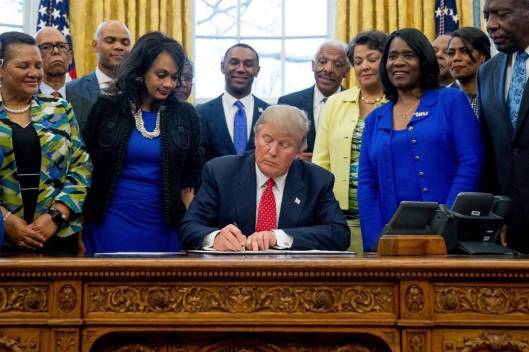
This article describes President Trump’s worsening relationship with the Congressional Black Caucus, from the cancellation of next month’s meeting to doubts about the President’s fitness to serve.

hbcu.jpgAndrew Harnik AP

Institutional Corruption and Public Trust

Tags

, , ,

“Because institutions rely on public trust to fulfill their purposes, loss of trust in institutions constitutes institutional corruption, as it harms the ability for institutions to achieve their purposes.”

This article from the Southern California Interdisciplinary Law Journal examines institutional corruption and its influence on the effectiveness of government. An aspect of institutional corruption is loss of public trust, as is highlighted in the excerp above. One might consider this as an additional consequence of President Trump’s lying, as examined in Professor Bowman’s recent posts. 

lying-trump.gif

The Rule of Law

Tags

, , , ,

Click here to read a note written by New York Bar Association President Sharon Gerstman that suggests that it is a lack of respect for the rule of law which has led to our President’s Special Investigation, and a studied respect for the rule of law which will guide it.

robert-mueller.jpgReuters/Molly Riley

Lying as an impeachable offense – Part II: Unindictable official falsehoods

Tags

, , , , , , , ,

In my last post, I noted that Mr. Trump has an historically unique propensity for falsehood and I began considering the question of whether a president can properly be impeached for lying.  In that post, I addressed the impeachability of criminally indictable forms of lying.  Here, I consider whether lies that are part of official communications with Congress, but are not indictable, can be impeachable offenses.

James Iredell, one of the first Supreme Court justices, speaking of the impeachment clauses during the North Carolina debates about ratifying the constitution, said that “The President must certainly be punishable for giving false information to the Senate.”  Although he was speaking of the particular situation in which a president was seeking senatorial approval of treaties or other foreign projects, the general principle he espoused was that the legislature as a coordinate branch of government is entitled to rely on a president’s honesty — and can impeach him if he willfully misinforms them on important matters.

There is at least one historical example of an attempt to impeach a president for lying to congress.

Article V of the proposed articles of impeachment of Richard Nixon charged concealment of the bombing of Cambodia through the creation of false military documents.  The House Judiciary Committee did not approve this article, although as I wrote some years ago, its decision not to do so:

probably resulted from a disinclination to inject the explosive politics of the Vietnam War into a case where ample ground for impeachment already existed, rather than a rejection of the principle that the Chief Executive may not intentionally deceive Congress in matters that relate to the legislature’s own constitutional duties.

In my judgment, it would be entirely consistent with the language and purpose of the impeachment clauses to impeach a president for telling congress material falsehoods on subjects that could affect legislative action.  Falsehoods of this sort could include both personal statements of the president or, as in the case of President Nixon, the submission to congress of agency testimony or reports the president knew to contain material untruths.

That said, precisely defining the types of presidential statements to the legislature that could plausibly be deemed impeachable is difficult.

Lies to congress by the president himself in a formal, official communication

The easiest case would arise if a president himself were to lie when speaking formally to congress or one of its committees in person or in writing in an effort to obtain a congressional decision on a matter where congressional action depended on the truth of the president’s statement.  This is the case Iredell and, two centuries later, the Nixon-era Judiciary Committee had in mind.

Another historical example of lies of this kind that might plausibly have been characterized as an impeachable offense would be the misstatements and omissions by President Johnson and Secretary of Defense Robert McNamara about encounters between U.S. and North Vietnamese naval vessels on August 2-4, 1964, that led to the passage of the Gulf of Tonkin Resolution and in turn to deepening U.S. involvement in the Vietnam War.

To make a long story short, in 1964, U.S. naval vessels were operating in the Gulf of Tonkin in support of South Vietnamese military operations against North Vietnamese military installations. On August 2, three North Vietnamese gunboats responded to one such South Vietnamese operation by attacking a supporting U.S. destroyer, the USS Maddox. The Maddox, in concert with U.S. aircraft, then sunk or damaged all three.  On the night of August 4, the Maddox thought it was attacked again, and responded by firing profusely at a variety of unidentified targets. There were strong indications even at the time that the August 4 “attack” was actually an overreaction to misinterpreted sonar data and that the US Navy was shooting at empty ocean.  In later years, this suspicion hardened to a virtual certainty.

Nonetheless, Secretary of Defense McNamara and President Johnson publicly characterized the events of August 2-4 as two unprovoked attacks on blameless U.S. naval vessels.  In addition to over-hyping the probably non-existent August 4 “attack,” they carefully concealed the fact that the U.S. ships came into the line of fire because they were supporting South Vietnamese assaults on the North.  President Johnson sought from Congress, and got, the famous “Tonkin Gulf resolution” which he used as legal justification for taking the U.S. ever deeper into what became the Vietnam War.

No less an authority than current National Security Advisor H.R. McMaster concluded that Johnson and McNamara “deceived the American people and Congress” about the Gulf of Tonkin incident.

This type of potentially impeachable presidential falsehood might occur in a formal written message from the president to Congress, such as the one LBJ sent on August 5, 1964.  Or it might occur in a personal address like the annual State of Union message.  There could be no doubt of the official character of either form of communication.  In the first, the president is expressly asking for congressional action.  In the second, the president’s obligation to provide a message to congress regarding the state of the union is written into Article II, Section 3 of the Constitution.

Of course, as the modern practice of “fact-checking” every presidential address has made plain, every president spins facts to his advantage at least somewhat on such occasions. It would be absurd to impeach a president for engaging in that well-understood political habit. Nonetheless, there must be some limit on presidential prevarication in official settings.  It is one thing for a president to place politically advantageous interpretations on ambiguous facts, or even to cherry-pick facts a bit to support a political argument.  It is quite another for a president to consciously misrepresent facts plainly germane to a congressional choice, or to consciously omit facts that, if revealed, might cause congress to act differently.

Lies to congress by administration agencies or officials with the president’s knowledge

A second type of potentially impeachable presidential lie to Congress occurred when the Nixon Administration submitted to Congress false reports about Cambodian bombing. There the president did not personally speak, but, at least so it was alleged, he caused or authorized his subordinates to deceive Congress on his behalf.  Again, every administration is going to try to bend the arc of truth a bit in the direction of its ideological or policy preferences, but even in this age of relativism there must be some boundary beyond which a president cannot go when authorizing official communications to a coordinate branch of the United States government.

This sort of executive branch misrepresentation could become relevant to the current administration.  For example, by law, the executive branch must, every four years, prepare and publish a “National Climate Assessment,” which is expressly designed to set out the best available science to guide congress, executive branch regulators, and state and local governments in making decisions about how to respond to the changing global climate.  Government scientists and career professionals were sufficiently concerned about whether the Trump Administration might either alter or suppress its findings that a draft was recently leaked to the press.  The availability of the draft may forestall any significant meddling with the report’s data or basic conclusions, but this is only one of many legally mandated reports and data compilations that might be subject to politically-motivated censorship.

The question – for which I confess I have no easy answer – is whether there is a type and degree of suppression or distortion of reports to Congress that would properly amount to an impeachable offense.  To constitute to an impeachable offense, such a report would certainly have to satisfy at least three requirements: (1) It would concern a matter of genuine national significance upon which Congress is required or reasonably expected to act; (2) it would contain a significant number and degree of provably false assertions of fact, and (3) the president could be proven to have known about the report and its contents and to have been aware of its essential falsity.

I will be watching the news over the coming months to see if a plausible example of this kind of presidential falsehood arises.  Suggestions from readers will be welcome.

***

In my next post, I will consider whether a president can constitutionally be impeached for unindictable, but pathological or pervasive, lying.


Rep. Cohen Introduces Articles of Impeachment

Tags

, ,

Representative Steve Cohen has stated that he intends to file his own articles of impeachment in response to President Trump’s comments following the riot in Charlottesville. Click here to read the details.

steve-cohen-trump-impeachment.jpgGetty Images