Gutiérrez Joins the Impeachment Effort

Tags

, , , , , , ,

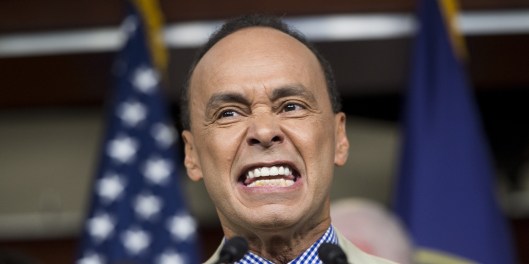
According to this article from the Hill, Representative Luis Gutiérrez is supporting a group of Democrats who intend to file new articles of impeachment against President Trump this month. This action comes at the exasperation of Minority Leader Nancy Pelosi, a critique of the premature focus on impeachment; however, Rep. Gutiérrez claims that in light of the recent indictments (talked about here) the time is right. Representative Green, who has read his own article of impeachment to the House floor, agrees that it is not necessary to wait for the results of the Mueller investigation, because “impeachment is political” not criminal.

Whether Reps. Green and Gutiérrez are correct about the timing of impeachment remains to be seen, but it seems very unlikely that talks of impeachment will be quelled anytime soon. Things in the House are hot and getting hotter.

o-LUIS-GUTIERREZ-facebook.jpg

Brief reflections about the Papadopoulos guilty plea

Tags

, , ,

In addition to the indictment of Paul Manafort and his associate Rick Gates, yesterday brought news of the guilty plea of George Papadopoulos, a former foreign policy advisor to the Trump campaign.  Some commentators have suggested that the Papadopoulos plea presents a bigger potential risk to Mr. Trump than the Manafort indictment.  I’m not sure that will ultimately prove to be true, partly because I suspect the real risk to Mr. Trump and his coterie of retainers and hangers-on lies in inquiries Mr. Mueller is, or may yet be, making into their finances.

Nonetheless, the Papadopoulos plea does suggest several points:

First, the Statement of the Offense accompanying the plea is chock full of assertions which, if true, give the lie (yet again) to the initial claims of Mr. Trump and associates that there were no contacts between the campaign and Russian interests.  It is undoubtedly correct that Papadopoulos himself was an insignificant figure in the Trump campaign universe and a complete nobody in the real world of foreign affaits.  (Indeed, the fact that the Trump campaign brought on such an utter neophyte as one of five foreign policy advisors is a shocking testament to the unwillingness of anyone of substance to associate with the campaign.)

BUT, it appears Papadopoulos was in contact with people who had genuine, if slightly attenuated, Russian government connections, people who were expressing interest not only in making general connections with Trump and his campaign, but were offering “dirt” on Hillary Clinton.  And the dangled dirt allegedly included emails which any reasonable person would have to have inferred had been obtained clandestinely and probably illegally.  Critically, Papadopoulos apparently passed all this along to very significant people in the Trump campaign – people such as Sam Clovis, the campaign national co-chair, and Corey Lewandowski, the one-time campaign manager.  If the Statement of Offense is accurate, these higher-ups encouraged Papadopoulos’s efforts, even those that obviously involved very questionable dealings with a traditionally hostile foreign power.

Second, even if everything in the Statement of the Offense is true, none of the Trump campaign’s senior officials may have committed any crime.  It is not a crime for senior members of a presidential campaign to talk with representatives of foreign governments. Indeed, if the point of the talks is to introduce the candidate and those around him to significant foreign actors and to learn about international issues relevant to the campaign and to American foreign policy, they can be laudable.  Even seeking opposition research that would appear to emanate from Russian intelligence services might not itself be criminal, even if (at least in a rational world) it would be politically poisonous if the Russian intelligence connection were revealed.  If it should ever be shown that such material was delivered, and used, more difficult legal questions would arise.  But nothing so far revealed suggests that the Papadopoulos overtures produced anything concrete.

Third, nonetheless, Mr. Papadopoulos’s fate illustrates the risk facing all the current and former Trump insiders.  They are under immense pressure from Mr. Trump and others around him to deny or minimize the extent of Russian contacts. The pressure may stem purely from Mr. Trump’s aversion to political embarrassment, rather than any fear of overt criminal liability.  But with the Papadopoulos case, Mueller’s team has served notice that it will not be lied to.  They want the whole truth, with no fudging, or felony charges will be forthcoming.

If those who haven’t yet talked to Mueller are getting, and taking to heart, competent legal advice, they will tell absolutely everything they know.  If they don’t, we can confidently expect more indictments akin to that of Mr. Papadopoulos.  The result should be that Mueller will get to the bottom of the Russian connection story.  If he does, I wouldn’t necessarily bet that the bottom line will be exposure of treasonous collusion.  The more likely outcome will be a continued slow exposure, bit by bit, of farcical bungling by unprincipled foreign policy naifs who would have committed crimes if they could, but were baulked by either their own incompetence or Russian unwillingness to deal directly with such boobs.

That said, I would not be surprised to see a significant number of Trump World inhabitants unwilling to come clean, even in the face of the Papadopoulos example. In which case more of them will go down.  And, as has so often proven the case over the years, it won’t be the underlying criminality of their flirtations with Moscow that gets them, but the cover-up.

The Manafort Indictment & Impeachment

Tags

, , , , , ,

The internet is buzzing with the news that former Trump campaign manager, Paul Manafort, and his associate, Rick Gates, have been indicted for conspiracy to defraud the United States, money laundering, and a variety of other federal crimes. Of perhaps equal significance, former Trump campaign foreign policy advisor, George Papadopoulos, pleaded guilty to making false statements to the FBI in denying contacts with Russian agents.

It is natural to wonder what effect these developments might have on a potential impeachment case against Mr. Trump.  Nonetheless, perhaps the main point to keep firmly in mind is that it is far too early even to make informed speculations on that ultimate point.  For the moment, I’d offer only these tentative observations:

First, as a former federal fraud prosecutor, I am impressed with the speed at which the Mueller investigation is moving.  The Manafort / Gates indictment describes a very complex set of international and domestic transactions.  Cases like this commonly take years to put together.  Mueller’s team sewed up this first indictment in five months.

Second, I’m also impressed with the apparent solidity of the case against Manafort and Gates.  Defense counsel will have their say, but on the face of it, this is a stout case.  It is very hard to see how Manafort and Gates beat this.

Third, the charges are very serious.  Manafort in particular is facing serious prison time.  It is, of course, a fool’s game to predict what sentence a white collar defendant will ultimately receive, but the Federal Sentencing Guidelines provide at least a yardstick for the kind of sentence a judge would consider upon conviction.

A reasonable guesstimate of the guidelines calculation for Manafort would put him at over ten years in prison.  A glance at the indictment suggests that the money laundering guideline would probably drive the calculation.  That guideline, 2S1.1, is notoriously tricky, but one could reasonably, if not certainly, assume a base offense level of 8  + 20 levels from 2B1.1 for $18 million laundered.  If you add 2 for 3C1.1 obstruction (false statements) and 4 for aggravating role under 3B1.1, that yields an offense level of 34.  Which equates to a guideline range of 151-188 months, or 12 ½ to 15 ½ years.  There are a variety of other factors that could push this number up or down considerably, and judges are not obliged to sentence within the guideline range, but as I say, Mr. Manafort and his attorneys will certainly have to take the guidelines as a serious benchmark of the kind of sentence an ill-disposed judge could impose.

Fourth, many commentators have observed that the point of indicting Manafort and Gates first is to pressure them into cooperation against others, potentially including Mr. Trump. Without presuming to read the minds of Mr. Mueller and his colleagues, this seems a reasonable hypothesis.  That said, it is interesting that Manafort and Gates let themselves be indicted rather than working out a pre-indictment plea agreement as Mr. Papadopoulos apparently did.  This is not to say that Manafort and Gates will never “flip,” but it does mean that they are resisting for now, and could persist in refusing cooperation no matter what happens.  At a minimum, Mueller may have to go to trial and convict one or the other or both before they agree to cooperate.  Which could take a long time.

Fifth, the subject matter of the Manafort / Gates indictment is not collusion of the Trump campaign with Russia. Rather, it is Mr. Manafort’s sleazy, but very lucrative, relationship with corrupt Ukranian politicians. Of course, Mr. Trump and his supporters have already been quick to note the absence of a “collusion” angle in this indictment.  But what I find interesting, and very suggestive, is that the indictment makes a point of describing the Ukranian group paying Manafort as pro-Russian.  Legally, that point is irrelevant.  Politically, it has two obvious points: It helps rebut any claim that, in indicting Manafort, Mr. Mueller’s team is going beyond the scope of its charge, which is to investigate Russian efforts to influence the American election and any collusion by the Trump campaign with those efforts.  If challenged, Mueller can point out that Manafort, Trump’s campaign manager, had a long history of dodgy, and in some respects criminal, connections with a pro-Russian party in a former Soviet republic, a point plainly relevant to the larger investigation.

My second, and far more speculative, reaction to the indictment’s pointed insistence on the Russian connection is that it is a direct signal to those around Mr. Trump who have Russian connections, but have not yet faced indictment — don’t get comfortable, we’re coming for you.

Finally, the other message in this indictment that I suspect is sending chills down the spines of Mr. Trump and many of his associates and family members stems from the nature of the charges themselves.  This indictment demonstrates both the incredibly broad reach of the federal criminal law in the area of financial crime and the professional competence of Mueller’s team.  Mr. Trump, his family, and retainers may not have engaged in the precise forms of financial shenanigans revealed in this indictment, but given Mr. Trump’s long history of skating on or over the edge of legality, it would be surprising indeed if at least some had not infringed on federal criminal law in analogous ways.

With the Manafort indictment, Mueller and his team have sent a blunt warning.  If the Trumps have financial skeletons, they will be found.

Frank Bowman

The Collusion Case Grows Stronger

Tags

, , , , , , , , , ,

This article, from the New York Times, reports that evidence of collaboration between the Russian lawyer, Veselnitskaya, and high ranking Russian officials has surfaced. Ms. Veselnitskaya met with Donald Trump Jr., Jared Kushner, and Paul Manafort last year at the Trump Tower, and the meeting was the subject of some scandal (more can be read about that here). However, Veselnitskaya has claimed to be an independent actor, which helped to undercut talks of collusion. That is until now.

Evidence shows Ms. Veselnitskaya may have been collaborating with Russian prosecutor general, Yuri Chaika. The talking points which Ms. Veselnitskaya brought to the meeting incorporate language from a memo Mr. Chaika had given to an American Congressman two months earlier, and there is evidence that Veselnitskaya had discussed her meeting with Chaika in the months proceeding it. Additionally, Veselnitskaya has a history of collaboration with Chaika.

If it can be established that Ms. Veselnitskaya was, in fact, an agent for the Russian government, then the allegations of Russian collusion will be strengthened. Though she did not meet with the President himself, she met with his family and advisors, and so the talk could be characterized as a meeting of agents.

veselnitskaya.jpgMartyanov — Getty Images

Foreign Emoluments, the President & Professor Tillman

Tags

, , , , , , ,

By Frank Bowman

Impeachment aficionados will be aware that a group calling itself Citizens for Responsibility and Ethics in Washington (CREW) has filed suit in the Southern District of New York seeking a declaration that Mr. Trump’s copious and lucrative business transactions with foreign governments and entities violate the Foreign Emoluments Clause of Article I, Section 9, which reads as follows:

No Title of Nobility shall be granted by the United States: And no Person holding any Office of Profit or Trust under them, shall, without the Consent of the Congress, accept of any present, Emolument, Office, or Title, of any kind whatever, from any King, Prince or foreign State.

Leaving to one side the question of whether the CREW plaintiffs have standing to bring the action, the central dispute is whether money paid to a president as a result of commercial transactions is a prohibited emolument.

As discussed on this site earlier in the year, Seth Barrett Tillman, an industrious professor from the National University of Ireland – Maynooth, has opened a second front in the emoluments battle with his claim that the foreign emoluments clause doesn’t apply to the president, or indeed to any elected federal official such the vice-president or members of congress.  In recent weeks, Professor Tillman has won two victories, one minor and another potentially less so.

His petit coup, recounted in a recent New York Times article, involved a dispute over the provenance of certain documents allegedly signed by Alexander Hamilton.  To make a long story short, in 1792, the Senate asked Hamilton, then the Secretary of the Treasury, to provide a list of all salaries and emoluments of “civil offices under the United States.” In a letter, Hamilton provided a list that included executive branch appointees, but not the president or vice president. Prof. Tillman contends that this letter is proof that Hamilton believed that the president is not a “person holding any Office of Profit or Trust under [the United States]” for purposes of the foreign emoluments clause.

You may think that this is a pretty thin argument (and as discussed below, it is), but a group of distinguished legal historians led by Professor Jed Shugerman who rejected Tillman’s interpretation in their amicus brief made an embarrassing mistake.  They pointed to a later 1793 document in government archives which does list the president and vice-president as holding civil offices under the United States and which appears to bear Alexander Hamilton’s signature.  They trumpeted this second document as conclusive disproof of an important prong of the Tillman position, only to have Tillman show that the second document almost certainly was not signed by Hamilton, but by some anonymous government functionary. Red faces abounded.  And the legal historians (very graciously) issued apologies for impugning the integrity of Tillman’s archival research.

Professor Tillman’s potentially more significant victory came in a letter from the Department of Justice to the judge in the CREW lawsuit in which DOJ stated that it is not conceding that the Foreign Emoluments Clause applies to the president.  This is notable because the Department’s position has traditionally been to the contrary, as most recently embodied in a 2009 memo from the Office of Legal Counsel opining that the president is “surely” covered by the clause.  So far, the Department has not reversed its 2009 opinion or affirmatively pressed the claim of presidential exemption, but the letter opens that possibility.

So does Tillman have a good argument?

In a word, no.

Tillman’s claim that the Foreign Emoluments Clause doesn’t include the president is based on two doubtful premises.

First, he contends that the phrase “office of profit or trust under [the United States]” doesn’t include the president because, he says, in English practice, the phrase “office under the Crown” referred not to the King or to elected offices, but only to appointed offices whose authority derived from the appointing hereditary sovereign.  But in the United States, the sovereign is not the president, but the people as a whole, or if one wants to take a strongly federalist view of the matter, the union of states represented by the elected central government.  All American officeholders — including the president — hold office “under the United States” because they derive authority from, and are not the sources of, the general government’s democratically legitimated sovereign power.

And even if this were not self-evidently the case, there is no plausible founding-era evidence that the drafters or ratifiers of the constitution viewed the phrase “office of profit or trust under” the United States in Professor Tillman’s peculiarly Anglophile sense.  Indeed, as the legal historians noted, the only direct expression of opinion by constitutional founders expressly endorses the view that the president is covered by the Foreign Emoluments Clause. During the Virginia ratifying convention, Edmund Randolph and George Mason plainly stated that presidents are bound by the clause, and Randolph, who would become Washington’s attorney general, went further to declare that a president who received foreign emoluments could be impeached for doing so.

The sole statement from a founding-era figure to which Tillman can point is the Hamilton response to the Senate inquiry.  But, as the legal historians convincingly explain, the Senate was asking for an accounting of “civil offices” and their salaries for a particular reason.

The request came in 1792, at the end of President Washington’s first term and towards the close of the second session of Congress. The term “civil offices” is distinct from the phrase in the Foreign Emoluments Clause (“office of profit or trust under [the United States]”), but matches the language of Article I, Section 6:

No Senator or Representative shall, during the Time for which he was elected, be appointed to any civil Office under the Authority of the United States, which shall have been created, or the Emoluments whereof shall have been encreased during such time; and no Person holding any Office under the United States, shall be a Member of either House during his Continuance in Office.

The most plausible explanation for the Senate request is that the Senate wanted to know which “civil offices” federal legislators would be barred from accepting, and which offices those standing for election to Congress for the first time in 1792 would be obliged to surrender if elected.  The presidency, being elective rather than appointive and thus irrelevant to the point of the inquiry, Hamilton did not include it.  What we can be absolutely sure of is that the Senate did not ask for, and Hamilton did not give, an opinion on whether the president is covered by the Foreign Emoluments Clause.

Before moving to Tillman’s next point, it is worth pausing on Article I, Section 6, to consider one of the many unpalatable implications of his theory.  If he is right and the phrase “office under the United States” does not include the president, then Article I, Section 6, does not bar the president from serving as a member of Congress while also serving as president. Which is ridiculous inasmuch as it would utterly destroy the constitution’s separation of powers.  But it is the unavoidable implication of Tillman’s argument that the framers used “office under the United States” as a term of art excluding the president.

Second, and this is the real meat of Tillman’s argument, he points to a handful of incidents in which early American presidents accepted ceremonial gifts from foreign governments or their representatives.  Washington accepted a key to the Bastille from the Marquis de Lafayette and from Louis XVI a portrait of that ill-fated monarch. Jefferson accepted a bust of Czar Alexander I.  Madison accepted a pair of pistols from a South American revolutionary, which he apparently passed on to his successor, James Monroe.  Tillman argues that these gifts prove that Washington, Jefferson, Madison, and Monroe all believed that the Foreign Emoluments Clause didn’t apply to the president, and he contends that these early incidents outweigh the roughly two centuries of subsequent practice in which both presidents and congress expressly recognized the applicability of the clause to the presidency.

Professor Tillman is deadly earnest in professing the interpretive importance of these incidents, but the moment one takes a deep breath and steps back to gain perspective, it’s plain that there’s little substance to the argument.  In the first place, as I wrote several months ago:

After all, the point of the [Foreign Emoluments] clause was to prevent foreign powers from seducing American officials away from their proper loyalties with valuable bribes.  The idea that anyone gave a moment’s thought to the idea that Washington or Jefferson would sell out the country because of a rusty old key or the marble visage of a member of the notoriously unattractive Russian royal line is just silly.  Accordingly, it is entirely unsurprising that Washington and Jefferson accepted the objects as a matter of courtesy and quite unlikely that anyone even thought about constitutional ramifications of doing so.

But the more important, and I think dispositive, point is this: If Tillman is right, then the framers wrote into the constitution a provision that would prohibit, say, the U.S. ambassador to France from accepting a jeweled snuff box from the French government, but would allow the King of France to award the President of the United States a title of nobility accompanied by a grant of land and revenues.  According to Tillman, King Louis XVI, rather than sending George Washington a portrait, could have tried to secure U.S. opposition to the Revolution of 1789 by declaring Washington the Duc de Haiti entitled to a percentage of the French crown’s revenues from that rich, sugar-producing colony.  Or George III of England could have begun the process of seducing America back into the British orbit by bestowing on Vice President Aaron Burr (a man notoriously open to extra-curricular peculation) the title of Baron of Barbados, with ownership of several large and lucrative sugar plantations.

These hypotheticals sound absurd to modern ears, but the problem of divided loyalties and overt corruption created by awards of foreign titles, lands, and revenue to heads of state and powerful notables was endemic to Europe from the Middle Ages through the 18th Century and would have been intimately familiar to the framers.

For centuries, English kings held French titles of nobility which, depending on the period, gave them French lands, which they held as feudatories of the French king, or even claims on the French crown.  Untold thousands of Englishmen and Frenchmen died in the wars fought over those territorial and dynastic claims. George III, the boogieman of the revolutionary generation, was simultaneously King of England, King of Ireland, and Duke and prince-elector of Hanover. And English critics were always troubled by the disposition of kings of the Hanoverian line to be drawn into German intramural squabbles. Phillip II was at various points King of Spain, Portugal, Naples, and Sicily, and Duke of Milan and lord of the seventeen provinces of the Netherlands. His far-flung dynastic commitments and devout Catholicism were the impetus for decades of near-constant warfare.  Endless additional examples could be cited, but the point is that the last thing the American framers would have wanted is an elected chief executive whose judgment might be distorted by enjoyment of an hereditary title or estate granted by a foreign power.

The even more acute problem that plainly concerned the founding generation was the seduction of both heads of state and lesser notables by rewards (or bribes, depending on your point of view) from foreign powers.  The practice was such a common aspect of European diplomacy as to scarcely merit remark on that side of the Atlantic. For example, the English Duke of Marlborough, Winston Churchill’s famous ancestor, was rewarded for his military successes with the title of Prince of the Holy Roman Empire and Prince of Mindelheim (a German principality). The entire European ruling class was entangled in a web of conflicting loyalties.

The American founders not only rejected hereditary aristocracy as a feature of the American future, but recoiled from the prospect of royal briberies.  In their brief, the legal historians note that Gouverneur Morris expressly cited the secret 1670 Treaty of Dover in which the King of England was induced to join France in its war against Holland both by providing him with a French mistress and paying him large sums to eliminate his debts.  Said Morris:

Our Executive was not like a Magistrate having a life interest, much less like one having an hereditary interest in his office. He may be bribed by a greater interest to betray his trust; and no one would say that we ought to expose ourselves to the danger of seeing the first Magistrate in foreign pay, without being able to guard agst. it by displacing him. One would think the King of England well secured agst. bribery. He has as it were a fee simple in the whole Kingdom. Yet Charles II was bribed by Louis XIV.

Morris was not discussing the foreign emoluments clause, but the passage reveals the founders’ acute awareness of the dangers of foreign payments to a head of state.  And it casts a revealing light on Professor Tillman’s primary defense against the practical absurdity of his position.  Tillman contends that it would have made sense to the framers to exclude the president from the foreign emoluments clause because a failure to do so would subject the country to diplomatic embarrassments attendant upon a constitutionally-mandated policy against the common European practice of accepting token diplomatic gifts.  But the whole point of the Foreign Emoluments Clause was to set the United States on a new path, free of the endemic corruption of European practices of the time.  To suggest that a fear of transitory diplomatic embarrassment would move them to gut this objective by permitting the most powerful officers of the United States to accept foreign titles and money is, frankly, absurd.

In the end, Professor Tillman deserves the respect due a diligent and inventive controversialist.  But his argument cannot stand up to serious examination.
Senators Corker & Flake and the meaning of “high Crimes & Misdemeanors”

Tags

, , ,

I begin this post with apologies to the regular readership for my prolonged absence from the blog.  For the past several weeks, I’ve been away receiving and recovering from a surgery that has knocked me sideways a bit. My invaluable research assistant and blog co-editor, Sam Crosby, has been filling in, doing yeoman service posting articles and developments of interest, for which I can’t thank him enough.  But I’m back at the old stand and ready to pick up where I left off.

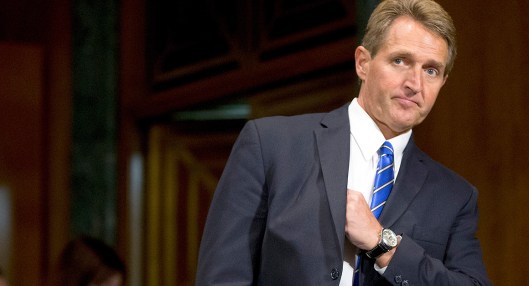
For the politically attuned, among the biggest stories of the last few weeks has been the open break between Mr. Trump and Senators Jeff Flake (R. Ariz.) and Bob Corker (R. Tenn.).  In the endless, bewildering swirl of abnormality our national life has become since Inauguration Day, it is easy to underestimate the utter uniqueness of what Flake and Corker have done.  It is not merely that they have criticized a president of their own party.  Sharp, even bitter, senatorial criticism is hardly unheard of.  Senator Ted Kennedy’s feud with President Jimmy Carter was acrimonious and personal.

But Flake and Corker have gone far beyond even the most heated disagreement on policy or political strategy.  Both of them have said, about as plainly as it is possible to say, that Donald Trump is unfit for the presidency and represents an immediate danger to American national security.  Neither man is either a hothead or politically estranged from mainstream conservative Republicanism.  Neither has so far voted against any legislative priority of the Trump Administration.  Indeed, at any point in the previous thirty years, either might have been held up as the very beau ideal of the solidly conservative Republican lawmaker. And yet both have said that the Republican president is an active danger to the Republic. If there is a historical parallel, I don’t know of it.

A number of commentators have taken the two apostate senators to task for failing to take any concrete action in opposition to Mr. Trump, noting that they have been and largely continue to be reliable supporters of Mr. Trump’s legislative priorities. Other commentators have suggested that the two should be pressing for legal constraints on Trump’s impulsivity, such as requiring congressional approval of a nuclear first strike.  In the end, I think such criticisms miss the mark.

Senators Corker and Flake can hardly be criticized for failing to oppose a legislative agenda with which they largely agree.  And perhaps they should be actively exploring legislative means of fencing in Mr. Trump’s wilder urges.  But the real shortcoming of their admirably forthright denunciations of Mr. Trump is that they fail to follow their own premises to the only logical conclusion — if, as they passionately claim, the White House is occupied by a man who presents a clear and present danger to the country, then the only effective remedy is removal of that man from office.  In short, impeachment.

It is hardly surprising that neither senator has been willing to go so far.  But it may be worth considering why they have not.  The most obvious, and most likely, reasons are that neither man feels that so seemingly radical a step would have any chance of success and both doubtless believe that calling for it would make them pariahs in their own party.  That said, I suspect that they are also forestalled by the conventional wisdom that “merely” being unfit and behaving in ways that are dangerously unsuitable for the office of the presidency is not an impeachable offense.  Absent concrete proof of a discrete “crime” intuitively recognizable as a “high Crime or Misdemeanor,” the senators may see no constitutional path forward.

I’ve been giving a good deal of thought to this problem in recent weeks.  I have concluded that the conventional wisdom is wrong.  I believe that it would be perfectly appropriate, and consistent with both originalist and more progressive approaches to constitutional interpretation, to impeach and remove a president if, by temperament and conduct, he proves himself unfit for office.  Sometime over the next few days, I hope to lay out the case for this view.

Stay tuned.

Frank Bowman

The Significance of Flake’s Retirement

Tags

, , , , , , , ,

Senator Jeff Flake announced on Tuesday that he will not be seeking reelection, and this article, from Politico, says that could be good for the Republican party. Flake is a loud critic of President Donald Trump, and that hasn’t not won him friends in the electorate: he hasn’t gained Independent or Democratic votes, and has alienated Republicans in the process.

So, what does this mean for impeachment? It goes back to yesterday’s discussion of Trump’s relationship with the Senate. If Trump’s dissenters are pushed out of Congress, then impeachment chances suffer. It may be that the President will have to do something particularly egregious to make enough enemies in Congress for impeachment to become an actuality.

160729-jeff-flake-ap-1160.jpgAP Photo

Trump’s Relationship with Republicans

Tags

, , , , , , ,

This article, from the Washington Post, elaborates on President Trump’s relationship with Republican senators, in light of a feud he had with Senator Corker over the tax code. The author references Trump’s shaky relationship with Republicans in general, citing specifically the tension Trump has had with Senate Majority Leader Mitch McConnell. However, amongst references to Trump’s spat with Republican senators, the article sprinkles in quotes from senators who are eager to hear Trump speak.

Whether President Trump has Republican support is an important question. Conviction in the Senate requires a 2/3 majority. However, I am not convinced that President Trump’s relationship with Republican senators is in fact a bad one overall. His attacks on McConnell make sense, since Trump protrays himself as an establishment busting populist, and McConnell represents the establishment. And his odds of support in the Senate may be improving. Sen. Corker is not seeking reelection, and meanwhile populist candidates are lining up to join the legislature. Therefore, it is far from clear that President Trump is going anywhere anytime soon.

corker-trump-rt-jef-171009_12x5_992.jpgJoshua Roberts/Reuters

Sherman’s Articles of Impeachment

Tags

, , , , , ,

Here you can find the text of Representative Sherman’s resolution to impeach President Trump for obstruction of justice. The resolution reads like a criminal indictment: it is short, focused, and clearly establishes the President’s mental state at the time of the firing of  James Comey.

Sherman was the first representative to offer articles of impeachment in the House, and their success may depend on the pending investigation of Special Counsel Robert Mueller.

RTSPVFU-e1497296257644.jpgREUTERS/Joshua Roberts

Cohen’s Objection to Trump

Tags

, , , , , ,

Here you can find the text of Rep. Cohen’s resolution which objected to the conduct of President Trump. Amongst the complaints listed in the resolution are Trump’s refusal to release his tax returns, potentially unfair international dealings relating to the Trump brand, communications with Russia, the firing of James Comey, his allegations of wiring tapping, his travel ban, feuding with the media, and other flagrant international communications.

Rep. Cohen has also expressed his intention to introduce articles of impeachment in the next upcoming months. An article summarizing Cohen’s position on impeachment can be found here.

1060x600-4574142ef6512a969da27342a8079ec7.jpg