• Home
  • Mission of This Site
  • Contact

Impeachable Offenses?

~ The Use & Abuse of Impeachment in the 21st Century

Impeachable Offenses?

Category Archives: Uncategorized

A Deeper Conspiracy: Saudi Arabia and the United Arab Emirates Enter the Mix

20 Sunday May 2018

Posted by crosbysamuel in Articles, Uncategorized

≈ 3 Comments

Tags

Conspiracy, defraud, Donald Trump Jr., Election, george, impeach, investigation, israel, joel, manipulation, nader, russia, saudi arabia, social media, trump, united arab emirates, zamel

The New York Times reports that Donald Trump Jr. met with George Nader, an emissary for the princes of Saudi Arabia and the United Arab Emirates, and Joel Zamel, an Israeli social media specialist, 3 months before President Trump’s 2016 election. Supposedly, the main purpose of the meeting was to develop relationships among the parties, but there was also discussion of the potential for social media manipulation on behalf of the Trump campaign. Nader and Zamel met with the Trump team again after he was elected. These meetings are being investigated by the FBI.

The question which may spring to one’s mind is whether this meeting could constitute further conspiracy to defraud the United States. This question has been analyzed thoroughly by Professor Bowman in the context of the Russian Lawyer Meeting. The crime is composed of two basic elements: 1) an agreement to 2) defraud the United States. The United States can be defrauded of its right to a fair and honest election, and we will assume for the sake of this post that the manipulation of social media constitutes such a fraudulent taking (though that may in fact be a gray area). So what is left to be examined is whether the meeting between Trump Jr., Nader, and Zamel constitutes an agreement.

Though we have no direct evidence of an agreement, a conspiracy may be established, at least in the context of antitrust, by parallel behavior accompanied by certain “plus factors” (those which add to the circumstantial possibility of agreement).  What we know is that Nader paid Zamel $2 million after President Trump was elected, the reason for which is unclear. We also know that Trump recently abandoned the Iran Nuclear Deal, a position Nader was known for advocating. This is probably not enough to establish a conspiracy, but perhaps further investigation will reveal more. There is also some evidence of ties between Nader and Zamel and Russia. Though it is very unclear as of yet, we may be dealing a conspiracy much larger than we first imagined.

20DC-INVESTIGATE-nader-superJumbo-v2.jpgRon Sachs/Picture-Alliance, via Associated Press

Share this:

  • Share on X (Opens in new window) X
  • Share on Facebook (Opens in new window) Facebook
Like Loading...

Trump won’t be Indicted

17 Thursday May 2018

Posted by crosbysamuel in Articles, Uncategorized

≈ 1 Comment

Tags

Congress, Impeachment, indicment, investigation, Mueller, president, report, rudolph giuliani, trump

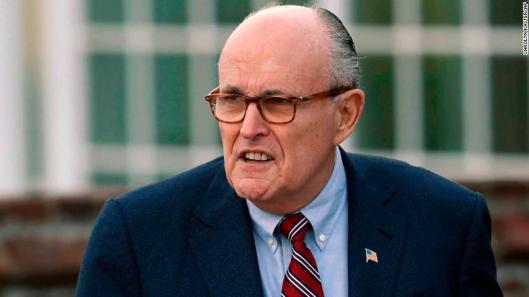
Rudolph Giuliani claims that he has it on good authority that Mueller will not indict President Trump; and the Washington Post says that there is good reason to believe him, because the Justice Department guidelines say that he can’t.  This question has been examined by Professor Frank Bowman on this blog; and he pointed out that the question, as far as Mueller goes, is not whether an indictment will occur, but whether Mueller will recommend that Trump be indicted. Bowman proposed that this recommendation may come in two forms; that Trump be indicted after his presidency, or that he be indicted immediately. The latter recommendation, even if doomed to fail, will potentially have the same effect as the former recommendation: Mueller’s report will reach Congress and lead to impeachment.

180503095830-01-rudy-giuliani-file-exlarge-169.jpgCarolyn Kaster, AP


Share this:

  • Share on X (Opens in new window) X
  • Share on Facebook (Opens in new window) Facebook
Like Loading...

Video

Why Being a Dreadful President Is an Impeachable Offense: A (mostly) dispassionate analysis

15 Tuesday May 2018

Posted by impeachableoffenses in Uncategorized

≈ 3 Comments

Tags

American Constitution Society, Being Dreadful President Is Impeachable Offense, Frank Bowman, Impeachment lecture

In April 2018, Professor Frank Bowman gave this lecture sponsored by the University of Missouri Chapter of the American Constitution Society explaining the impeachment clauses of the Constitution, the historical precedent for their use in the cases of Presidents Andrew Johnson, Richard Nixon, and Bill Clinton, and a view of impeachment as an essential tool in the case of a president who consistently violates legal and behavioral norms essential to the preservation of American constitutional order.

ACS Impeachment Video

ACS Impeachment Video

Share this:

  • Share on X (Opens in new window) X
  • Share on Facebook (Opens in new window) Facebook
Like Loading...

Greitens’ Criminal Case Dismissed: Be Careful What You Wish For…

14 Monday May 2018

Posted by impeachableoffenses in Uncategorized

≈ Leave a comment

Tags

Eric Greitens, Governor Greitens, Greitens criminal case, Greitens criminal case dismissed, Greitens impeachment, Greitens invasion of privacy

By Frank Bowman

Never a dull moment here in Missouri.  This afternoon brings the news that, on the third day of jury selection, St. Louis Circuit Attorney Kim Gardner has moved to dismiss the invasion of privacy prosecution against Governor Eric Greitens.  This is, at least in theory, what is a called a dismissal without prejudice, meaning that the case can be refiled.  And Ms. Gardner says she will seek to refile.

The stated reason for the dismissal is that the defense named Ms. Gardner as a defense witness, and the trial judge allowed them to do so.  Ms. Gardner claims that she cannot proceed with the trial in a situation where her subordinates would be in the position of cross-examining her.

Ms. Gardner says she is considering either seeking a special prosecutor to handle the case or refiling and asking one of her assistants to lead the prosecution.

I haven’t yet thought through the validity of Ms. Gardner’s assertions about her ethical position.  I may have some thoughts on that later.

For the moment, I have a sneaking suspicion that Governor Greitens’ trial team has been too clever by half, at least if their objective is to preserve Mr. Greitens in the governor’s office.  My own necessarily tentative assessment of the invasion of privacy criminal case has been that it’s a very tough one for the prosecution in the absence of the photograph, or at least forensic evidence that a photograph once existed.  From what can be gleaned from press reports, the government had neither the picture nor any circumstantial forensic evidence. Thus, the state’s entire case rested on the credibility of the victim, who, according to her own statement, was blindfolded at the time the supposed picture was taken. And the state had to prove its case beyond a reasonable doubt and secure votes of guilty from every juror.

Therefore, while the state could have won (and may yet win) this trial based purely on a favorable jury assessment of the victim’s credibility, my money would have been on an acquittal or at most a hung jury.  Politically, either is a great outcome for Greitens.

But the aggressiveness of trial counsel has just deprived the governor of a reasonably likely legal win.  Instead, the criminal trial will either never happen or will be delayed for months by further legal wrangling.  In the meantime, the action shifts to the legislature’s special impeachment session, where the governor is saddled by multiple handicaps:

  • The charges in the legislature probably won’t be limited to invasion of privacy, with the inherent weakness of the absence of the photo.  As noted in an earlier post, if one believes the former mistress victim, Mr. Greitens also arguably committed one or more forms of felony sexual assault.  And, of course, there are now allegations of campaign finance violations.
  • Even if the impeachment case were limited to allegations about Mr. Greitens’ encounters with his mistress, the report of the House special committee on that matter indicates plainly that the committee members unanimously believe her, not him.
  • The burden of proof in impeachment is lower than the “beyond a reasonable doubt” standard of criminal cases.  And those seeking impeachment don’t need a unanimous verdict.
  • The legislators, even in Greitens’ own party, seem not to like him.  The Republicans in particular plainly think he is a political millstone.  And unlike jurors, they can’t be challenged for political bias or for prejudging the case.

It sure looks to me like the governor’s lawyers have outsmarted themselves.

Share this:

  • Share on X (Opens in new window) X
  • Share on Facebook (Opens in new window) Facebook
Like Loading...

Impeachment in the States: Missouri Governor Edition, Part 11 (More on suspension after impeachment)

09 Wednesday May 2018

Posted by impeachableoffenses in Uncategorized

≈ Leave a comment

Tags

Eric Greitens, Governor Greitens, Greitens conviction, Greitens impeachment, Missouri constitution, Suspension of Governor Greitens

By Frank Bowman

Jason Hancock, a diligent reporter from the Kansas City Star, alerted me to a Missouri constitutional provision that kicks up even more dust on the question of whether Governor Greitens could be suspended from office following impeachment by the House, but before conviction by the panel of seven “eminent jurists” appointed by the Senate.

Article IV, Section 11(a) of the Missouri constitution states:

On the death, conviction or impeachment, or resignation of the governor, the lieutenant governor shall become governor for the remainder of the term.

Candidly, this language is almost impenetrable.

It says that the Lt. Gov takes over for “the remainder of the term” upon “the death, conviction or impeachment, or resignation of the governor.”  But it is entirely unclear about what “conviction or impeachment” means.  “Impeachment” could mean just a vote by the House on articles of impeachment, which is usually the technical meaning of that term.  But that can’t be right in this context because that would mean that the Lt. Gov. becomes the governor, and stays governor until the end of the term, as soon as the House votes and regardless of what the judges do.

Which leads one to think that the drafters intended “impeachment” in this context to mean completion of the whole process – the House vote and then the “eminent jurist” vote.

But if so, that leaves unexplained the word “conviction” in the odd phrase “conviction or impeachment.”  Does conviction here refer solely to the impeachment setting and thus to the verdict of the eminent jurists?  That would make logical sense, but it makes no grammatical sense because of the word “or” connecting conviction with impeachment.  In other words, one cannot have an impeachment conviction without first having a House impeachment vote, but one can have a separate criminal conviction regardless of whether there is an impeachment proceeding.

In which case, does conviction refer to some kind of conviction independent of an impeachment proceeding?  But that makes no sense because the term “conviction” doesn’t seem to have a definition.  Presumably, outside of the impeachment context it would have to refer to a criminal conviction.  But absent any other qualifier, it would include every kind and degree of criminal conviction from murder to jaywalking.  And that can’t be right.

Here’s my best guess:  The sensible way to read this is that the governor stays governor until the impeachment process – House vote and judge vote – produces a final result.  At which point, if the governor is impeached and convicted, the Lt. Governor takes over as governor for the remainder of the governor’s term.  But this sensible reading is not necessarily required by the text.

In addition, as explained in my last post, the governor could be suspended from exercising his official powers in the interval between the House impeachment vote and judicial vote on the articles of impeachment if the “eminent jurists” vote to suspend him.  Presumably, the Lt. Governor would take over the powers of governor during the suspension, to return them if the governor were acquitted, but keep them until the end of the governor’s term if the governor were convicted.


Share this:

  • Share on X (Opens in new window) X
  • Share on Facebook (Opens in new window) Facebook
Like Loading...

Impeachment in the States: Missouri Governor edition, Part 10 (Suspension after impeachment)

09 Wednesday May 2018

Posted by impeachableoffenses in Uncategorized

≈ 1 Comment

Tags

Greitens impeachment, Moriarty impeachment, suspension of governor after impeachment

By Frank Bowman

I have been asked by several media outlets about what happens in the period after a state official is impeached by the House of Representatives, but before the matter is tried by the “seven eminent jurists” appointed by the Senate.  So here’s the scoop:

There is a Missouri statute that purports to automatically suspend a state officer upon impeachment by the House, RSMO 106.050.  However, in a 1994 decision involving the impeachment of Missouri Secretary of State Judith Moriarty, the Missouri Supreme Court found that suspension cannot be automatic.  Rather, the judges charged with trying the impeachment can, but need not, vote to suspend the impeached officer during pendency of the impeachment proceedings.

To be candid, I find this decision quite peculiar.  The statute is plainly meant to mandate automatic suspension.  It makes no reference to a discretionary choice by the judiciary panel charged with trying impeachments. Nor does it state or imply that some kinds of impeachable offenses merit suspension while others do not. Yet the Moriarty decision necessarily means that there are suspendable and non-suspendable offenses, and does so without specifying how one would tell the difference.

Some indication of the court’s thinking on the latter point can be gleaned from this passage in the opinion:

Here, the offense alleged went to a claim of misconduct regarding the core responsibilities of the office of the Secretary of State, certification of a candidate for public office. Here, also, a general election was scheduled to occur prior to the trial of impeachment. The charges cast doubt as to the ability of Ms. Moriarty to properly carry out her supervisory responsibilities. There was no possibility of clearing away that doubt until after Ms. Moriarty’s impeachment trial was completed. This was a matter of such unique importance and sensitivity that suspension pending trial was required to uphold the sanctity of our election process.

The court seems to say that suspension is warranted in a case where the nature of the charges “cast[s] doubt as to the ability of [an officeholder] to properly carry out” the responsibilities of office.  But that is, at best, a political judgment, and a highly speculative one at that.  Yet this is the same court that in its later decision convicting and removing Secretary of State Moriarty piously declared that, “this Court must assume that our role is as a court, not as a substitute political body.”

Regardless, for the present it appears that, should Governor Greitens be impeached, he would continue to exercise his gubernatorial powers until such time as the panel of eminent jurists appointed by Senate voted to suspend him.

Share this:

  • Share on X (Opens in new window) X
  • Share on Facebook (Opens in new window) Facebook
Like Loading...

Michael Cohen cashes in…. Somewhere Robert Mueller smiles

09 Wednesday May 2018

Posted by impeachableoffenses in Uncategorized

≈ 7 Comments

Tags

AT&T, Essential Consultants, Michael Cohen, Novartis, Trump's lawyer, Vekselberg

By Frank Bowman

I have been extremely reluctant to speculate about whether the investigations by Special Counsel Robert Mueller and other federal law enforcement authorities will produce results that could present a real danger to the Trump presidency.  I retain that reluctance.  But tonight’s reports that over the past year or so multiple corporations, including one associated with Russian oligarch  Viktor Vekselberg, deposited large sums in an account held by a shell company controlled by Michael Cohen, Trump’s personal lawyer, have a different feel than anything that’s come before.

In sum, Cohen created a company called Essential Consultants LLC.  One or more bank accounts in the name of that company were used to make the 2016 hush payment to “adult entertainer” Stormy Daniels.  In addition, during 2017 and early 2018, the same account(s) received the following deposits:

  • $500,000 from Columbus Nova, an investment firm in New York whose biggest client is a company controlled by oligarch Viktor Vekselberg, a Putin associate who recently became the subject of American sanctions.
  • Roughly $400,000 from Novartis Investments S.A.R.L., a subsidiary of Novartis, the multinational pharmaceutical company Switzerland.
  • $150,000 from Korea Aerospace, which “has partnered with the American defense contractor Lockheed Martin in competing for a multibillion-dollar contract to provide trainer jets for the United States Air Force that is expected to be awarded this year.”
  • $200,000 from AT&T

Columbus Nova claimed that the money was for an investment consulting arrangement commenced shortly after the Trump inauguration, but later terminated.

AT&T has said that, “Essential Consulting was one of several firms we engaged in early 2017 to provide insights into understanding the new administration,” adding that, “[t]hey did no legal or lobbying work for us, and the contract ended in December 2017.”

There are two important threads here.

First, this presents perhaps the first link between a very close Trump associate and a high-level Russian actor where the connection is not merely a meeting or solicitation with debatable objectives and uncertain results. The money is real and undeniable, and not even Russian billionaires pay people half-a-million dollars without some expectation of return on the investment.  Exactly what the money was for remains to be seen, but it will have to be explained.

Moreover, this story should be seen in conjunction with the excellent reporting over the past few days by both the Washington Post and the New York Times about the finances of both the Trump Organization and Michael Cohen.

The Post details the Trump Organization’s sudden shift in around 2006 from financing acquisitions through debt to making huge purchases totaling in the hundreds of millions of dollars, with cash.  It is possible, as Eric Trump has claimed, that the change occurred because other Trump properties were generating so much cash that debt financing was no longer necessary. But given Trump’s career-long failure to achieve that level of profitability, that explanation seems at least questionable.  Although it is far too early to reach any conclusion, the speculation that the cash may have come from sources like Russian oligarchs and others looking to park shady money is not far-fetched.  After all, back in 2014, before Trump became a candidate and the Russia connection became politically hazardous, Eric Trump bragged that the Trumps had access to huge quantities of Russian money.

The Times maps what it calls Cohen’s “shadowy business empire,” in which connections to Russians and Ukrainians of doubtful probity seem disturbingly common.

The more the connections between Trump’s people and Russia are measurable in dollars and cents, the harder it will be for Republicans who retain any measure of intellectual honesty to dismiss the Russia investigation as a “witch hunt.”  And that in turn should give Mueller and the Southern District both more time and solid legal reasons to perform a full analysis of the Trump Organization’s entanglements with Russia, and perhaps other questionable sources of financing.

Second, the other side of the story is the fat paychecks for Cohen from corporations with an obvious interest in currying favor with Cohen’s client, the newly minted president of the United States.  Those companies are going to have to answer a lot of pointed questions about what they thought they were buying.  And I suspect either Mr. Mueller or the U.S. Attorney’s Office in the Southern District of New York are going to dig deeply into the question of what Cohen was selling.

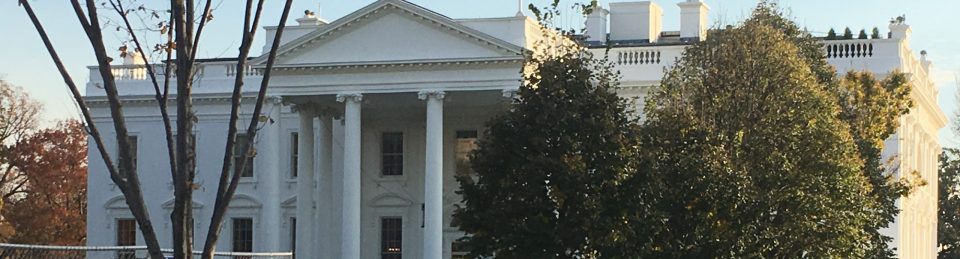
The results of those inquiries are quite likely to add to the growing legal pressure on Cohen. Moreover, the existence of large payments to Cohen by corporations with obvious interests in influencing the White House will put pressure on Trump to disavow his former lackey.  Which should in turn increase the likelihood that an abandoned Cohen will agree to cooperate against his faithless boss.

This is getting interesting.
Share this:

  • Share on X (Opens in new window) X
  • Share on Facebook (Opens in new window) Facebook
Like Loading...

Must Trump comply with a subpoena?

06 Sunday May 2018

Posted by impeachableoffenses in Uncategorized

≈ 2 Comments

Tags

Fifth Amendment, grand jury subpoena, Guiliani, Mueller, Robert Mueller, Trump subpoena

By Frank Bowman

Rudolph Giuliani, the newest in the revolving cast of Mr. Trump’s lawyers, has made a number of striking legal claims in his short tenure.  His latest is that Mr. Trump is not obliged to comply with a subpoena to testify from a court or grand jury.

Giuliani is assuredly wrong.  But any attempt to subpoena Mr. Trump would raise a number of complicated issues.

First, Giuliani is right that Mr. Trump, like any other person, has a right under the Fifth Amendment to decline to answer questions that may tend to incriminate him.  However, that right does not allow Trump or anyone else to simply refuse to appear in a court or grand jury room if properly subpoenaed.  Rather, a person subject to subpoena must appear at the date and time specified in the subpoena and assert the privilege to particular questions.

If a witness is technically a “target” of a grand jury investigation and provides the prosecution with a written statement of intention to assert the Fifth Amendment, DOJ policy is that such a witness “ordinarily should be excused from testifying.”  U.S. Attorney’s Manual, 9-11.154 . But that would be a matter of discretion, not law.  And even in that case, unless the witness is expressing an intention to assert the Fifth as to all questions, he would ordinarily be obliged to appear and answer questions that cannot be reasonably viewed as seeking self-incriminatory information.

In the case of a president, even one who is not formally a “target,” the prosecutor might accommodate the president’s expressed intention not to answer questions on particular topics that seem plainly incriminatory by agreeing in advance not to ask them.  But that, too, would be a matter of discretion rather than law.

In any case, it seems somewhat unlikely that even this unconventional president would want to be seen as formally “taking the Fifth” to avoid testifying.

Second, there are issues about which Mr. Trump might claim some form of “executive privilege.”  Broadly speaking, executive privilege is the claim that a president can withhold information from congress, the courts, or the public for reasons relating to the proper functioning of the presidential office.  Legitimate claims of executive privilege are generally related to national security or protecting the privacy of White House deliberations for reasons promoting the public interest.

A great many questions Mueller is said to be interested in asking cannot by any reasonable stretch of the imagination fall within the executive privilege doctrine. Virtually all the questions on the list published by the New York Times that relate to Russia seem far outside any reasonable executive privilege claim.  Leaving all other considerations aside, almost all of them relate to events that occurred before Mr. Trump took office.

Some questions Mueller might ask would probably draw objections on executive privilege grounds.  For example, questions about conversations between Mr. Trump and White House advisers about whether to fire former FBI Director James Comey would probably draw such objections on the theory that executive branch personnel decisions should ordinarily remain private.  Mr. Mueller’s team might respond that executive privilege, to the extent it exists, must yield when the inquiry is into possible criminal misuse of the presidential power being discussed.  The analogy would be to the crime-fraud exception to the attorney-client and marital privileges, pursuant to which otherwise confidential communications must be disclosed if they were in furtherance of crime.

The Supreme Court held in U.S. v. Nixon that claims of executive privilege must yield in the face of investigation of criminal wrongdoing by the president or his aides. Nonetheless, Mueller’s people would have to make more than a bare claim of investigative interest to succeed in compelling testimony from this or any president about internal deliberations on policy or personnel decisions.

Finally, one argument that has been floated in the wake of Giuliani’s comments is that the president need not comply with a subpoena because he is the head of the executive branch and thus the ultimate boss of the prosecutors running the Mueller investigation.  This is frivolous. A subpoena is not a request by a prosecutor.  It is an order issued by authority of the court (if a trial subpoena) or of the court and the grand jury (if a grand jury subpoena).  It is a command by the judicial branch.  And it is not one that a president is entitled to disobey.

My personal bet is that Mr. Trump will not agree to testify voluntarily, and that Mueller’s team will subpoena him as a last resort.  Should that come to pass, it will get interesting very fast.

Share this:

  • Share on X (Opens in new window) X
  • Share on Facebook (Opens in new window) Facebook
Like Loading...

Impeachment in the States: Missouri Governor Edition, Part 9 (Still more on pre-office conduct)

04 Friday May 2018

Posted by impeachableoffenses in Uncategorized

≈ 1 Comment

Tags

federal impeachment for pre-office conduct, Governor Greitens, Greitens impeachment, Impeachment for pre-inaugural conduct, impeachment for pre-office conduct, Missouri impeachment, Missouri state impeachment, Porteous, pre-office conduct, Schiff

By Frank Bowman

Regular readers will recall that former Missouri Chief Justice Michael Wolff and I have disagreed about whether Governor Eric Greitens can be impeached for conduct that occurred before he took office.  Judge Wolff said no.  I said yes.

One of Judge Wolff’s arguments was that there had been no impeachments of federal officers for conduct prior to assumption of office.  I responded, in part, that federal practice is irrelevant to Missouri constitutional rules because the standards for impeachment are markedly different in the U.S. and Missouri constitutions.  But I concurred with Judge Wolff’s assertion that no federal official had been impeached for pre-office conduct.

Both of us were wrong.  In an op-ed in today’s New York Times, Congressman Adam Schiff recalls his experience as a member of the House Judiciary Committee in 2010 when it voted to recommend impeachment of  U.S. District Judge Thomas Porteous.  He notes that one of the articles of impeachment approved by the House and later the Senate alleged corrupt behavior while Porteous was a state judge and before he took the federal bench.

As Congressman Schiff observed, “In voting overwhelmingly to convict Judge Porteous on every count, the Senate established the precedent that a federal official can be removed for conduct committed before assuming office.”

Precedent in federal impeachment is a peculiar animal.  The process lies entirely within the province of Congress, and is generally agreed not to be reviewable by the courts. Therefore, the legal principle of stare decisis — meaning that earlier decisions of appellate courts have some binding effect on judges in later cases — doesn’t apply to federal impeachments.  Each new congress can interpret the impeachment language of the constitution however it chooses, regardless of what previous congresses may have done.  That said, congressmen have tended to look at prior impeachment decisions as guides to appropriate constitutional interpretation.  Therefore, it seems quite likely that the Porteous case will be seen as establishing a meaningful precedent.

This may be of some modest consequence in the case of Governor Greitens.  The standard for impeachment under the Missouri constitution is entirely different than the federal constitution’s famous “treason, bribery, or other high crimes and misdemeanors.”  And therefore federal practice is of little or no real importance.  Still, Governor Greitens defenders will surely try to use precedent from any source if they think it helps their man.  The impeachment of Judge Porteous takes one possible argument off the table.

The Porteous case is of greater potential importance should Mr. Trump ever face a formal impeachment inquiry.  Inasmuch as the Mueller investigation focuses largely on contacts between Mr. Trump and his associates and agents of Russia prior to Trump’s inauguration, the Porteous precedent places any misbehavior in that period squarely within the purview of the congressional impeachment power.

Share this:

  • Share on X (Opens in new window) X
  • Share on Facebook (Opens in new window) Facebook
Like Loading...

Pres. Trump Hiding his Health

03 Thursday May 2018

Posted by crosbysamuel in Articles, Uncategorized

≈ 1 Comment

Tags

25, amendment, articles of impeachment, dishonesty, doctor, fitness, hair loss, harold bornstien, impeach, lie, mental, pervasive, president, raid, removal, remove, trump, unfitness

Trump’s former doctor, Harold Bornstein, claims that a 2015 statement about the  President’s health, which was then attributed to Bornstein, was in fact written by Trump himself. For those who don’t recall, a passage from the “Doctor’s letter” which received special attention went as follows: “[h]is physical strength and stamina are extraordinary. If elected, Mr. Trump, I can state unequivocally, will be the healthiest individual ever elected to the presidency.” Bornstein went on to say that, after he let it slip that Trump took a hair-loss medication, three men from Trump’s office, a group which included Alan Garten, a lawyer, and Keith Schiller, former director of Oval Office  operations, came to his office and took Trump’s medical records in a “raid”-like fashion.

Trump’s actions have been described as totalitarian, and one opinion summarizes his concern over the news as follows: “[d]oes he have a condition or problem that will shorten his life or impair his ability to do the job?” The problem with Trump’s attempts to hide his medical history can be divided into two issues: 1) his fitness to serve, and 2) a trend of dishonesty.

There has been some speculation about the use of the 25th amendment to remove Trump for mental or physical unfitness.  One might argue that if Trump is trying to hide some serious health issues, that might increase the likelihood of his removal; however, Trump is hardly the first president to have and hide health issues. President Franklin Delano Roosevelt  concealed the true extent of his polio-caused paralysis throughout his political career, and kept his increasing heart problems carefully under wraps during his third and fourth terms. President Wilson suffered from a severe stroke while in office which his wife and doctor hid from the public, and President Kennedy, though “famous for having a bad back,” successfully hid “other illnesses, including persistent digestive problems and Addison’s disease, a life-threatening lack of adrenal function.”

What may distinguish Mr. Trump’s blatant falsification of his medical history from the concealment practiced by some of his predecessors is the degree to which this incident is part of a larger pattern of lying.

The topic of President Trump’s pervasive falsehoods has been explored thoroughly on this blog. Should congress choose to pursue impeachment on that basis, Trump’s efforts to hide his health may constitute another avenue of inquiry.


Share this:

  • Share on X (Opens in new window) X
  • Share on Facebook (Opens in new window) Facebook
Like Loading...
← Older posts
Newer posts →

Blog Owner

Frank O. Bowman, III


Curators' Distinguished Professor Emeritus
Floyd R. Gibson Missouri Endowed Prof of Law Emeritus
Univ of Missouri School of Law

Web Profile

Enter your email address to follow this blog and receive notifications of new posts by email.

Professor Bowman on Impeachment »

Bibliographies

Explore bibliographies categorized by author and subject, and find other resources.

Posts by Topic

  • The Case for Impeachment
  • Defining Impeachable Conduct
  • Impeachment on Foreign Policy Grounds
  • Impeachment for Unfitness
  • Obstruction of Justice
  • Abuse of Criminal Investigative Authority
  • Election Law Violations
  • Foreign Emoluments
  • Conspiracy to Defraud the   United States
  • Politics of Impeachment
  • Lying as an Impeachable Offense
  • Abuse of Pardon Power
  • Electoral College
  • House Impeachment Resolutions
  • The Logan Act
  • The Mueller Investigation
  • Impeachment of Missouri Governor Greitens
  • Historical Precedent for Impeachment
  • Messages from Professor Bowman

Student Contributors »

Enter your email address to follow this blog and receive notifications of new posts by email.

Blog at WordPress.com.

  • Subscribe Subscribed
    • Impeachable Offenses?
    • Join 199 other subscribers
    • Already have a WordPress.com account? Log in now.
    • Impeachable Offenses?
    • Subscribe Subscribed
    • Sign up
    • Log in
    • Report this content
    • View site in Reader
    • Manage subscriptions
    • Collapse this bar
 

Loading Comments...
 

    %d