Pres. Trump Hiding his Health

Tags

, , , , , , , , , , , , , , , , ,

Trump’s former doctor, Harold Bornstein, claims that a 2015 statement about the  President’s health, which was then attributed to Bornstein, was in fact written by Trump himself. For those who don’t recall, a passage from the “Doctor’s letter” which received special attention went as follows: “[h]is physical strength and stamina are extraordinary. If elected, Mr. Trump, I can state unequivocally, will be the healthiest individual ever elected to the presidency.” Bornstein went on to say that, after he let it slip that Trump took a hair-loss medication, three men from Trump’s office, a group which included Alan Garten, a lawyer, and Keith Schiller, former director of Oval Office  operations, came to his office and took Trump’s medical records in a “raid”-like fashion.

Trump’s actions have been described as totalitarian, and one opinion summarizes his concern over the news as follows: “[d]oes he have a condition or problem that will shorten his life or impair his ability to do the job?” The problem with Trump’s attempts to hide his medical history can be divided into two issues: 1) his fitness to serve, and 2) a trend of dishonesty.

There has been some speculation about the use of the 25th amendment to remove Trump for mental or physical unfitness.  One might argue that if Trump is trying to hide some serious health issues, that might increase the likelihood of his removal; however, Trump is hardly the first president to have and hide health issues. President Franklin Delano Roosevelt  concealed the true extent of his polio-caused paralysis throughout his political career, and kept his increasing heart problems carefully under wraps during his third and fourth terms. President Wilson suffered from a severe stroke while in office which his wife and doctor hid from the public, and President Kennedy, though “famous for having a bad back,” successfully hid “other illnesses, including persistent digestive problems and Addison’s disease, a life-threatening lack of adrenal function.”

What may distinguish Mr. Trump’s blatant falsification of his medical history from the concealment practiced by some of his predecessors is the degree to which this incident is part of a larger pattern of lying.

The topic of President Trump’s pervasive falsehoods has been explored thoroughly on this blog. Should congress choose to pursue impeachment on that basis, Trump’s efforts to hide his health may constitute another avenue of inquiry.


Playing “20 Questions” With Trump

Tags

, , , , , ,

By Frank Bowman

The New York Times this morning released a series of questions which it says Special Counsel Robert Mueller’s team would like Mr. Trump to answer.  The provenance of this list is murky.

First, we don’t really know if it’s genuine.  Second, if the list is essentially genuine, it seems unclear whether the questions are actually those Mr. Mueller would like answered or are, instead, summaries in question form by Trump’s lawyers of broad topic areas Mueller’s people have said they’d like to discuss with Mr. Trump.  Third, the source of the list is uncertain.  According to the Times, the list did not come from Mueller’s team.  Which leaves people in the White House or others associated with Mr. Trump’s legal defense.

Although the question list is certainly a scoop for the Times, I’m not sure it adds much to our knowledge of the Mueller investigation.  All of the published questions concern issues or events that have been discussed ad nauseum in the public press.

That said, I am struck by the prevalence of questions that seem to relate primarily to obstruction of justice.  There is a set relating to the firing of former National Security Adviser Michael Flynn, a long set about the firing of former FBI Director James Comey, and, quite interestingly, a set about threats to the continued tenure of Attorney General Jeff Sessions.  In addition, several of the questions relate to the activities and potential termination of the office of special counsel itself.

My first reaction to the questions about Sessions and the special counsel’s office is that they serve as a kind of brush-back pitch — a warning that Trump’s threats to Mueller and his efforts to influence Mueller’s investigation are themselves legally and politically dangerous.

Beyond that obvious point, I find the heavy emphasis on obstruction of justice a tad disturbing.  It is undoubtedly true that obstruction of justice is a crime (albeit one for which, under current DOJ policy, a sitting president will not be indicted) and potentially an impeachable offense.  And it is also true, contrary to the assertions of Mr. Trump, that one can be guilty of obstruction of justice for impeding investigation of matters that ultimately prove not to be criminal.

Nonetheless, those who ardently oppose Mr. Trump — particularly those who long for his impeachment — must remember that this is a political process.  By which I mean that changing the public mind matters as much or more than legal fine points.  Suppose that, at the end of his investigation, all Mr. Mueller comes up with is evidence that Mr. Trump obstructed an investigation that produces no proof of other significant wrongdoing by Trump or those closest to him.  In that case, those who already despise Trump will hail the obstruction finding as a victory.  But Trump and Trump supporters will claim exoneration because, they will say, a president is entirely within his rights to squelch a politically damaging investigation into non-existent crimes.

That the Trumpists would be wrong on the law won’t matter a fig in the court of public opinion, or in the Republican precincts of the House of Representatives if, post-midterms, the House were to begin an impeachment inquiry.  It is perfectly clear that the hard core of congressional Trump supporters just aren’t interested in abstractions like prosecutorial independence or even the rule of law itself. The only result from Mueller that might change the progressively hardening partisan positions on Trump would be solid evidence of serious substantive crime.

Of course, Mr. Trump’s own tweeted response to the leaked questions, in which he claims there are “No questions on Collusion,” is flatly wrong.  Many of the questions relate directly to possible cooperation between Russian entities and the Trump campaign.  Still, one hopes that Mueller’s inquiries are focused more heavily on that end of things than the leaked queries suggest.

In short, a Trump critic should hope that the Mueller folks will, in the end, be able to show that Mr. Trump’s obstructive behavior was intended to conceal real, and incontrovertibly serious, misconduct.

Russians follow up about Sanctions

Democrats of the House Intelligence Committee have revealed that both Natalia Veselnitskaya, the Russian Lawyer of the now infamous Trump Tower Meeting, and Aras Agalrov, a Russian Oligarch tied to the meeting, reached out to the Trump Administration after Trump’s election to discuss Russian sanctions promulgated by the Magnitsky Act in 2012. The initial Trump tower meeting, attended by Trump Jr., though thought to be about the exchange of information about Hillary Clinton, in fact focused on those same sanctions.

The impeachment enthusiast will want to know how this information affects Trump’s likelihood of being removed. Though continued contact by high-powered Russians may seem ominous, it could in fact better the case against a charge of Conspiracy to Defraud the United States. To prove a conspiracy, one must show that there was an agreement between two parties. If after the meeting at Trump Tower, Russians continued lobbying, that would seem to indicate that they were unable to establish an agreement at the initial meeting. That being said, the Trump Administration has denied that there was any follow up at all, so there may still be more to this story. The possibility of an agreement still exists.

110717_moscow-1499812599.jpgVictor Boyko/Getty Images

Justices Signal that Revised Travel Ban is Constitutional

Tags

, , , , , , , , , , , ,

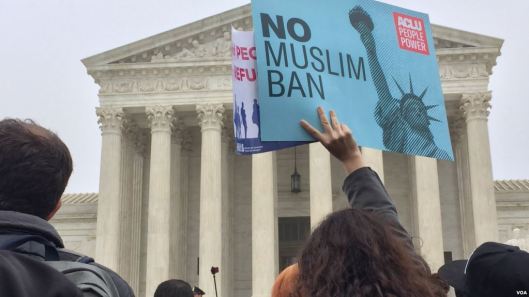
Oral arguments over the Trump Administration’s new travel ban occurred yesterday in front  of the Supreme Court. The conservative justices of the Court signaled that they believed the revised ban to be a constitutional exercise of executive power done in pursuit of national security. Significantly, Chief Justice Roberts indicated that President Trump’s statements detailing an intention to implement a “Muslim-ban” would likely not be considered in determining the order’s constitutionality.

If the Supreme Court ultimately confirms that the revised travel ban is constitutional despite Trump’s statements, it may have a negative effect on future impeachment proceedings. Representative Al Green’s impeachment resolution cited President Trump’s travel ban as one reason he should be impeached. Though an act may be both constitutional and worthy of impeachment, as they have far different standards, the Supreme Court decision could still set a precedent. It may act as an endorsement of sorts.

A3C0CAC7-5D5B-4C82-8E01-AB1360326948_cx0_cy7_cw0_w1023_r1_s.jpgV. Macchi/VOA


Impeachment in the States: Missouri Governor Edition, Part 8 (More on impeachment for pre-office conduct)

Tags

, , , , ,

By Frank Bowman

I’ve written before on this site expressing the view that a Missouri state official may constitutionally be impeached for conduct prior to taking office. Last week, former Chief Justice of the Missouri Supreme Court Michael Wolff expressed the contrary opinion in an op-ed in the St. Louis Post-Dispatch.  As much as I respect Judge Wolff for his legal acumen and his many contributions to this state, on this point at least, I have to respectfully disagree.

Consequently, I wrote a rebuttal explaining why impeachment for pre-office conduct is surely permissible which was published in the Post-Dispatch yesterday.  Here’s the link to the article.  And it is reproduced in full below.

Yes, the Governor Can Be Impeached Right Now

Michael Wolff, former Chief Judge of the Missouri Supreme Court, recently wrote that, Governor Eric Greitens cannot constitutionally be impeached for misconduct committed before he assumed office.   

 I admire Judge Wolff immensely. But I respectfully disagree.

First, the Missouri constitution places no time limit on impeachable conduct.  It defines impeachable behavior as “crimes, misconduct, habitual drunkenness, willful neglect of duty, corruption in office, incompetency, or any offense involving moral turpitude or oppression in office.” 

Some items on this list — “willful neglect of duty, corruption in office … or oppression in office” — unmistakably refer to official misbehavior.  Several others are probably meant to have an official connection. “Incompetency” probably refers either to a debilitating mental breakdown or an evident inability to perform official functions.  Similarly, “habitual drunkenness” before, but not during, an officeholder’s term can’t possibly be a sound reason to impeach.

Likewise, the phrase “any offense involving moral turpitude or oppression in office” could be interpreted to require that the words “in office” modify both “moral turpitude” and “oppression.” Then the phrase could be read like this: “any offense involving moral turpitude [in office} and oppression in office.” That’s at least plausible.

But Jim Layton, former Solicitor General of Missouri, points out that, at the time this constitutional impeachment language was written in 1945, “oppression in office” was, and long had been, a specific statutory crime. Therefore, the phrase “oppression in office” was just the name of one offense for which an officeholder could be impeached. Thus, it is very unlikely that the words “in office” were intended to reach back up the sentence and limit the impeachability of an “offense of moral turpitude” to crimes committed during an officeholder’s term.

But even if we didn’t know this clarifying fact about old Missouri law, the real textual problem for Judge Wolff’s argument is that the constitutional list of impeachable conduct starts with the words “crimes [and] misconduct,” and those terms aren’t modified in any way that limits them to the period following assumption of official duties.

Most importantly, as a matter of good governance and common sense, the notion that a governor can’t be impeached for conduct that predates his inauguration can’t be right.  If it were to be discovered that a governor had bribed election officials to help secure election, no one would suppose that the governor couldn’t be impeached on that basis, even though the conduct occurred before he took office.

Governor Greitens’ defenders might concede that pre-inaugural misconduct can sometimes count, but insist that impeachment is limited to conduct directly related to the electoral or appointive process by which the person impeached gained office. 

But that’s not what the Missouri constitution says.  And such a rule would be irrational.  Suppose a sitting governor accepted bribes while he occupied a previous state position, or committed murder six months before his election.  Would anyone seriously suggest that such a governor could not be impeached and removed?  The necessity of impeachment is made clear by the multiple Missouri cases flatly holding that the only means of removing a constitutional officer (such as the governor) is impeachment, even if the officer has also been convicted of a crime. In short, if we can’t impeach a criminal governor, we’re stuck with him until his term expires, even if he’s sitting in jail as a convicted felon.  That can’t be right.  And the Missouri constitution does not require that result.

Finally, Judge Wolff notes that there have been no federal impeachments for pre-office conduct.  That’s true, but irrelevant. [NOTE: As I observe in a later blog post, this is not actually the case – the most recent impeachment of a federal judge included an article charging misconduct while the judge was on the state bench.] Missouri chose not to adopt the “high crimes and misdemeanors” formula of the U.S. constitution. In Missouri, the words of the Missouri constitution govern. Moreover, almost all federal impeachments have been of judges, and grounds for their removal are arguably limited to misconduct in office by the constitutional guarantee that they will remain in office “during good behavior.” Finally, no serious student of federal impeachment law doubts that federal officials could be removed for pre-office behavior if sufficiently serious.

The question for the Missouri House is not when the governor may have committed offenses, but whether such offenses fit within the words of the Missouri constitution and are serious enough to merit impeachment.

The Tragedy of James Comey

Tags

, , , , ,

By Frank Bowman

Young lawyers become prosecutors because they want to be the good guys.  They want to become the only kind of lawyer whose obligation is not to promote the interests of sometimes morally compromised clients, but only to seek the truth and do justice.  They also quickly understand that with the mission to seek justice comes immense power — to expose evil, to root out corruption, to protect the weak, to vindicate the wronged.  Young prosecutors who make it a career begin to see themselves as members of a kind of warrior priesthood, paladins of light in an ethically murky and sometimes blackly malign world.

I know this because many years ago I was one of the young postulants of this priestly caste, and I spent fourteen of my seventeen years in practice as either a state or federal prosecutor before becoming a teacher.  As corny as it may sound, in some deep place I remain a member of my old order.  I honor its mission.  I cherish its traditions and unwritten codes.

But those who truly understand what it is to be a public prosecutor in the American democracy recognize that membership in the order comes at a price, and accompanied by a particular set of risks.

The price is two forms of self-denial.  First, a commitment to relative asceticism — career prosecutors can certainly live a comfortable middle-class life, but so long as they remain in government, they will never see the vast riches of elite private practice.  Second, but more importantly, prosecutors must abide by a set of professional norms that elevates the pursuit of justice, respect for individual rights, and protection of the justice system over personal fame.

As a federal prosecutor, you are empowered to hunt those suspected of crime, but you are obligated to wield the immense resources at your disposal with restraint and in strict accordance with the rules.  You are granted many tools to unearth evidence, but you must analyze what you find dispassionately.  While an investigation is ongoing, you may not speak about its details publicly, no matter how high-profile the target and how intense the interest of the public, the press, or elected politicians.

You are commissioned to prosecute the guilty, but may not ethically subject anyone, however dodgy you personally may think them, to the risk of criminal conviction unless you believe the evidence proves guilt beyond a reasonable doubt. Therefore, if at the close of an investigation you indict, you announce the fact and thereafter do your talking in court, not on the courthouse steps or in private leaks to reporters.

If the evidence you collect does not merit indictment, you don’t proceed.  Then, whatever your personal feelings about that may be, you say nothing, or at most make an unadorned announcement of the fact.  Your job is to prosecute crime, not to make public assessments of personal character.

In short, the job is about justice.  It’s not about you.

Prosecutors can be heroes.  But it is the self-abnegating heroism of the warrior-monk, not the self-promoting heroism of the solo knight errant who rescues maidens and slays dragons in the hope of having bards compose ballads extolling his fame.  Unsurprisingly, however, people drawn to prosecution by the promise of action in the service of virtue can be seduced into seeing themselves as the second kind of hero.

A peculiar feature of a prosecutor’s life is that, although he is formally only a cog in a notably rule-bound machine, his day to day experience is of immense personal authority.  This is particularly true in court.  When you rise in the well of a courtroom to represent the United States, you are very much on your own.  The questions you ask, the words you choose, the arguments you craft are yours and no one else’s.  Even in making the decisions to bring or dismiss or plea bargain a charge, in all but the rarest cases, the individual prosecutor’s judgment will be dispositive.

One of the risks of becoming a career prosecutor is that, because you are so often in the right and so often confront people who obviously did wrong, in time you can begin to mistake the perpetual obligation to be right with inevitably being right. And as one rises in rank, filling offices in which one commands the resources and speaks with the voice of the United States Department of Justice, the deference that comes with such roles is immense.

It requires great discipline, deep self-awareness, and a strong measure of humility to keep remembering that the job is about justice and not about you.  And that doing the job means following the rules, formal and informal, of the prosecutor’s code, even if doing so may seem unwise to you personally in the heat of the moment.

Jim Comey is an honest man, whatever the prevaricator in the White House may say.  But he has not always been a wise one. And since the second half of 2016, he has repeatedly made grievous errors that very probably changed the history of America and the world, errors he might have avoided if he had adhered to the rules and longstanding norms of the United States Department of Justice.

Comey’s first error, now somewhat obscured by later ones, was the choice to hold a press conference in July 2016 to announce and explain in detail the conclusions of the FBI about the investigation of Hillary Clinton’s email practices while Secretary of State, including its decision not to recommend an indictment.  Note what I just said — “conclusions of the FBI.”

Comey candidly admitted at the beginning of his press conference that he had not consulted the Attorney General about the recommendations he was about to discuss or the opinions he was about render.  And he knew perfectly well how aberrational this behavior was.  He said:

This will be an unusual statement in at least a couple ways. First, I am going to include more detail about our process than I ordinarily would, because I think the American people deserve those details in a case of intense public interest. Second, I have not coordinated or reviewed this statement in any way with the Department of Justice or any other part of the government. They do not know what I am about to say.

The FBI is an investigative agency subordinate to the Attorney General.  It has no independent authority to bring or not bring indictments. Deliberations about whether to bring an indictment sometimes include FBI representatives, but the final decision rests exclusively with the prosecutors of the Justice Department and ultimately with the Attorney General.  And those deliberations are conducted in private, before the final decision is made, not in the public square.

To anyone with experience in the American criminal justice system, Comey’s arrogance was simply flabbergasting. By announcing publicly what he had decided the outcome of the Clinton case should be before discussing his opinion with the Attorney General or her authorized designates he blithely assumed for himself a power no FBI Director has.

Worse, Comey’s expansive statement at the press conference flagrantly violated the Justice Department norm against discussing the details of investigations that do not result in indictment.  That kind of exposition is disfavored because it always risks besmirching the character of the uncharged target of the investigation, while providing no forum in which to rebut the inevitable stain of having drawn prosecutorial scrutiny in the first place.

When the Department breaks with that norm, the decision to do so is made by the Department’s senior leadership, not by the FBI, which is, I repeat, merely a subordinate investigative arm of the Department.  And careful thought goes into what should and should not be said.

Therefore, when Comey chose to march up to the microphones and provide a dog-and-pony show about the Clinton investigation, complete with his personal opinions about her “extreme carelessness” and the like, he committed two cardinal sins: First, he ignored the fact that, as FBI head, he was a cop, and no longer a prosecutor — that the Attorney General, not the FBI decides who gets indicted. Second, he ignored the norm that the Justice Department doesn’t “explain” decisions not to indict when the effect of the explanation will be to smear the person not indicted.

His excuse — that the “American people deserve .. details [of the FBI’s investigation and conclusions] in a case of intense public interest” — was both arrogant and in some measure disingenuous. By announcing the FBI recommendation not to indict, he effectively preempted Justice Department prosecutors.  Once the FBI Director declared that there was no prosecutable case, prosecutors could hardly have decided otherwise.

But that, of course, was not the real objective of the Comey statement.  The senior leadership of the Justice Department would surely have concurred in the recommendation not to prosecute, but would probably have issued a much more conventionally terse explanation of the decision. Instead, Comey got out front with a statement that simultaneously took credit for what, given the evidence, was the only sensible prosecutorial choice, while at the same time including enough tut-tutting disapproval of Secretary Clinton’s behavior to deflect the ire of Clinton critics on Capitol Hill and beyond from the FBI and James Comey, Esq.

But you don’t get to ignore chains of command or defining norms of prosecutorial behavior because you think it will make the FBI, or you personally, look better.  The job is about justice, not about you.

Comey’s later decision to send his infamous letter to Congress mere days before the election saying that some unexamined Clinton emails had been found on Anthony Weiner’s laptop, and that the Clinton investigation might be reopened depending on what was in them, was even less excusable.  In that case, he violated yet another important Justice Department norm, which is not to comment on the status of pending investigations immediately prior to elections.  Why does the norm exist?  Precisely in order to prevent what happened in this case: breaking news about uncharged crimes has the potential to sway elections, even if, as proved true here, the charges have no merit.

Comey’s explanations of this decision are wholly inadequate.  He poses his choice as between disclosure and “concealment,” as if there is some obligation on the part of federal law enforcement to update the public or congress on every unsubstantiated lead in an investigation.  But the norm is precisely the reverse.  The Department and subordinate law enforcement agencies like the FBI don’t comment on the status of investigations until they are complete and they don’t comment on unsubstantiated leads at all.  Particularly not less than two weeks before an election in which the subject of an investigation is a candidate.

Comey claims that he had some special obligation to inform Congress about this lead because he had previously told them that the investigation was closed and that he’d advise them if that status changed.  In the first place, the general norm against non-disclosure of investigative details doesn’t change because of loose wording in a letter from the FBI Director.  More to the point, there was absolutely nothing in Comey’s congressional letter that compelled him to disclose an unchecked lead days before the election.

Comey’s real reason was the worry that, if he had not disclosed before the election and something important was found on the laptop, then he would have been criticized by Republicans for hiding important information.  To which the only possible response is — tough!  Either disclosure or non-disclosure of uncorroborated allegations about a candidate can affect an election.  The Justice Department policy against disclosure was created with full understanding of that dilemma. But it enjoins disclosure because only nondisclosure protects a candidate — like Hillary Clinton — whose electoral prospects will definitely be damaged by the release of information that may in the end prove baseless.

The mission of the Department of Justice is to convict the guilty, yes, but also to protect the innocent.  Another part of its mission is to ensure that the process of winkling out truth does not warp the democratic process.  If you work in the Department of Justice, or for its subordinate agencies, then no matter how high you climb, the job is still about justice.  It’s not about you.

Rod Rosenstein has been sharply criticized, and not without reason given the timing, for writing the memo about Comey’s errors that Trump used to justify firing Comey.  But everything in the Rosenstein memo — the facts and the judgments — was correct.   Comey should have been fired.  The only thing that makes his firing remotely controversial is that Mr. Trump sacked him for an unwillingness to do wrong in the future, rather than for the wrongs he’d done in the past.

Jim Comey is an honest man.  Or at least as honest as any inevitably flawed human can be.  But his basic honesty comes with two intertwined flaws. First, he knows he is honest, and on balance probably more honest than many people in public life.  And that leads to a level of sanctimony dangerous in a man granted great public authority.  Because if deep down you believe that you are morally superior, then you will be tempted to break rules and norms you see as having been created to cabin the base impulses of the less pure. But the prosecutorial norms Comey violated arose over long years to protect against both corruption and misguided virtue.

Second, although Comey is honest, he also has an irrepressible need to be seen as honest, indeed as more honest, and more forthrightly, courageously honest than anybody else.  He thirsts, it would seem, to be publicly acclaimed as the the spotless hero of his own saga.  And that is an especially dangerous trait in a law enforcement official. For such officials, it is not enough to be honest. One must also possess the virtue of self-restraint in the face of public criticism and a capacity for silence unless and until the law requires speech.

By choosing to publish a book and embark on an endless round of self-promoting interviews while the Mueller investigation is ongoing, Comey, tragically, confirms that his need for self-affirmation is stronger than his loyalty to the rules and norms of the justice system he purports to be defending.  He knows that he is a central witness in a potential obstruction of justice case against the president, whether that case is made in the courts or in an impeachment inquiry.  And surely he remembers that the very last thing any prosecutor wants is for his star witness to be parading around the country giving interviews and creating all the little inconsistencies and toeholds for cross-examination that can undercut the credibility of any witness.  And yet he seemingly cannot help himself.

For those of us who love the American justice system and would defend it against the daily assaults of the man in the White House, the claim to “A Higher Loyalty” in the title of the Comey memoir is bitterly ironic.

Trump and Comey are polar opposites in virtue.  But they are doppelgangers of ego.  Neither can bear that the world might see him other than as he sees himself.  As loathsome as Trump may seem to him, Jim Comey needs to understand that he, too, is hurting the Republic.
Adam Schiff’s legislative warning shot on pardons … and more from “Impeachable Offenses?” on SLATE

Tags

,

Today, Slate senior editor Jeremy Stahl wrote an informative piece about Congressman Adam Schiff’s effort to dissuade Mr. Trump from using pardons to derail investigations.  Mr. Schiff introduced a bill that would require disclosure to Congress of all files “obtained by a United States Attorney, another Federal prosecutor, or an investigative authority of the Federal Government” about any case involving a pardon recipient in which the president or any of his relatives are implicated as a subject, target, or witness.

Though Schiff’s bill seems unlikely to pass, its obvious objective is to signal to Mr. Trump that abuse of the pardon power will not go unexamined by congress, and indeed can be impeachable.  Mr. Stahl was kind enough to quote Professor Bowman at several points.

Also, on Monday, Slate syndicated a revised version of this website’s post arguing that “It’s Too Late for a New ‘Saturday Night Massacre.'”

We’re grateful for the exposure.


Impeachment in the States: Missouri Governor Edition, Part 7 (The “eminent jurists”)

Tags

, , , , ,

By Frank Bowman

An inquisitive reader, and former excellent student of mine, wrote in with a question about precisely who would try any impeachment charges against Governor Greitens approved by the Missouri House of Representatives.  He correctly noted that Article VII, Section 2 of the Missouri constitution provides that, if the governor or a member of the state supreme court is impeached, the trial of the articles of impeachment is to held before a “special commission of seven eminent jurists to be elected by the senate.”  But he wanted to know who counts as an “eminent jurist.”

Before I could respond, my industrious correspondent found and sent me the answer in a statute, RSMo 106.080, which states:

If the governor or a judge of the supreme court shall be impeached, the house of representatives shall immediately transmit such articles of impeachment to the senate who shall, without delay, proceed to the election of a special commission to try the cause, which commission shall be composed of seven eminent jurists, who at the time of their election are judges of the circuit or appellate courts of this state; provided, however, that judges of the supreme court shall not be eligible to serve on such special commission. The commission shall meet in the City of Jefferson within thirty days after their election on a day designated by the senate.

In short, by statute, only sitting circuit and appeals judges can be on the special commission.

ADDENDUM: After I first posted this analysis, my eminent friend Jim Layton, former Solicitor General of Missouri, pointed out that “eminent jurists” is a vague term that could be read to include retired judges, federal or state, and that it’s doubtful the legislature can, by statute, modify the meaning of a constitutional term.  I take his point, but since the constitution requires that the “eminent jurists” be “elected by the Senate,” my bet is that they follow the rule they plainly thought they had the power to enact.

Sean Hannity!

Tags

, , ,

By Frank Bowman

Just when you thought the Trump saga couldn’t get weirder, Michael Cohen, Trump’s longtime consigliere, was forced to reveal that his entire list of human clients consists of Donald Trump, Elliott Broidy (a rich Republican fundraiser for whom Cohen arranged a $1.6 million payoff to a former mistress), and … tah-dah … Sean Hannity.

This revelation has occasioned tut-tutting from media watchdogs who note that Hannity has been screaming daily on his TV and radio shows about the illegitimacy of the Cohen search, while conspicuously omitting to mention that he was among Cohen’s clients.  Fair and balanced indeed! And of course, Hannity’s discomfiture has drawn howls of laughter and hoots of derision from pretty much everyone, left and right, who has not yet been submerged into the Borg of Fox News Land.

Along with the outrage and hilarity, there has also been speculation about what sort of thing Hannity could possibly have wanted the legal advice of Michael Cohen, a guy who isn’t so much a lawyer as muscle with a law degree. The obvious salacious speculation has centered on the fact that Cohen’s only two other human clients are guys for whom he arranged payoffs to inconvenient ex-girlfriends.  Does Hannity have his own #MeToo problem?

Hannity has hastened to deny that he might need such services, insisting that the matters as to which he consulted Cohen did not involve any “third party.”  Moreover, says Hannity, Cohen was, perhaps, kind of his lawyer, but not really (“we just chatted, he never sent me a bill, I never paid fees… well, ok, maybe I slipped him a ten-spot once”).  And, insists Hannity, he only talked to Cohen about real estate matters.  Probably.  Mostly.

It’s been a perverse pleasure to watch Hannity try to walk the tightrope between denying any real connection with Cohen, while at the same time trying to claim just enough of a connection to be able to invoke attorney-client privilege.  There has been plenty of skepticism about Hannity’s story, particularly the claim that anyone, especially a gazillionaire like Hannity with the means to hire the best specialists in America, would go to Michael Cohen to get legal advice about real estate matters.

But so far, the delighted commentariat has missed one other telling point: If Hannity is telling the truth and the only time he used Michael Cohen as a lawyer was for occasional verbal chats about real estate, then there would be nothing for FBI searchers to find in Cohen’s office or the other spots subject to the warrant that would reveal either the Hannity-Cohen attorney-client relationship or its subject matter.  Yet Cohen apparently believes there is such material because otherwise he would not have listed Hannity among his clients.  And Hannity apparently agrees, because otherwise he would not have requested Cohen’s lawyers (as he apparently did) to keep his identity secret.

In short, if there’s nothing — no document, no e-mail, no tape, no phone message, no nothing — anywhere in Cohen’s domain that would identify and cause difficulties for Sean Hannity, then neither Cohen nor Hannity would have tried to protect it by identifying Hannity as Cohen’s client.

Unless I miss my guess, Mr. Hannity is sweating with reason.

The “Take Care Clause” Does Not Permit Trump to Fire Robert Mueller Directly

Tags

, , , , , , ,

By Frank Bowman

In last Friday’s New York Times, John Yoo and Sakrishna Prakash contend that President Trump has the power to fire special counsel Robert Mueller “directly,” meaning without complying with the Department of Justice regulation mandating that a special counsel can be fired “only by the personal action of the Attorney General” (or if the AG is recused, his designee) and then only for “good cause,” such as “misconduct, dereliction of duty, incapacity, [or] conflict of interest.”  In plain terms, they are saying that the president can simply ignore the Justice Department’s chain of command and its regulations and fire Mueller for any reason or, as they insist, “no reason at all.”

It is important to understand how radical this argument is. Most of the commentary about how Mr. Trump could fire Mr. Mueller accepts the premise that Justice Department regulations specifying how and by whom a special counsel can be removed are laws, binding both officers of the Justice Department and the president himself.  Hence, the endless discussions of whether Trump will embark on a “Saturday Night Massacre” round of firings in search of a senior Justice Department official willing to behead Mueller.

To non-lawyers, it might seem odd that an internal departmental rule called a “regulation” is treated as equivalent to a “law.”  But in our legal system, departmental regulations promulgated using procedures prescribed in the “Administrative Procedure Act” are “law.” And they every bit as binding on presidents or anyone else as a congressionally enacted statute or a decision of the Supreme Court.  The Justice Department’s regulations on the special counsel are precisely this kind of regulatory law.

Yoo and Prakash try to evade this elementary reality of modern American jurisprudence by referring to Article II, Section 3, of the Constitution, which requires a president to “take care that the laws be faithfully executed.”  They say this constitutional language means that the president has absolute control over the federal law enforcement function and thus can direct that legal actions be terminated and federal law enforcement officers fired whenever it suits him.  According to them, the “take care” clause means that a president cannot be bound by any regulation, or indeed any statute that Congress might pass, purporting to limit his power to dismiss subordinates in the executive branch.

They’re wrong.  Though they focus here on the narrow issue of the tenure of a special counsel, their position is merely a local manifestation of the “unitary executive” theory occasionally fashionable on the fringes of the intellectual far right.  It remains a fringe view because, if accepted, it would strike a crippling blow to the rule of law in this country.

Consider its effect in the law enforcement setting.  If the Take Care Clause effectively overrides Justice Department regulations on the special counsel, it also overrides all statutory and regulatory rules purporting to safeguard federal employees from arbitrary dismissal. In that case, the president may not only fire a prominent special appointee like Robert Mueller, without process and without cause, but also every career prosecutor, FBI agent, analyst, and secretary who worked on a case that displeased the president.

A criminal justice apparatus cowed by the chief executive and wielded only according to his unchecked whims is the first step on the road to autocracy.

Moreover, the extremist view propounded by Yoo and Prakash resonates far beyond criminal justice.  After all, the president’s obligation to ensure faithful execution of “the laws” is not limited to criminal statutes.  It extends to all of the myriad laws – constitutional, statutory, and regulatory – that govern all aspects of our national existence.  A president is every bit as obliged to ensure faithful execution of laws governing revenue collection, fair housing, collective bargaining, workplace safety, environmental protection, and the distribution of Medicare and Social Security benefits as he is to ensure proper administration of laws against fraud and official corruption.

Thus, if Yoo and Prakash are right, the president cannot constitutionally be prevented from firing any executive branch employee in any department whenever he feels that such an employee isn’t executing the law as the president would prefer it executed.  For them, legal protections against arbitrary or politically motivated dismissal can be of no effect so long as it is the president who orders a firing. In short, their reading of the constitution would effectively destroy the federal civil service system which, since 1883, has protected the country from the corruption endemic whenever a president or ruling party has unchecked power to dismiss federal employees who will not obey directions from political superiors.

No court will, or should, accept a reading of the constitution so contrary to long-settled legal norms and so destructive of the professionalism and political neutrality of federal civil servants.

It has been reported that the White House has sought advice on whether Robert Mueller might be directly dismissed, and that it has received some scholarly support for the idea.  One hopes that Mr. Trump has not relied on ideas like those of Professors Yoo and Prakash, which combine the defects of being constitutionally unsound, unlikely to find acceptance in the courts, and deeply subversive of the rule of law.