• Home
  • Mission of This Site
  • Contact

Impeachable Offenses?

~ The Use & Abuse of Impeachment in the 21st Century

Impeachable Offenses?

Category Archives: Uncategorized

FBI Deputy Director McCabe’s Resignation

30 Tuesday Jan 2018

Posted by impeachableoffenses in Uncategorized

≈ 4 Comments

Tags

Andrew McCabe, Department of Justice, McCabe resignation

By Frank Bowman

It was reported this morning that FBI Deputy Director Andrew McCabe, long a target of Mr. Trump’s ire, has resigned.

McCabe has been under attack from the White House and its allies because his wife received campaign donations during her unsuccessful 2015 bid for a Virginia legislative seat from a political action committee associated with Virginia governor Terry McAuliffe, who in turn was a prominent supporter of Hillary Clinton. The implication has been that McCabe was biased against Trump and in favor of Secretary Clinton during the FBI investigation of the Clinton e-mail scandal and somehow influenced the outcome.

Of course, as carefully reported here by Politifact, the facts don’t support the allegation.  As Politifact summarizes the matter:

At the time of the contribution, the candidate’s husband was not directly involved in the FBI probe of Clinton’s email server, according to the FBI. The bureau says that by the time he had some oversight role in the Clinton investigation, the election involving his wife had been over for three months. Meanwhile, the decision not to charge Clinton was a recommendation made by the director of the FBI [not by McCabe].

I am of two minds about McCabe’s departure.  On the one hand, in the short term, it may be just as well to have him out of the picture.  Regardless of the facts of the matter, it is not helpful to the Bureau in the present moment to have a Deputy Director with family links, however attenuated, to Secretary Clinton’s political allies. McCabe’s resignation means one less distraction from the substance of the investigations swirling around Mr. Trump.

On the other hand, McCabe’s departure is profoundly disturbing for at least two reasons. The first is that an honorable public servant should not have his career cut short by unsubstantiated slurs from the President of the United States.

The second, and deeper, concern is that the attack on McCabe is yet another Trumpian assault on essential norms that have long governed relations between the White House and the career civil service generally and federal law enforcement agencies in particular. Central to a functioning modern state is confidence that the government’s ordinary employees perform their tasks free of partisan political bias. To help ensure that civil servants will do so, the Hatch Act of 1939 requires that career federal employees surrender some of the rights of political participation enjoyed by everyone else.  Conflict of interest regulations go still further to prevent, so far as possible, even the appearance of favoritism or bias. Equally importantly, the civil service has for many decades cultivated an ethos of political neutrality, offering professional diligence in the service of the law and the agency’s mission, rather than the party of the moment.

This ethos is particularly strong in the Justice Department and federal criminal justice investigative agencies.  Anyone who has served in these bodies through several changes of administration recognizes that new presidents bring policy changes at the margins, but the focus of the career people remains on finding facts and enforcing the law. The internal norm is that personal political affiliations don’t matter and are usually unknown to one’s co-workers. No one worries that career prosecutors or agents will go harder on targets who are of the opposite party or easier on targets who share their political affiliation.

To be fair, these norms of professional even-handedness are sometimes strained in the highest profile cases. But to an impressive degree federal law enforcement agencies have lived up to the expectation of neutral professionalism.  Which is why both congress and the public have traditionally accorded the results of DOJ investigations a degree of respect they would never offer to the work of state or local governments.

It is precisely in order to protect the tradition of independent judgment so essential to its institutional mission that the Justice Department (of which the FBI is a component) has long jealously resisted White House efforts to meddle in investigations or prosecutions.

Trump’s now-successful attack on McCabe is an assault on the federal civil service in general, and the independence of the Justice Department more particularly.  In effect, Mr. Trump’s argument against McCabe is that a career FBI agent cannot be trusted if his wife ran for state elective office on the ticket of the party opposing the president. And that, in turn, is fast translating into the demand from Trump adherents and their media cheerleaders that no Democrat, or indeed any Republican not slavishly attached to Mr. Trump, can participate in investigations that might reflect adversely on the present administration.  And, of course, Mr. Trump has already embraced the view that he is entitled to “loyalty” — and protection — from “his” Attorney General and “his” FBI Director.

I have written before about the continuing Trumpist subversion of the Justice Department and the grave consequences that will flow if it succeeds.  McCabe’s resignation takes us a tiny step closer to the point of no return.

Share this:

  • Share on X (Opens in new window) X
  • Share on Facebook (Opens in new window) Facebook
Like Loading...

Russian Bots Preferred Trump

29 Monday Jan 2018

Posted by crosbysamuel in Articles, Uncategorized

≈ 1 Comment

Tags

2016 election, bots, Collusion, committee, impeach, interference, judiciary, russia, Senate, trump, tweeter, tweets

The Senate Judiciary Commitee’s probe of social media platforms uncovered data concerning the number of retweets Donald Trump and Hillary Clinton each received from Russian robots between September 1st and November 15th. While Trump received 470,000 retweets from the Russian bots, Clinton only received 50,000.  C-NET reports that Twitter has around 450,000 suspicious logins (possibly from bots) a day, and as such the number of retweets the candidates received is relatively insignificant. However, it does establish the Russian bots had a preference for retweeting Trump. Additionally, this preference cannot be said to be a mere reflection of the candidate’s rate of tweeting, as their daily average was more or less on par with each other.

This information falls far short of establishing collusion. Even if we could take the data to mean that the Russian government supported Trump, it does not show that Trump solicited said support. However, it does help to further establish Russian interference with the 2016 election. To look at the Committee’s complete report click here.

download (1).jpegJosh Haner/New York Times/Redux

Share this:

  • Share on X (Opens in new window) X
  • Share on Facebook (Opens in new window) Facebook
Like Loading...

Much ado about titillating tidbits in the Mueller investigation

26 Friday Jan 2018

Posted by impeachableoffenses in Uncategorized

≈ Leave a comment

Tags

Comey, McGahn, Mueller, Obstruction of Justice, Robert Mueller, Special Counsel

By Frank Bowman

In the last week,  several items surfaced in relation to the Mueller investigation that set the media atwitter, in both the traditional and social media senses.

First, as my invaluable RA and blog co-author Sam Crosby noted, the New York Times reports that last June Mr. Trump ordered the firing of special counsel Robert Mueller, but backed down after White House Counsel Donald McGahn threatened to resign if he followed through with the order.  Since the story broke, commentators have tended to fall into three camps.  Mr. Trump himself called the report “fake news.” (Notably, neither Mr. McGahn nor anyone else from the White House has so far denied its veracity.)  Those who accept the report as true but are disposed to defend Mr. Trump have argued that he was just blowing off steam, which is no offense.  Those who view Mr. Trump less favorably have suggested either that this event is evidence of Mr. Trump’s state of mind in relation to obstruction of justice (i.e., it tends to prove that actions like firing James Comey were undertaken for the purpose of obstructing the Russia investigation), or that the rescinded order was itself an attempt to obstruct justice.

On this one, I’m more sympathetic than usual to the pro-Trump camp. Standing alone, Trump’s reported order is of no consequence.  NEWS FLASH: President decides to do something politically stupid and possibly illegal, but is talked out of it!  That’s not a crime. It’s not an impeachable offense. At most it demonstrates, as if more demonstration were needed, the extraordinary variability of our wayward chief executive’s brain.

As for the multiple commentators straining to make Mr. Trump’s almost-firing of Mueller part of the mosaic of evidence in a case of obstruction of justice, well, yeah, I guess it adds a teensy bit to the argument that Mr. Trump had a corrupt purpose in firing Mr. Comey.  But, let’s face it, not much.  Bob Mueller’s job, after all, is to be a highly public thorn in the president’s side.  The temptation to sack him would be intense, even for a president who was both entirely innocent and far more temperate than Mr. Trump.  Nearly yielding to that temptation, but pulling up short of actually doing it, just doesn’t prove much.

The week’s other big Trump-Mueller story was Mr. Trump’s apparently off-the-cuff declarations that he’d be happy to talk on the record, under oath, to Mueller’s investigators.  This was treated as earth-shaking news, perhaps signaling confidence by White House counsel and Mr. Trump’s private lawyers that the Mueller investigation would be winding up soon with nothing untoward to report about Mr. Trump.  This interpretation survived for a few hours — roughly the period it took for Mr. Trump’s lawyers to pick themselves up off the floor, swear colorfully at their client’s incorrigible refusal to listen to their advice, knock back a neat whiskey or two, and then get on the phones to start walking the story back.

Personally, I put Mr. Trump’s assertion that he looks forward to talking with the Mueller team, under oath or otherwise, in the same bin with his statements  during the campaign that he would release his tax returns once they were no longer under audit.  Mr. Trump’s whole life is a saga of promises blithely made and even more blithely broken.  His egotism may persuade him that he could dance nimbly through the minefield of an encounter with really good prosecutors.  But my bet is that his lawyers will dissuade him from a voluntary interview by Mr. Mueller, and that they will resist any effort to compel an appearance before a grand jury.

In short, nothing much of consequence happened this week on the Mueller front. Stay tuned.

Share this:

  • Share on X (Opens in new window) X
  • Share on Facebook (Opens in new window) Facebook
Like Loading...

Trump Called to have Mueller Fired

26 Friday Jan 2018

Posted by crosbysamuel in Articles, Uncategorized

≈ 1 Comment

Tags

attempt, Comey, conflict of interest, corrupt, davos, don mcgahn, FBI, fired, impeach, Mueller, Obstruction of Justice, president, request, trump

Reports that President Trump called to have Special Counsel Robert Mueller fired surfaced last night. The request came only a month after Former FBI Director James Comey was fired, and soon after it was revealed that Mueller would be invesitgating potential charges for obstruction of justice against the President. Apparently, White house counsel Don McGahn refused to initiate the firing, because he did not agree with the President’s reasons for doing so (the President cited several conflicts of interest he believed Mueller had).

Trump denies that he asked that Mueller be fired, and Former White House Communications Director Anthony Scaramucci said the accusation was irrelevant because Mueller was not actually fired. However, it may not be so irrelevant. As discussed by Professor Bowman previously on this blog, 18 United States Code, Section 1512(c) outlaws a corrupt attempt to obstruct, influence, or impede an actual or impending proceeding. If the President’s request that Mueller be fired could constitute a corrupt attempt, that may mean additional charges for obstruction of justice against Trump.

mueller-fbi.jpgJ. SCOTT APPLEWHITE/AP

Share this:

  • Share on X (Opens in new window) X
  • Share on Facebook (Opens in new window) Facebook
Like Loading...

The Firing of Flynn and Comey

24 Wednesday Jan 2018

Posted by crosbysamuel in Uncategorized

≈ Leave a comment

Tags

ambassador, Collusion, Comey, firing, flynn, impeach, Impeachment, interview, kislyak, Mueller, Obstruction of Justice, president, russia, Special Counsel, trump

Special Counsel Robert Mueller is  seeking to interview President Trump about the firing of former FBI Director James Comey and the departure of former national security adviser Michael Flynn. Comey was in the midst of an investigation of Trump’s campaign’s connections with Russia when he was fired by the President, and Flynn resigned, apparently under pressure from the President, for lying about his contacts with the Russian Ambassador, Sergey Kislyak.

The firing of Comey has often been cited as obstruction of justice, and the removal of both Comey and Flynn could indicate that the President is guilty of collusion. Regardless of whether that is the case, however, Mueller’s attempts to interview the President indicate that he is nearing the end of his investigation. Whether the President will submit to an interview remains to be seen.

170517210646-comey-mueller-super-tease.jpgNicholas Kamm/AFP/Getty Images


Share this:

  • Share on X (Opens in new window) X
  • Share on Facebook (Opens in new window) Facebook
Like Loading...

FBI Director Pressured to Remove Deputy Director

23 Tuesday Jan 2018

Posted by crosbysamuel in Articles, Uncategorized

≈ Leave a comment

Tags

baker, Comey, FBI, federal bureau of investigation, firing, Impeachment, Obstruction of Justice, president, sessions, trump, wray

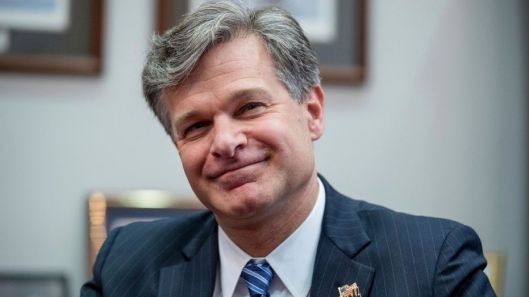
FBI Director, Christopher Wray threatened to resign if Deputy FBI Director, Andrew McCabe, was removed from his post. Attorney General Jeff Session apparently pressured Wray to remove both McCabe and the FBI’s lawyer James Baker from their posts (though it is unclear whether that meant firing or transfering the two). Baker was reassigned last year. President Trump has also made his distaste for the Deputy Director known via twitter, apparently for the way he handled Hillary Clinton’s email scandal.

The pressures Wray is facing remind me of the firing of former FBI Director James Comey, who was in the midst of investigating Trump’s connections with Russia when his position was terminated. Commentators feel that the firing of James Comey could constitute obstruction of justice, a potentially impeachable offense. The pressure to remove to McCabe would likely not constitute further obstruction of justice, as it unclear that McCabe is currently involved in the investigation of Russian collusion. However, the pressure put on Wray does show a pattern of interference with the FBI which paints the President in a negative light. One would think that after the firing of Comey, the White House would take a hands off approach.

1512667702968.jpgAP Photo

Share this:

  • Share on X (Opens in new window) X
  • Share on Facebook (Opens in new window) Facebook
Like Loading...

Impeachment in the states: Missouri governor edition, Part 2

20 Saturday Jan 2018

Posted by impeachableoffenses in Uncategorized

≈ 2 Comments

Tags

blackmail, Eric Greitens, Governor Greitens, impeachment of governor, impeachment of Greitens, invasion of privacy, Missouri state impeachment, revenge porn, stealing, tampering with evidence

By Frank Bowman

In yesterday’s post, I discussed the basics of the impeachment provisions of the Missouri state constitution and how they compare with federal practice.  Today I turn to how Missouri’s rules intersect with the publicly reported facts of Governor Eric Greitens’ sex scandal.

The Basics

To recap, under the Missouri constitution the procedure for impeaching state judges and all elective officials is as follows:

The official must first be impeached by the state House of Representatives. Curiously, the state constitution does not specify a minimum vote threshold for approving articles of impeachment, but presumably, as with federal impeachment, approval requires a majority vote.

Once articles of impeachment are approved by the House, the trial of the allegations is held, not in the state senate, but by judges.  For all officials except members of the supreme court and the governor, impeachments are tried before the supreme court.  Impeachment of the governor or a member of the supreme court is tried to “a special commission of seven eminent jurists to be elected by the senate.”

Article VII, Section 1 of the Missouri constitution lists as impeachable conduct “crimes, misconduct, habitual drunkenness, willful neglect of duty, corruption in office, incompetency, or any offense involving moral turpitude or oppression in office.”  As I discussed in detail in my last post, this apparently very broad standard has been interpreted by the Missouri Supreme Court in Matter of Impeachment of Judith K. Moriarty, 902 S.W.2d 273 (1994), to include only conduct that is a violation of some other law, i.e., some law other than Article VII, Section 1.

The legal violation need not be criminal. Nor does there seem to be a requirement like that in the federal constitution that the impeachable behavior be a “high” or great offense.  Even, as was the case in Moriarty, a minor civil regulatory infraction could apparently suffice. Moreover, it does not appear that the impeached official must have been previously found guilty or adjudged liable by any tribunal other than the impeachment court.

[NOTE: After this article was first posted, an astute reader who worked in the statehouse at the time of the Moriarty impeachment e-mailed me to point out that, prior to her impeachment, Ms. Moriarty was indicted and convicted in Cole County for a misdemeanor election law violation in connection with the same transactions that led to her impeachment. Curiously, however, in its opinion convicting Ms. Moriarty of the articles of impeachment, the Supreme Court never mentions the prior conviction or any criminal infraction.  It merely finds that she knowingly violated the civil election statutes, as alleged by the House.]

Finally, the Missouri Supreme Court held in Moriarty that judges sitting as a court of impeachment should not make political judgments about whether the charged conduct is serious enough to merit removal.  The practical effect of this limitation is that, while judges should not convict in an impeachment case unless the charged conduct violates state law, any proven violation of any state law, however minor, should result in conviction and removal so long as the Missouri House of Representatives deemed the conduct worthy of inclusion in an article of impeachment in the first place.

Is Governor Greitens impeachable?

These ground rules have significant implications for any effort to impeach Governor Greitens.

First, because the governor cannot be impeached unless he somehow violated the law, we must begin by determining whether any of his reported conduct did so.  Here’s a rundown of the major possibilities:

  • Adultery: A surprising number of states still make adultery illegal.  But Missouri is not among them.
  • Sexual offenses or false imprisonment:  Media accounts of the sexual contact between Mr. Greitens and his former hairdresser suggest that it was consensual.  In an interview today, Mr. Greitens resolutely insisted that this was the case. However, the woman’s account of the relationship includes at least one sexual encounter in which she was bound, a point Mr. Greitens has not so far denied. So long as the woman consented to the binding and all sexual contact occurring while she was bound, there would be no crime.  That said, if either the binding or any of the particular kinds of sexual contact that occurred while the woman was bound was non-consensual, the non-consensual behavior could be criminal.  Sexual contact without consent can constitute a series of crimes, ranging in seriousness from the misdemeanor of Sexual Abuse, RSMo 566.101, to felony Second Degree Rape, RSMo 566.031.  Either binding the woman without consent or declining to release her after she withdrew consent could in theory amount to false imprisonment (now known as third degree kidnapping), RSMo 565.130.  It must be emphasized that at this point there is no evidence of anything other than a consensual sexual encounter with somewhat unusual, shall we say, rules of engagement.  And that’s not a crime.
  • Blackmail or extortion: During a conversation with her husband in which she confessed to the affair with Mr. Greitens, the woman asserted that while she was bound, unclothed, and blindfolded, she saw a flash, which she interpreted as Mr. Greitens photographing her. She also said that Greitens threatened to release the photo to the public if she revealed the affair.  Mr. Greitens has denied that he took a picture or threatened to release it. There has been widespread media speculation that this conduct, if proven, might amount to “blackmail.”  The legal difficulty with this speculation is that there is no Missouri crime of blackmail.  If a person threatens public release of embarrassing material unless the victim turns over money or something else of economic value, that constitutes “stealing” by “coercion” – which includes a threat “to expose any person to hatred, contempt or ridicule.”  But there is no allegation here that Mr. Greitens sought money or anything else of economic value. Similarly, Missouri has no extortion statute.
  • “Revenge porn”: Some jurisdictions make it an offense to release publicly indecent images of another person without consent.  But Missouri has no such statute. And Mr. Greitens released nothing.
  • Invasion of privacy (the alleged picture):  Regardless of whether Mr. Greitens committed any crime akin to blackmail, if he simply took a picture, without the woman’s consent and while she was fully or partially unclothed, that would be a plain violation of Missouri’s invasion of privacy statute, RSMo 565.252.
  • Tampering with physical evidence: If the alleged photograph was ever taken, it has not surfaced, and the woman in the case says that Mr. Greitens told her he erased / destroyed the picture. However, if there was a picture and Mr. Greitens erased it for the purpose of preventing its disclosure in any “official proceeding or investigation,” that would be the crime of tampering with physical evidence, RSMo 575.100. Of course, if such a picture once existed, but Mr. Greitens destroyed it either out of remorse for his bad behavior or to prevent its discovery by, say, his wife, that would be no crime.

The bottom line here is that, if the woman is telling the truth, Mr. Greitens committed at least one crime under Missouri law – invasion of privacy for taking a non-consensual nude photograph.  The offense is only a misdemeanor, but as noted above, Missouri’s impeachment provisions set no minimum level of severity for impeachable offenses.

The most obvious impediment to proving conclusively that Mr. Greitens violated the invasion of privacy statute is the absence of the alleged photograph.  That said, even in ordinary criminal cases, physical evidence is not necessary to establish contested facts.  In criminal court, Mr. Greitens could be charged with and convicted of invasion of privacy purely on the testimony of the woman in the case.  As a practical matter, this would require her cooperation (trying to prove the case with only her taped statement to her husband would probably run afoul of the rules of evidence). But if she testified consistently with her taped statement, nothing would prevent a judge or jury from convicting Mr. Greitens because they believed her story and not his denials.

The same is true of an impeachment proceeding.  The Missouri House of Representatives could frame an article of impeachment based on violation of the invasion of privacy statute and the panel of judges appointed to hear the matter could convict the governor because they found her more credible than him. That said, without some corroboration that a photo ever existed, it seems somewhat improbable that either a prosecutor or the House of Representatives would proceed.

The most interesting legal question an impeachment case for invasion of privacy would present is whether a state official can be impeached for conduct that occurred before he took office.  The Missouri constitution doesn’t address this issue.  And the final intriguing twist on the matter is that we cannot be sure that the issue is what lawyers call “justiciable.”  In other words, the Missouri constitution delegates the task of trying impeachment of a governor to a special commission of judges appointed by the state senate.  In the federal system, the decision of the U.S. Senate on whether or not to convict an impeached officer is generally understood not to be reviewable by the courts. The Missouri constitution certainly implies that the decision of the special commission is final, but inasmuch as no such commission has ever been convened, we cannot know whether its decision would be deemed final by the regular courts.

As a final note, I have not discussed here the fact that the FBI is also apparently taking a preliminary look at this case.  I may return in a later post to consider whether any federal statute could possibly have been violated and whether a violation of federal law would be grounds for impeachment under the Missouri constitution.

Frank Bowman


Share this:

  • Share on X (Opens in new window) X
  • Share on Facebook (Opens in new window) Facebook
Like Loading...

Impeachment in the states: Missouri governor edition, Part I

19 Friday Jan 2018

Posted by impeachableoffenses in Uncategorized

≈ 4 Comments

Tags

Alexander Hamilton, Governor Greitens, Greitens, Greitens impeachment, impeachable offenses, Missouri state impeachment, state impeachment

By Frank Bowman

Here in the Show-Me State, we have been granted a temporary reprieve from the feverish national focus on all things Trump by news of the sexual peccadillos of our recently-elected governor, Eric Greitens. As has now been reported across the nation, on Wednesday, January 10, shortly after his State of the State address, Governor Greitens released a statement admitting to a extramarital sexual affair with his former hairdresser back in 2015.

The admission came in anticipation of impending media reports alleging not only that there were one or more sexual encounters between the hairdresser and Mr. Greitens, but that on one occasion Mr. Greitens took a picture of the woman while she was bound and in a state of full or partial undress and then threatened to release the picture publicly if she were ever to speak about the affair. The reports were made all the juicier by the fact that the woman’s former husband secretly recorded her tearful confession to the affair and released the recording to the media.

In his statement, Mr. Greitens admitted the sex, but denied that he had either taken a picture of the woman en déshabillé or threatened to release such a picture to maintain her silence.

Political reaction to these revelations has been swift and somewhat surprisingly severe given that Mr. Greitens is a first-term Republican governor often touted as a rising political star in a state where Republicans hold all but one state-wide office and supermajorities in both houses of the legislature. Democrats immediately called for Mr. Greitens’ resignation, as have multiple Republican legislators. Even Republicans who haven’t gone that far seem, at best, to be withholding judgment pending the outcome of a criminal investigation by the St. Louis Circuit Attorney (and possibly one by the FBI).  One Republican state senator, Gary Romine, said that if investigations into Mr. Greitens’ behavior do not exonerate him, he should “resign or face impeachment.”

Naturally, as soon as I read the word “impeachment,” I perked up like a foxhound when the Master of the Hunt yells “Talley Ho!”  What follows is a two-part look at the law governing impeachment of Missouri state officials, a comparison of Missouri law to federal practice, and a preview of the particular issues an effort to impeach Mr. Greitens would present given the current state of the evidence.

Impeachment in Missouri

Article VII, Sections 1 and 2 of the Missouri constitution state:

Section 1. All elective executive officials of the state, and judges of the supreme court, courts of appeals and circuit courts shall be liable to impeachment for crimes, misconduct, habitual drunkenness, willful neglect of duty, corruption in office, incompetency, or any offense involving moral turpitude or oppression in office.

Section 2. The house of representatives shall have the sole power of impeachment. All impeachments shall be tried before the supreme court, except that the governor or a member of the supreme court shall be tried by a special commission of seven eminent jurists to be elected by the senate. The supreme court or special commission shall take an oath to try impartially the person impeached, and no person shall be convicted without the concurrence of five-sevenths of the court or special commission.

The most obvious difference between federal and state impeachment procedure is that, while in both systems the house of representatives impeaches the officer, i.e., specifies the charges against the accused, in Missouri the state supreme court, rather than the senate, tries the case. That is, the Missouri Supreme Court, not the Missouri senate, decides whether the allegations in the bill of impeachment are proven and thus whether the officer ought to be removed.  The way the Missouri Supreme Court has interpreted its function materially alters the Missouri impeachment process.

In the federal system, the president may be impeached for serious crimes (although there is disagreement about which ones) and for very serious non-criminal misconduct either in relation to the office or of a personal sort that undermines the president’s legitimacy. Most scholars would agree that, under the federal constitution, the president ought not be impeached for minor crimes (and perhaps not even for serious crimes like perjury if unrelated to his official duties) or for laziness, ineptitude, or pursuing political objectives contrary to those of the legislative majority.

Critically, all informed observers of the federal impeachment process agree that both the decision by the House about which behavior is impeachable and the subsequent decision by Senate about whether to convict and remove the accused are to a significant degree “political.”  As Alexander Hamilton famously said in Federalist #65, impeachable offenses “are of a nature which may with peculiar propriety be denominated POLITICAL, as they relate chiefly to injuries done immediately to the society itself.”

The concededly political character of the federal impeachment process shapes the essential nature of the decision-making process.  Both the House and Senate are called upon not merely to decide the truth of factual allegations against the president, but to judge whether the conduct is of a nature that merits removal of the nation’s chief executive officer.  The second choice is a political judgment which the Framers consciously placed in the hands of two political bodies.

The Missouri constitution originally consigned the trial of impeachments to the state senate.  But in the 1940’s (perhaps in response to a case where the senate refused to convict a former senator whose factual guilt was patent), the constitution was amended to institute the present arrangement assigning impeachment trials to the state supreme court. The apparent purpose of the change was to eliminate politics from the last stage of the impeachment process, but as is so often true, this benevolent-sounding objective created a new complication.

In theory, courts are not supposed to be political bodies.  In theory, they are limited to deciding what the law is, whether facts are proven, and whether proven facts fall within the ambit of the law. Of course, any serious student of courts realizes that politics in the broad sense affects judicial decisions at every level. Judges unavoidably bring their own philosophical predilections to deciding both law and facts, and perhaps more importantly, common law judging has always had a public policy component.  Nonetheless, judges traditionally shun explicitly political judgments – such as whether removal of a particular executive branch official would or would not be beneficial to the commonweal.

This judicial discomfort manifested itself in the only Missouri impeachment case to arise after the constitution was amended to give the responsibility of trying impeachments to the supreme court. The case, Matter of Impeachment of Judith K. Moriarty, 902 S.W.2d 273 (1994), arose from the impeachment of the Missouri Secretary of State for “knowingly allow[ing] the signature of her son as candidate or of her administrative aide or both to be placed on an unsigned declaration of candidacy [for public office] so that declaration falsely declared that the son had appeared in presence of aide to declare for office within the time provided for by statute.”

The Missouri Supreme Court found that Ms. Moriarty did what the articles of impeachment charged, thus removing her from office. The interesting part is the court’s explanation of its role in the impeachment process. The court began by contrasting the traditional impeachment system in which the house impeaches and the senate tries the accused with the Missouri system of trial by supreme court:

An impeachment is thus a judgment by the House of Representatives—one of the popularly-elected, representative bodies of the people’s General Assembly—that an officer of the state has committed acts such that, were an election held, the people would not permit the impeached officeholder to remain in office. When a Senate determines whether to convict under articles of impeachment, the vote affirms or rejects the judgment of the House. Under this system, the possibility exists that the House may impeach and the Senate may convict an official for purely political reasons, though they clothe their charges with constitutional language like “misconduct.”

Missouri’s constitutional provision is a clear acknowledgment that the trial of impeachment charges is essentially judicial in character and is not a political function. This Court can convict only where there is actual misconduct as the law defines it. “Misconduct” means doing an unlawful act, doing a lawful act in an unlawful manner, or failing to perform an act required by law. It does not include errors in judgment, acts done in good faith, or good faith exercise of discretion.

This passage is remarkable in several respects.

First, it offers a distorted interpretation of the standard for defining an impeachable offense in federal and state systems in which legislators both formulate and try the articles of impeachment. The court opines that in such systems legislators are supposed to engage in a sort of mass mind-reading exercise assessing the probable electoral reaction of the public to the charged conduct. I confess to thinking this assessment misguided. In the federal system, at least, it is quite clear that senators are intended to exercise independent judgment, and that they should not decline to convict an office holder merely because they think the public might re-elect him despite constitutionally obnoxious conduct.  Were that the case, no demagogue could ever be impeached so long as he retained the probable support of the mob.

Moreover, when the Missouri court disparages senate impeachment trials on the ground that an officeholder may be convicted “for purely political reasons,” it betrays a crabbed and historically inaccurate view of what Founders like Hamilton meant by “political.”  For Hamilton and others of his generation, the term “political” ran far beyond narrowly partisan considerations to broad considerations of constitutional balance and societal good.  For them, impeachment was “political” because it demanded the exercise of sound judgment about whether removing a particular officer for particular conduct protected or disserved republican government.

More important from Governor Greitens’ standpoint is the court’s holding that, because judges and not legislators try Missouri impeachments, there can be a conviction only:

… where there is actual misconduct as the law defines it. ‘Misconduct’ means doing an unlawful act, doing a lawful act in an unlawful manner, or failing to perform an act required by law. It does not include errors in judgment, acts done in good faith, or good faith exercise of discretion.

This is huge because it markedly narrows the definition of impeachable conduct.  Indeed, the result is to judicially amend the Missouri constitution.  Recall that Article VII, Section 1 of the Missouri constitution says that officials may be impeached for “crimes, misconduct, habitual drunkenness, willful neglect of duty, corruption in office, incompetency, or any offense involving moral turpitude or oppression in office.”

Some of the items on this list obviously do refer to illegal conduct, notably “crimes … corruption in office, [and] any offense involving moral turpitude or oppression in office.” On the other hand, the constitutional text pretty plainly contemplates impeachment for lots of behavior that violates no other law. For example, neither “habitual drunkenness” nor “incompetency” is illegal.  Nor is either “willful neglect of duty” or “misconduct” necessarily a legal infraction.

To maintain its preferred self-conception of non-political arbiter of facts, the Missouri Supreme Court imposed a limiting construction on the constitutional term “misconduct” that requires the impeached official to have violated some other law.  (For you law geeks in the audience, it does so by the extremely dubious expedient of adopting its definition of “misconduct” from a Tennessee case construing the common law crime of “official misconduct,” an offense which exists nowhere in Missouri law.” Mid–South Indoor Horse Racing, Inc. v. Tennessee State Racing Commission,798 S.W.2d 531, 538 (Tenn.App.1990).)

Notably, the laws the Court found Ms. Moriarty to have violated were simply statutory rules for proper filing of candidacy for office.  Failing to perform the duties prescribed in these sections was apparently chargeable as a misdemeanor (perhaps under RSMo 115.641).  Moreover, it appears that, prior to the impeachment proceeding, Ms. Moriarty was charged in Cole County and convicted of such a misdemeanor for her conduct.  But curiously, the Missouri Supreme Court made no reference in its opinion either to the Cole County proceeding or to any violation of criminal law.  The bottom line of Moriarty seems to be that, on the one hand, the Supreme Court will not convict in an impeachment case unless the charged conduct violates state law, but on the other hand, violation of any state law, however minor, will result in conviction and removal so long as the Missouri House of Representatives deems it impeachable.

One sympathizes with Court’s reluctance to stray from its traditional judicial role, but the result is a markedly strained reading of the Missouri constitution — and one that could have considerable impact on any effort to impeach Governor Greitens.

I will address the specifics of the Greitens case in my next post.

Frank Bowman


Share this:

  • Share on X (Opens in new window) X
  • Share on Facebook (Opens in new window) Facebook
Like Loading...

Rep. Green is Back on the Floor

19 Friday Jan 2018

Posted by crosbysamuel in Articles, Uncategorized

≈ Leave a comment

Tags

Article, article of impeachment, government shutdown, Green, house, immigration, impeach, Impeachment, Pelosi, Politics, politics of impeachment, Representative, shithole, The House of Representatives, trump

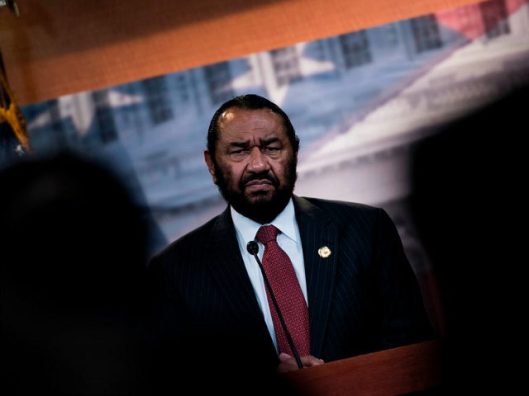
Representative Green offered articles of impeachment on the House floor for the second time this morning. Those who read Rep. Green’s first set of articles, will know that they cited Trump’s continued sexism and bigotry, which “underminded the integrity of his office.” Specific examples of said bigoty were his Muslim ban, comments towards the Charlottesville protestors, and his attack on the kneeling NFL players. Added to this list now are the comments President Trump made during the presentation of the bipartisan immigration proposal, insulting immigrants from African nations, Haiti, and El Salvador  — his “shithole” comment. Green claims that Trump is trying to convert his bigotry into policy.

The timing of Green’s resolution is questionable. With a government shutdown looming, and Congressmen’s minds on things such as immigration reform, Green is unlikely to make any headway with impeachment. However, that has not stopped Green before. Despite the fact that House Minority Leader Nancy Pelosi has made it known that she prefers a more diplomatic approach to impeachment, Green has been vocal in the impeachment effort. It seems likely that Green cares less about the success of his efforts than he does about making a statement: that he will not tolerate bigotry in the Oval Office. Frankly, I can’t blame him.

The text of his resolution can be found here.

rep-al-green-tx-getty-photo-640x480.jpgBRENDAN SMIALOWSKI/AFP/Getty Images

Share this:

  • Share on X (Opens in new window) X
  • Share on Facebook (Opens in new window) Facebook
Like Loading...

The President is Not Demented

17 Wednesday Jan 2018

Posted by crosbysamuel in Articles, Uncategorized

≈ 7 Comments

Tags

25th amendment, alzheimer's, cognitive, dementia, exam, impeach, mental, Politics, presidential physician, trump, unfit

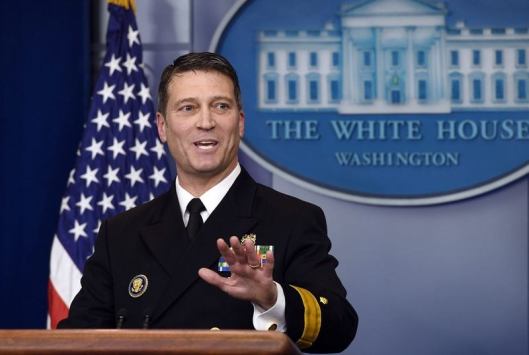
Trump apparently requested that his presidential physician perform a cognitive exam on him during his annual physical exam. The exam used was the Montreal Cognitive Assessment, which is used to test for Alzheimer’s and dementia. The President received a perfect score, indicating that he is free of dementia. This result contradicts some recent speculation. Though some have questioned the rigor of the test, it has done its job. It has armed Trump against attacks on his mental fitness, and made removal via the 25th amendment much less likely.

AR-180119380.jpgOlivier Douliery/Abaca Press/TNS

Share this:

  • Share on X (Opens in new window) X
  • Share on Facebook (Opens in new window) Facebook
Like Loading...
← Older posts
Newer posts →

Blog Owner

Frank O. Bowman, III


Curators' Distinguished Professor Emeritus
Floyd R. Gibson Missouri Endowed Prof of Law Emeritus
Univ of Missouri School of Law

Web Profile

Enter your email address to follow this blog and receive notifications of new posts by email.

Professor Bowman on Impeachment »

Bibliographies

Explore bibliographies categorized by author and subject, and find other resources.

Posts by Topic

  • The Case for Impeachment
  • Defining Impeachable Conduct
  • Impeachment on Foreign Policy Grounds
  • Impeachment for Unfitness
  • Obstruction of Justice
  • Abuse of Criminal Investigative Authority
  • Election Law Violations
  • Foreign Emoluments
  • Conspiracy to Defraud the   United States
  • Politics of Impeachment
  • Lying as an Impeachable Offense
  • Abuse of Pardon Power
  • Electoral College
  • House Impeachment Resolutions
  • The Logan Act
  • The Mueller Investigation
  • Impeachment of Missouri Governor Greitens
  • Historical Precedent for Impeachment
  • Messages from Professor Bowman

Student Contributors »

Enter your email address to follow this blog and receive notifications of new posts by email.

Blog at WordPress.com.

  • Subscribe Subscribed
    • Impeachable Offenses?
    • Join 199 other subscribers
    • Already have a WordPress.com account? Log in now.
    • Impeachable Offenses?
    • Subscribe Subscribed
    • Sign up
    • Log in
    • Report this content
    • View site in Reader
    • Manage subscriptions
    • Collapse this bar
 

Loading Comments...
 

    %d